

- Review Articles
- Other
- Virtual reality for managing pain and fear and anxiety during pediatric needle procedures: an umbrella review
- Thomas Saliba, Guillaume Fahrni
- Clin Exp Pediatr. 2026;69(8):609-621. Published online July 14, 2026
-
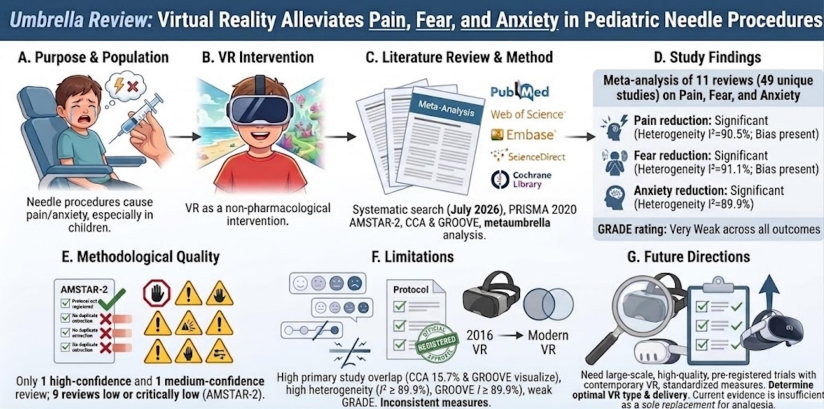
Meta-analyses suggest that virtual reality (VR) reduces self-reported pain, fear, and anxiety in children during needle procedures but has high heterogeneity, high overlap between primary studies, and low methodological quality, leading to a "very weak" GRADE (Grading of Recommendations Assessment, Development and Evaluation) classification. Clinicians should view VR as a promising additional distraction tool; however, VR cannot yet replace current analgesic and anxiolytic strategies. Future research should focus on age-stratified analyses, measurement tool standardization, and modern VR technology
- Endocrinology
- Linking pediatric obesity to youth-onset type 2 diabetes: integrated longitudinal and cross-sectional evidence from population-based studies worldwide
- Ashraf T. Soliman, Fawzia Alyafei, Nada Alaaraj, Noor Hamed, Shayma Mohamed, Ahmed Elawwa
- Clin Exp Pediatr. 2026;69(8):622-635. Published online July 20, 2026
-
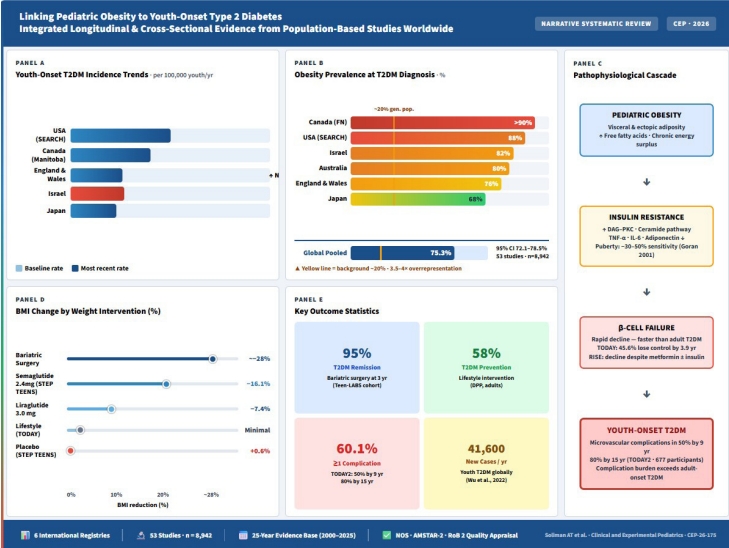
Pediatric obesity and youth-onset type 2 diabetes have increased simultaneously across 6 continents over the last 25 years. Approximately 75% of affected youths are obese at diagnosis, beta-cell declines occur rapidly, and microvascular complications occur early. Glucagon-like peptide-1 receptor agonists and bariatric surgery achieve meaningful weight loss and glycemic improvement; however, the primary prevention of childhood obesity remains the most powerful strategy for arresting this epidemic.
- Editorial
- Neurology
- Network-based biomarkers in pediatric drug-resistant epilepsy
- Joseph Lim, Jaeso Cho, Hunmin Kim
- Clin Exp Pediatr. 2026;69(8):636-638. Published online July 24, 2026
-
Conventional preoperative evaluation in pediatric drug-resistant epilepsy relies on clinical surrogates that quantify seizure exposure but not its impact on brain networks. A newly developed diffusion-weighted imaging connectome biomarker, anchored to intracranial electroencephalography-confirmed seizure onset zones and resolved across 6 neurocognitive domains, addresses this gap. This individualized approach classifies cognitive impairment with high accuracy and may offer a more precise, clinically interpretable tool to inform surgical timing.
- Original Articles
- Other
- Association between sodium content of intravenous immunoglobulin and electrolyte changes and clinical course of Kawasaki disease
- Yoshitaka Watanabe, Naomi Yagi, Toya Hattori, Chisato Oyake, Shota Endo, Maria Yoshimi, Takayoshi Kyoda, Hirokazu Ikeda
- Clin Exp Pediatr. 2026;69(8):639-645. Published online July 1, 2026
-
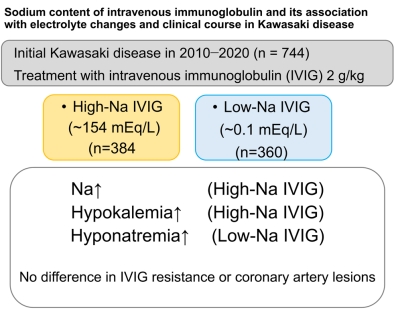
Question: Hyponatremia in Kawasaki disease is associated with inflammation and disease severity. Intravenous immunoglobulin (IVIG) formulations feature various sodium contents. What is the clinical impact of such variations?
Finding: IVIG sodium content was associated with sodium, potassium, and protein level changes.
Meaning: Coronary outcomes were similar but electrolyte changes differed: high-sodium IVIG caused hypokalemia, whereas low-sodium IVIG caused hyponatremia. IVIG preparation requires consideration when interpreting laboratory values.
- Gastroenterology
- Prognosis of pediatric hepatic Wilson disease with ATP7B loss of function variants
- Amresh Kumar Mishra, Moinak Sen Sarma, Anchal Dubey, Pratik Gadekar, Amita Moirangthem, Anshu Srivastava, Amrita Mathias
- Clin Exp Pediatr. 2026;69(8):646-654. Published online July 13, 2026
-
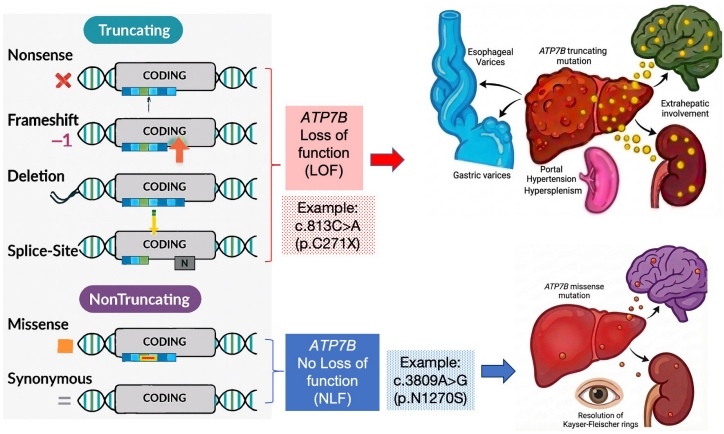
Question: Do the loss of function (LOF) of ATP7B mutated variants affect the severity or outcomes of hepatic Wilson disease (WD)?
Finding: LOF is associated with advanced liver disease, portal hypertension, and extrahepatic involvement. LOF did not determine hepatic or overall outcomes. ATP7B: c.813C>A (truncation variant) has an aggressive course with higher predisposition to acute liver failure. Lower serum exchangeable copper levels and higher disappearance of Kayser-Fleischer ring were observed in ATP7B: c.3809A>G (nontruncation variant) suggesting a better effect of chelation and lesser systemic copper.
Meaning: Truncation of the ATP7B protein determines the severity of the phenotype in WD.
- Neonatology (Perinatology)
- Efficacy and safety of home-based fiberoptic blanket versus hospital-based light-emitting diode phototherapy for neonatal jaundice: a retrospective cohort study from Thailand
- Chayatat Ruangkit, Thanyathorn Thaninjeerawat, Saitarn Klaidangklum, Saowalak Prasopa, Pongsakorn Atiksawedparit, Sasivimon Soonsawad
- Clin Exp Pediatr. 2026;69(8):655-664. Published online July 1, 2026
-
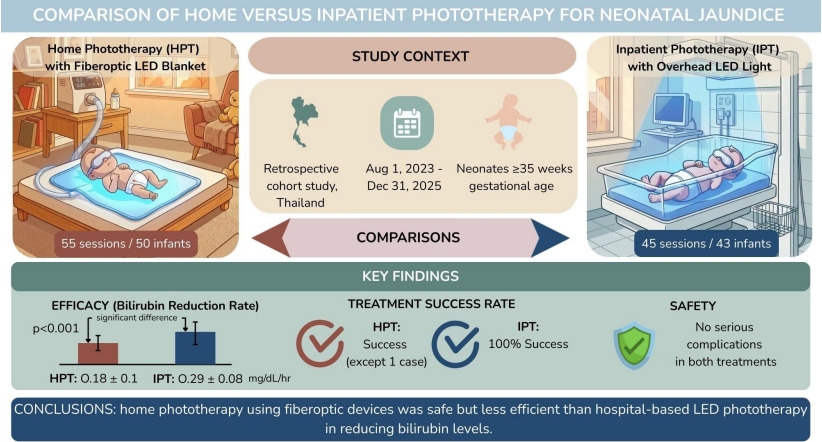
Question: Is a home-based fiberoptic phototherapy blanket as effective and safe as hospital-based overhead light-emitting diode phototherapy for the treatment of neonatal jaundice?
Finding: Home phototherapy (HPT) resulted in a slower bilirubin reduction rate than inpatient phototherapy (IPT); however, both modalities achieved the therapeutic targets without phototherapy-related complications.
Meaning: With careful patient selection, structured monitoring, and reliable follow-up, HPT is a safe and feasible alternative to IPT for neonatal jaundice.
- Neurology
- Patient-independent automated pediatric seizure monitoring based on expert-labeled electrographic ictal data as core reference knowledge
- Yoon Gi Chung, Jaeso Cho, Anna Cho, Hunmin Kim, Byung Chan Lim
- Clin Exp Pediatr. 2026;69(8):665-675. Published online July 14, 2026
-
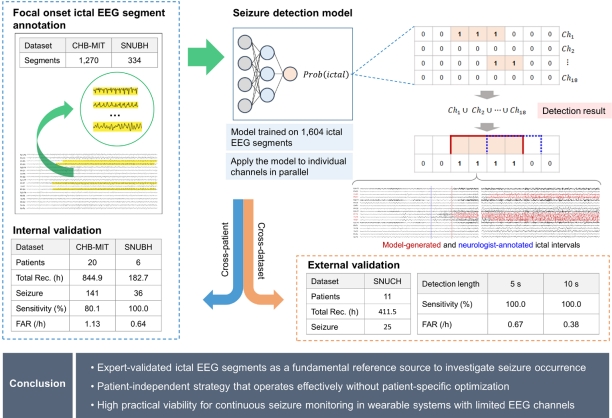
Question: Can deep learning models trained on expert-verified electroencephalography segments reliably detect seizures and be applied to single-channel wearable monitoring?
Finding: This technique demonstrated 80.1%–100% sensitivity and low false-alarm rates. On 1,604 expert-labeled segments, the model outperformed previous studies in terms of latency and accuracy across unseen datasets.
Meaning: Expert-labeled data are essential for achieving universal seizure detection. This channel-specific approach enabled efficient and continuous monitoring using wearable devices.
- Clinical Notes
- Nephrology (Genitourinary)
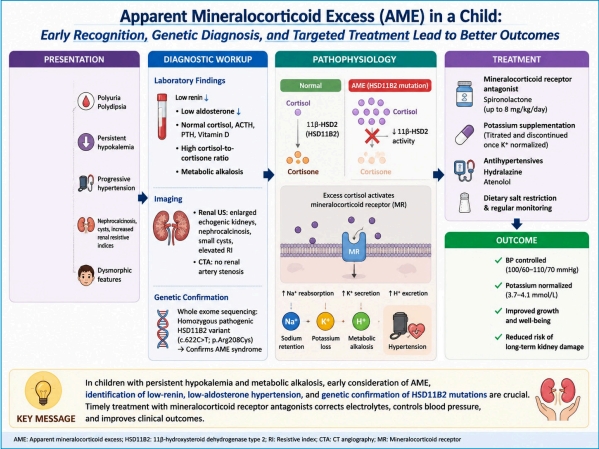
- A rare genetically confirmed case of apparent mineralocorticoid excess syndrome due to a homozygous HSD11B2 variant in a 2-year-old child with severe hypertension: response to targeted therapy
- Bashair Alabbasi, Mugahid Elamin, Ghadah Alsallum, Ghada Alzahrany
- Clin Exp Pediatr. 2026;69(8):676-679. Published online July 24, 2026
-
- Neonatology (Perinatology)
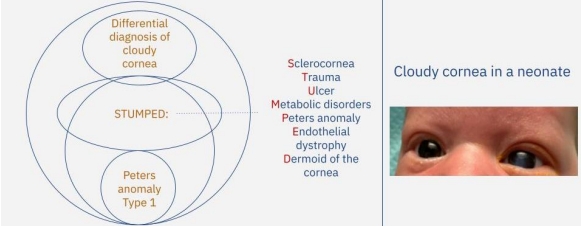
- Peters anomaly: a rare etiology of corneal clouding in the newborn
- Gregory Ison, Srividya Naganathan
- Clin Exp Pediatr. 2026;69(8):680-682. Published online July 13, 2026
-
- Perspective
- Neonatology (Perinatology)
- Neonatal care in a low-birthrate society: insights from population-based observations in Japan
- Hirokazu Arai, Hiroshi Miura, Yohei Onodera, Hiroyuki Adachi, Akira Sato, Tomoo Ito, Masaru Mizuno
- Clin Exp Pediatr. 2026;69(8):683-685. Published online July 24, 2026
-
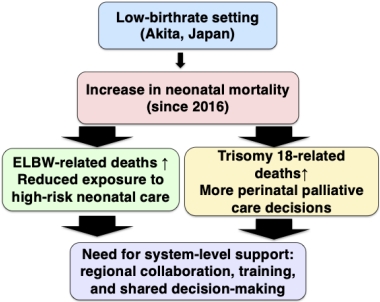
Declining birth rates are reshaping neonatal care. In low-birthrate settings, shifts in the underlying causes of neonatal death, including greater use of perinatal palliative care for trisomy 18 and challenges in maintaining expertise in extremely low-birth-weight infants, may contribute to fluctuations in neonatal mortality. These observations highlight the need for a coordinated system-level support.