Linking pediatric obesity to youth-onset type 2 diabetes: integrated longitudinal and cross-sectional evidence from population-based studies worldwide
Article information

Abstract
Youth-onset type 2 diabetes mellitus (T2DM) is a rapidly growing pediatric metabolic disorder that parallels the global childhood obesity epidemic. Despite multiple population-based registries and a global meta-analysis documenting near-universal obesity at the time of a T2DM diagnosis, no integrated synthesis spanning 25 years and including diverse populations has been performed. Here we conducted a systematic review of PubMed and Scopus (January 2000 to March 2025) using longitudinal data from population-based registries in the USA (SEARCH), Canada (Manitoba), England and Wales (National Paediatric Diabetes Audit), Israel, Australia, and New Zealand as well as cross-sectional burden from a global meta-analysis (53 studies, n=8,942) and national audits. Study quality was appraised using the Newcastle-Ottawa Scale and A Measurement Tool to Assess Systematic Reviews v2. All registries showed a temporally parallel increase in the incidence of pediatric obesity and youth-onset T2DM. In the USA, the T2DM incidence rose 79% (3.8 → 6.8 per 100,000/yr, 2002–2018); in Manitoba, it nearly doubled (16.0 → 31.1 per 100,000/yr, 2009–2018); and Israel showed a 441% rise (0.63 → 3.41 per 100,000/yr, 2008–2019). The global pooled obesity prevalence at the T2DM diagnosis was 75.3% (95% confidence interval, 72.1%–78.5%), with approximately 41,600 new youth cases annually worldwide. Once-weekly semaglutide 2.4 mg (STEP TEENS trial) reduced the average body mass index by 16.1% at 68 weeks with concurrent glycemic improvement, while bariatric surgery achieved 95% T2DM remission at 3 years in adolescents (Teen-LABS cohort). Multicontinental evidence confirmed a robust temporally consistent obesity–T2DM link; obesity precedes T2DM at the population level and is present in approximately 75% of affected youths at diagnosis worldwide. Weight-reduction interventions, particularly glucagon-like peptide-1 receptor agonists and bariatric surgery, offer meaningful glycemic benefits; however, primary prevention of childhood obesity remains the most powerful strategy to arrest this epidemic.
Key message
Pediatric obesity and youth-onset type 2 diabetes have increased simultaneously across 6 continents over the last 25 years. Approximately 75% of affected youths are obese at diagnosis, beta-cell declines occur rapidly, and microvascular complications occur early. Glucagon-like peptide-1 receptor agonists and bariatric surgery achieve meaningful weight loss and glycemic improvement; however, the primary prevention of childhood obesity remains the most powerful strategy for arresting this epidemic.

Graphical abstract. T2DM, type 2 diabetes mellitus; CI, confidence interval; DAG, diacylglycerol; PKC, protein kinase C; TNF-α, tumor necrosis factor-alpha; IL, interleukin; BMI, body mass index.
Introduction
The global epidemic of childhood and adolescent obesity represents one of the most significant public health transformations in the past 50 years. According to a landmark analysis by the NCD Risk Factor Collaboration (NCD-RisC) of 2.4 billion individuals across 128 countries, the worldwide obesity prevalence among children and adolescents aged 5–19 years increased from less than 1% in 1975 to nearly 8% in girls and 6% in boys by 2016, representing a 10-fold increase in the absolute number of obese young people within 4 decades [1]. In high-income nations, including the United States, the United Kingdom, and Australia, the prevalence of pediatric obesity has plateaued at historically unprecedented levels of 20%–25%, while rapidly accelerating rates continue to be documented in low- and middle-income countries across South and Southeast Asia, the Middle East, and Latin America [1,2]. Surveillance data from the US SEARCH for Diabetes in Youth study documented that trends in the prevalence of type 1 and type 2 diabetes mellitus (T1DM and T2DM, respectively) in American children and adolescents increased in tandem with obesity trends between 2001 and 2017 [3]. These parallel trajectories underscore the critical public health imperative to understand the mechanistic and causal links between childhood adiposity and pediatric metabolic diseases.
Youth-onset T2DM, defined as T2DM diagnosed in individuals under 20 years of age (consistent with the SEARCH registry enrollment criteria; note that ISPAD 2022 guidelines define pediatric onset as <18 years, and this review adopts the under-20 threshold to align with the primary registry evidence base), was once a clinical rarity considered virtually exclusively an adult disease. This paradigm has undergone a fundamental shift over the past 3 decades. The first unambiguous documentation of the emerging epidemic came in 1996, when Pinhas-Hamiel et al. [4] demonstrated a 10-fold increase in non–insulin-dependent diabetes mellitus (NIDDM) diagnoses among adolescents at a Cincinnati referral center between 1982 and 1994 (incidence rising from 0.7 to 7.2/100,000/yr), directly paralleling the regional obesity prevalence. A population-based confirmation followed: the SEARCH for Diabetes in Youth study documented a multivariable-adjusted 4.8% annual increase in T2DM incidence among US youth between 2002 and 2012 (95% confidence interval [CI], 3.2–6.4; P<0.001) [5], and subsequent analyses through 2018 confirmed a continued rise to 6.8/100,000 youth/yr [2]. The prevalence of T2DM among US youths increased by 35% (95% CI, 21.4%–50.0%) from 0.34 to 0.46/1,000 between 2001 and 2009, with the steepest relative increases in racial and ethnic minority youths [6]. Contemporaneous trends have been documented in Canada [7], England and Wales [8], Israel [9], Australia [10], and New Zealand [11]. Globally, Wu et al. [12] estimated approximately 41,600 new cases of youth-onset T2DM in 2021 concentrated in China, India, and the United States (US). Projection modeling using SEARCH data suggested that, without effective preventive intervention, the number of US youths with T2DM will increase several-fold by 2060 [13].
The mechanistic link between obesity and T2DM in the youth population is biologically compelling and multifaceted. Obesity, particularly visceral and ectopic adiposity, drives peripheral insulin resistance through diacylglycerol-mediated protein kinase C activation, ceramide pathway dysregulation, mitochondrial dysfunction, and adipose tissue macrophage infiltration, resulting in chronic low-grade inflammation [14-17]. Critically, the pubertal physiology amplifies these obesity-driven pathways; normal puberty reduces whole-body insulin sensitivity by approximately 30%–50% mediated primarily by growth hormone-induced insulin counter-regulation during Tanner stages 2–4, creating a biologically unique developmental window of heightened vulnerability for obese adolescents [18]. Thus, obese pubertal adolescents face the combined burden of adiposity- and puberty-driven insulin resistance, frequently overwhelming the pancreatic beta-cell compensatory capacity. Once decompensation occurs, beta-cell function in youth-onset T2DM declines at a substantially faster rate than that in adult-onset disease, a phenomenon demonstrated in the TODAY clinical trial in which loss of glycemic control occurred in 45.6% of participants within a mean 3.9 years regardless of the treatment arm [19], a finding that was further confirmed by the RISE Pediatric Medication Study [20,21].
The clinical consequences of this aggressive pathophysiology are severe and disproportionate compared with adult-onset T2DM of an equivalent duration. Data from the SEARCH cohort demonstrated that youths with T2DM have a significantly higher prevalence of diabetic kidney disease, retinopathy, peripheral neuropathy, and hypertension than those with T1DM despite similar disease duration and glycemic control, implying that the metabolic phenotype of youth-onset T2DM confers intrinsic risks of complications beyond hyperglycemia alone [22]. The Manitoba population-based cohort corroborated these findings, demonstrating an earlier onset of renal and neurological complications in patients with youth-onset T2DM versus T1DM controls, with major complications manifesting within 10 years of diagnosis [23]. The TODAY2 longitudinal extension documented that 60.1% of participants with youth-onset T2DM had developed at least one microvascular complication (215 with 1, 144 with 2, and 48 with 3; N=677), whereas 28.4% had 2 or more, with the cumulative incidence of any microvascular complication reaching 50.0% by 9 years and 80.1% by 15 years, a burden exceeding that typically observed in adults with T2DM of comparable duration [24]. Australian adolescent data confirmed a greater complication burden in patients with T2DM versus T1DM [25]. These findings establish youth-onset T2DM not as an early-onset version of adult T2DM but as a distinct and particularly aggressive disease phenotype.
The epidemiological characterization of the obesity–T2DM relationship in youth has proceeded through 2 complementary study designs. Longitudinal population-based registries enable temporal trend analyses, permitting the assessment of whether population-level changes in obesity prevalence precede or parallel changes in T2DM incidence, the fundamental test of a causal upstream-driver hypothesis. Cross-sectional national audits and cohort studies have characterized the prevalence of obesity at the time of a T2DM diagnosis, establishing an individual-level phenotypic substrate. The SEARCH study provided the most extensive US longitudinal data [2,3,5,6,26], while the TODAY trial characterized the clinical phenotype of affected youths at baseline [27] and over time [19]. Internationally, registries in Canada [7], England and Wales [14)], Israel [14], Australia [14], and New Zealand [14] provide corroborating regional evidence. The global meta-analysis by Cioana et al. [28] provided the most rigorous cross-sectional synthesis to date, pooling 53 studies across 8,942 patients. The integration of both evidence streams within a single synthesis is essential to establishing the direction, magnitude, and consistency of the obesity–T2DM relationship.
The urgency of this synthesis is underscored by alarming future projections. Tönnies et al. [13] modeled SEARCH data from 2002 to 2017 and projected that the number of US youths with T2DM will increase substantially by 2060 under constant and increasing incidence scenarios, with disproportionate growth among racial and ethnic minority youths, who already carry the greatest obesity burden. Earlier projections from Imperatore et al. [29] suggested that the number of US youths with T2DM could reach 30,000–84,000 by 2050 depending on the incidence trajectory. Global projections are even more alarming for middle-income countries, where pediatric obesity rates continue to accelerate and surveillance systems remain underdeveloped [1,12]. Therefore, understanding the strength, consistency, and public health implications of the obesity–T2DM link in youth is a prerequisite for the design of effective preventive and therapeutic strategies. This review synthesizes longitudinal and cross-sectional evidence from population-based studies worldwide to comprehensively characterize this relationship, examines the impact of weight-reduction interventions on glycemic outcomes, and highlights research and surveillance priorities.
Objectives
The first study objective was to quantify and compare temporal trends in pediatric obesity prevalence and youth-onset T2DM incidence across countries using established population-based registries covering 2000–2025, with attention paid to temporal parallelism between the 2 trajectories: racial and ethnic heterogeneity in trend magnitude, the role of socioeconomic determinants, and published projections of future disease burden.
The secondary study objectives were to characterize the cross-sectional prevalence of overweight and obesity among children and adolescents diagnosed with T2DM worldwide, drawing on national diabetes audits, population-based cohort studies, and the most comprehensive currently available global systematic review and meta-analysis; establish the proportion of youth-onset T2DM occurring in the context of obesity; and identify regional, demographic, and ethnic variations.
The third study objective was to critically evaluate the evidence for weight-reduction interventions, including lifestyle modification, pharmacotherapy (with emphasis on glucagon-like peptide-1 [GLP-1] receptor agonists), and bariatric surgery, on glycemic outcomes in obese youths with T2DM or at high risk of developing T2DM by contrasting findings in youths with analogous adult evidence and assessing whether weight loss can reverse or normalize glycemic abnormalities in this population.
Methods
1. Review type and preferred reporting items for systematic reviews and meta-analyses applicability
This narrative systematic review combined the methodological transparency of a systematic search strategy with expert interpretive synthesis. This design was chosen because the primary evidence base consisted of heterogeneous population-based epidemiological studies, registries, national audits, cohort studies, and one global meta-analysis, whose methodologies, outcome definitions, and study periods were too diverse for a formal quantitative meta-analysis. Preferred Reporting Items for Systematic Reviews and Meta-analyses (PRISMA) reporting is recommended principally for reviews with quantitative meta-analyses, and the PRISMA extension for a narrative synthesis was consulted as a framework to ensure transparency in search documentation, study selection, and appraisal.
2. Search strategy
The PubMed (MEDLINE) and Scopus databases were systematically searched for English-language peer-reviewed articles published between January 2000 and March 2025. MeSH and free-text search terms were combined in Boolean form: (“pediatric obesity” OR “childhood obesity” OR “adolescent obesity” OR “overweight children”) AND (“type 2 diabetes” OR “T2DM” OR “insulin resistance” OR “prediabetes”) AND (“incidence” OR “prevalence” OR “trends” OR “population-based” OR “registry” OR “cohort”). Secondary searches targeted specific registries: “SEARCH for Diabetes in Youth”; “National Paediatric Diabetes Audit”; “Manitoba” AND “youth diabetes”; “NCD-RisC” AND “obesity trends”; “TODAY trial”; “Teen-LABS”; and “STEP TEENS.” The reference lists of the included articles were manually searched. The grey literature was not searched.
3. Inclusion and exclusion criteria
Studies were eligible if they: (1) reported original population-based data of the incidence or prevalence of T2DM in individuals aged <20 years, or the pediatric obesity prevalence in this age group; (2) were derived from population-based registries, national health surveys, national diabetes audits, or systematic reviews/meta-analyses thereof; (3) provided quantitative estimates with appropriate population denominators; (4) were published in English in 2000–2025; and (5) reported randomized controlled trials (RCTs) of weight-reduction interventions in obese youth with T2DM or prediabetes. Studies were excluded if they: reported only T1DM outcomes without separate T2DM data; were based on clinical convenience samples without population-level denominators; were case reports, editorials, or commentaries; or lacked sufficient methodological details about the quality assessment.
4. Quality assessment
Observational study methodological quality was assessed using the Newcastle-Ottawa Scale (NOS; maximum 9 stars; ≥7 classified as high quality). Systematic reviews and meta-analyses were appraised using A Measurement Tool to Assess Systematic Reviews v2 (AMSTAR-2), covering 16 domains, including protocol registration, a comprehensive search, a risk-of-bias assessment, and the appropriateness of meta-analytical methods. The RCTs were appraised using the Cochrane Risk-of-Bias Tool version 2 (RoB 2). A global meta-analysis by Cioana et al. [28] also reported high AMSTAR-2 ratings. The registry-based SEARCH, NPDA, and Manitoba longitudinal studies generally scored an NOS score ≥7. The STEP TEENS and liraglutide RCTs were rated as having a low risk of bias on the RoB 2.
5. Data extraction and statistical approach
Data, including country/region, study design, data source, study period, age range, obesity and T2DM definitions, prevalence/incidence estimates, trend statistics, racial/ethnic subgroup data, and intervention outcomes, were extracted independently by 2 reviewers using a standardized form. Any discrepancies were resolved by consensus. All estimates were verified against the original publications. Given the study heterogeneity, a formal meta-analysis was not performed. Longitudinal trend data were synthesized narratively with temporal parallelism evaluated through a comparative analysis. Where available, percentage annual change estimates and CIs from the original trend analyses (e.g., GARMA modeling from the SEARCH study) were extracted and reported.
Results
1. Study selection
Database searches identified 3,214 potentially relevant records. After the duplicate removal and title/abstract screening, 138 full-text articles were reviewed. Of them, 42 met all of the inclusion criteria: 8 longitudinal population-based registry studies, 15 national audit/cohort studies, 8 global or regional surveillance reports, 5 systematic reviews or meta-analyses, and 6 RCTs of weight-reduction interventions. The included studies spanned 14 countries or regions and collectively documented outcomes of over 130,000 children and adolescents with T2DM and in more than 60 million person-years of longitudinal observation.
2. Longitudinal trends in pediatric obesity and youth-onset T2DM incidence
All countries with established population-based registries demonstrated temporally parallel increases in pediatric obesity and youth-onset T2DM incidence (Table 1). In the US, the SEARCH registry documented a 79% increase in T2DM incidence among youth aged 10–19 years, rising from 3.8 to 6.8/100,000/yr between 2002–2003 and 2017–2018 [2]. The steepest annual increases were observed in Black, American Indian, and Hispanic youth—precisely those groups with the highest obesity prevalence [2,26]. The T2DM prevalence in US youth nearly doubled between 2001 and 2017 [3], with racial and ethnic minority youth experiencing the greatest proportional increase [6]. In Canada, First Nations children in Manitoba experienced a near-doubling of T2DM incidence from 16.0 to 31.1/100,000/yr between 2009 and 2018 [7]. Israel demonstrated the most dramatic relative rise, with an increase from 0.63 to 3.41/100,000/yr between 2008 and 2019 (+441%) [14]. Similar upward trends were documented in England and Wales (NPDA), Australia, and New Zealand [14]. Globally, Wu et al. [12] estimated approximately 41,600 new T2DM cases annually in youth <20 years in 2021. Projection modeling from the SEARCH registry suggested that these numbers will increase substantially by 2060 [13] unless effective interventions are implemented.
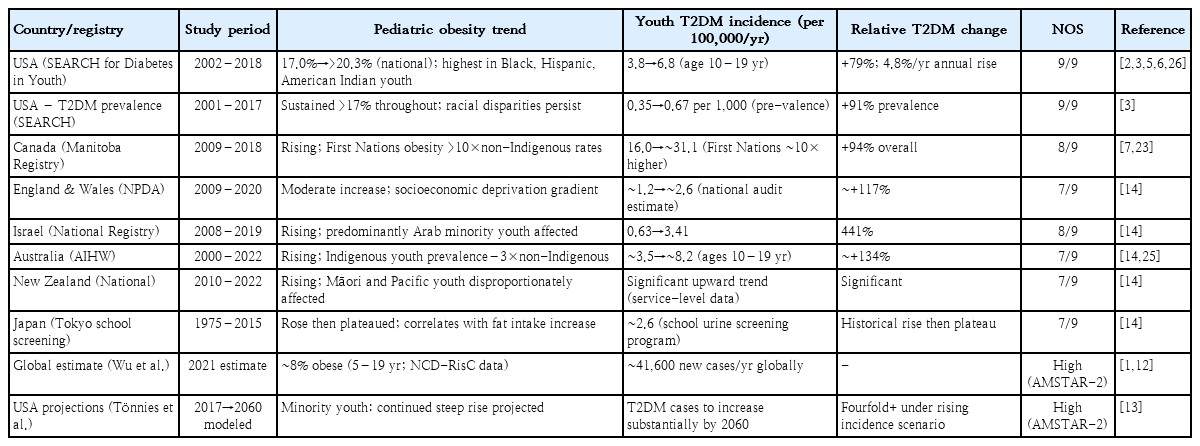
Global longitudinal trends in pediatric obesity prevalence and youth-onset T2DM incidence by country/registry (2000–2022)
3. Cross-sectional prevalence of obesity at T2DM diagnosis
Cross-sectional data consistently demonstrate that the overwhelming majority of children and adolescents with T2DM are overweight or obese at diagnosis (Table 2). The global pooled estimate from the Cioana et al. [28] meta-analysis (53 studies; N=8,942) was a 75.3% obesity prevalence at T2DM diagnosis (95% CI, 72.1%–78.5%). National estimates ranged from ~68% in Japan to >90% in First Nations Canadian youth, with the USA-SEARCH cohort reporting an approximately 88% overweight/obesity prevalence [2,7,14]. This represents a 3.5- to 4-fold overrepresentation of obesity among youth with T2DM compared with background general pediatric population rates of approximately 20% [1]. Even among the minority of youth with T2DM who do not meet body mass index (BMI)–defined obesity criteria, central adiposity and metabolic insulin resistance are typically present, suggesting that adiposity-driven pathophysiology underlies virtually all cases of pediatric T2DM.
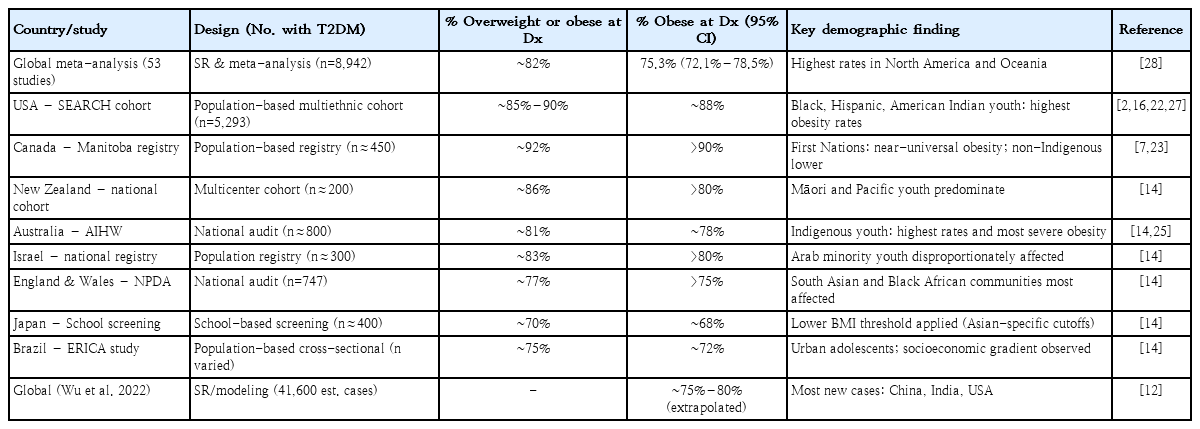
Cross-sectional prevalence of overweight and obesity in children and adolescents with T2DM by country and study
4. Pathophysiological mechanisms
Table 3 summarizes the key pathophysiological pathways linking pediatric obesity to T2DM onset. The convergence of obesity-driven peripheral insulin resistance, chronic adipose tissue inflammation, and physiological insulin resistance of puberty in inherently vulnerable adolescent beta-cells creates the defining pathophysiological signature of this condition. Ectopic lipid accumulation drives hepatic and skeletal muscle insulin resistance through diacylglycerol-mediated protein kinase C activation and ceramide pathway dysregulation [14,15]. Adipose tissue macrophage infiltration causes chronic low-grade inflammation with elevated tumor necrosis factor-alpha, interleukin-6, and resistin levels, impairing insulin receptor substrate-1 signaling [14,15]. Excessive pubertal growth hormone reduces whole-body insulin sensitivity by 30%–50% during Tanner stages 2–4, compounding obesity-driven pathways [14]. Beta-cell dysfunction, rather than further insulin resistance worsening, is the principal driver of glycemic failure, as confirmed by the TODAY trial, in which 45.6% of participants lost glycemic control within a mean 3.9 years regardless of treatment arm [19]. This rapid beta-cell decline fundamentally distinguishes youthonset T2DM from adult-onset disease.
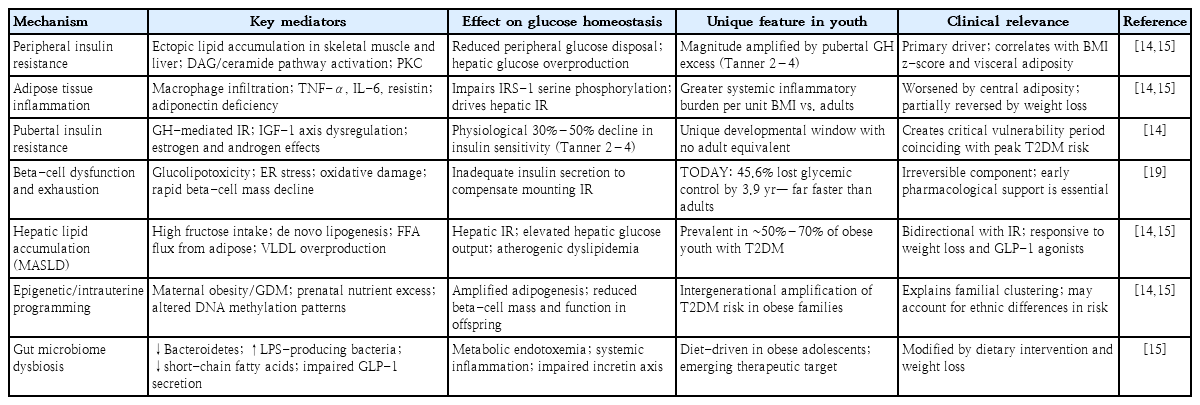
Pathophysiological mechanisms linking pediatric obesity to youth-onset T2DM
5. Weight-reduction interventions and glycemic outcomes
Table 4 summarizes the evidence of weight-reduction interventions in obese youths with T2DM or prediabetes compared to adults. The TODAY randomized trial, the largest and most rigorous weight management trial in youths with T2DM, found that intensive lifestyle interventions combined with metformin use provided no glycemic advantage over metformin monotherapy alone at 3.9 years [19]. Approximately 46% of participants across all 3 arms lost glycemic control, a rate far exceeding that reported in comparable adult studies [19]. In stark contrast, the Adult Diabetes Prevention Program (DPP) demonstrated that a 7% weight loss through lifestyle intervention reduced T2DM progression due to impaired glucose tolerance by 58% [30] as well as a sustained benefit over 15 years [31]. The RISE Pediatric Medication Study (RISE Consortium) further confirmed the rapid betacell function decline in youth-onset T2DM; despite intervention with metformin monotherapy or metformin plus insulin glargine, beta-cell function deteriorated significantly over 12 months, underscoring the intrinsic aggressiveness of the youth phenotype [20,21]. The STEP TEENS phase 3 RCT demonstrated that once-weekly subcutaneous semaglutide 2.4 mg produced a mean BMI reduction of 16.1% over 68 weeks in obese adolescents aged 12–17 years compared to a 0.6% increase in the placebo group, with concurrent improvements in glycated hemoglobin (HbA1c), fasting glucose, and lipid profiles [32]. The Teen-LABS prospective multicenter cohort documented a 95% T2DM remission rate at 3 years after bariatric surgery in adolescents with severe obesity (19 of 20 evaluable participants with T2DM) [33], which exceeded the 72% adult remission rate at 2 years in the Swedish Obese Subjects (SOS) study [34]. Regarding primary prevention, the adult DPP demonstrated that lifestyle interventions targeting 7% weight loss reduced T2DM incidence by 58% in adults with impaired glucose tolerance, with a sustained benefit over 15 years [30,31]. In nondiabetic obese youths, structured lifestyle interventions demonstrated significant improvements in insulin sensitivity, HbA1c, and BMI standard deviation scores (SDS); however, no large-scale pediatric RCT used incident T2DM as the primary endpoint. Emerging GLP-1 receptor agonist data (STEP TEENS) suggested that meaningful weight reductions in obese, nondiabetic adolescents may plausibly delay or prevent T2DM onset by reducing the obesity-driven insulin resistance burden prior to beta-cell decompensation. Dedicated primary prevention trials with T2DM incidence endpoints are prioritized in this field (Tables 1–4; Figs. 1–2).
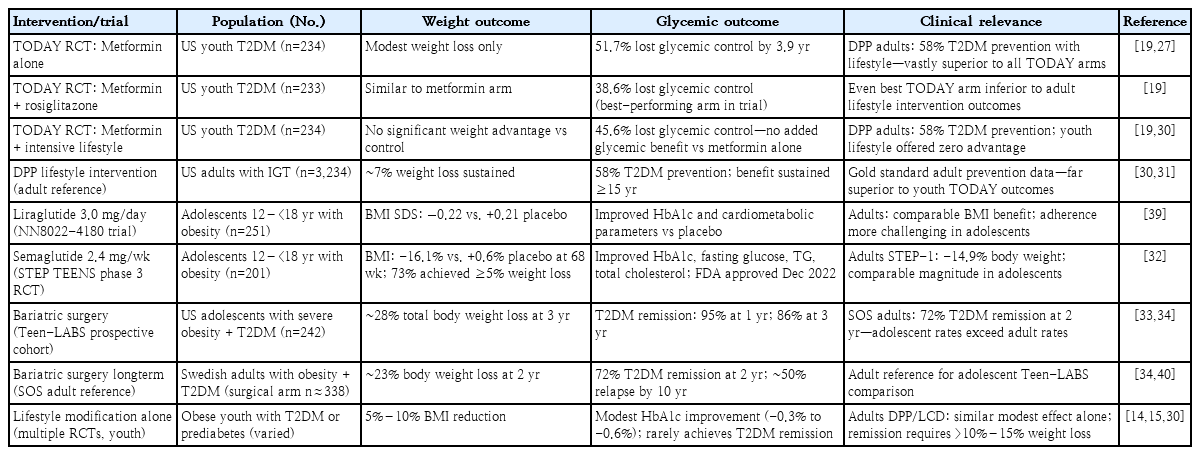
Weight-reduction interventions and glycemic outcomes in obese youth with T2DM or prediabetes: comparison with adult evidence
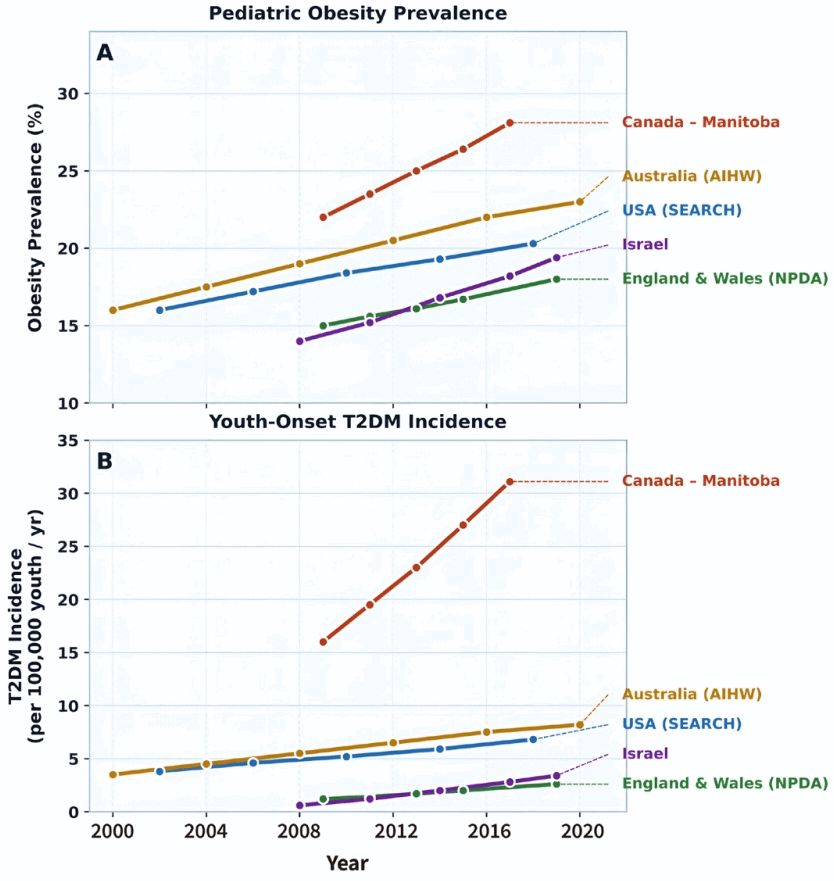
Parallel temporal trends in pediatric obesity prevalence and youth-onset T2DM incidence: A multicountry overview (2000–2022). Panel A shows the childhood/adolescent obesity prevalence (%), while Panel B shows the youth-onset T2DM incidence (per 100,000 youths/yr) across 5 countries with established population-based registries: the USA (SEARCH), Canada (Manitoba), England and Wales (NPDA), Israel (National Registry), and Australia (Australian Institute of Health and Welfare). Co-temporal upward trends were observed in all five registries, consistent with pediatric obesity as the principal upstream driver of youth-onset T2DM. T2DM, type 2 diabetes mellitus; SEARCH, Search for Diabetes in Youth; NPDA, National Paediatric Diabetes Audit. Data sources: Wagenknecht et al., Lancet Diabetes Endocrinol 2023 [2]; Sellers et al., Diabetes Res Clin Pract 2024 [7]; Perng et al., Diabetes Care 2023 [14]; and NCD-RisC, Lancet 2017 [1].

Prevalence of obesity at youth-onset T2DM diagnosis: cross-country comparison with a global pooled estimate. The horizontal bars show the percentage of children and adolescents with type 2 diabetes who were obese at the time of diagnosis by country or study. The gold-dashed vertical reference line marks the approximate background prevalence of pediatric obesity (~20%) in the general population, illustrating the ~3.5- to 4-fold overrepresentation of obesity among youth with T2DM. The global pooled estimate (75.3%; 95% CI, 72.1%–78.5%) reported by Cioana et al. is highlighted. The error bars represent 95% CIs, where available. T2DM, type 2 diabetes mellitus; SEARCH, Search for Diabetes in Youth; NPDA, National Paediatric Diabetes Audit. Data sources: Cioana et al., JAMA Netw Open 2022 [28]; Wagenknecht et al., Lancet Diabetes Endocrinol 2023 [2]; Perng et al., Diabetes Care 2023 [14]; and NCD-RisC, Lancet 2017 [1].
Fig. 1 demonstrates temporally parallel increases in the prevalence of childhood/adolescent obesity as well as the incidence of youth-onset T2DM incidence across multiple international population-based registries, including the USA (SEARCH), Canada (Manitoba), England and Wales (NPDA), Israel, and Australia. Panel A illustrates progressive increases in the prevalence of pediatric obesity over the past 2 decades, while panel B shows concomitant rises in T2DM incidence per 100,000 youths per year. The steepest increase in T2DM incidence was observed in Israel (+441%), followed by Manitoba (+94%) and the USA (+79%). Synchronized upward trajectories across geographically and ethnically diverse populations strongly support pediatric obesity as the principal upstream driver of the expanding epidemic of youth-onset T2DM. These findings also highlight the disproportionate burden on indigenous, minority, and socioeconomically vulnerable youth populations.
Fig. 2 illustrates the prevalence of obesity in children and adolescents diagnosed with youth-onset T2DM across multiple countries and population-based cohorts. The prevalence of obesity exceeded 75% in most registries and reached >90% among First Nations youths in Canada, emphasizing the strong association between adiposity and pediatric T2DM. The pooled global estimate from the meta-analysis by Cioana et et al. [28] (53 studies; N=8,942) demonstrated an obesity prevalence of 75.3% (95% CI, 72.1%–78.5%) at diagnosis. The dashed reference line representing the approximate background pediatric obesity prevalence (~20%) highlights the marked 3.5- to 4-fold overrepresentation of obesity among youths with T2DM compared with the general pediatric population. Collectively, these findings provide compelling epidemiological evidence that obesity constitutes the dominant phenotypic substrate and is a major modifiable risk factor for youth-onset T2DM worldwide.
Discussion
This narrative systematic review synthesized 25 years of population-based evidence from multiple continents, confirming with high methodological rigor that the global rise in pediatric obesity has been accompanied by a temporally parallel and epidemiologically consistent increase in the incidence of youth-onset T2DM. The convergence of longitudinal registry data from the USA (SEARCH), Canada (Manitoba), England and Wales (NPDA), Israel, Australia, and New Zealand, each demonstrating upward cotrajectories in obesity prevalence and T2DM incidence, constitutes compelling multisource evidence that the 2 epidemics are causally linked [2,3,7,14,26]. The temporal sequence—obesity rising first, followed by T2DM incidence—is consistent across all studied regions and aligns with the mechanistic hypothesis that obesity drives insulin resistance, which, in the context of pubertal physiology and genetic susceptibility, precipitates beta-cell failure and frank T2DM [14,15]. Cross-sectional evidence from a global meta-analysis by Cioana et al. [28] established that approximately 75% of youth with T2DM have obesity at diagnosis, a 3.5- to 4-fold overrepresentation relative to the general pediatric population.
The most striking finding of the longitudinal analyses was the universality and quantitative consistency of the parallel trend pattern across highly divergent epidemiological contexts. In the US, the SEARCH registry documented a 79% increase in T2DM incidence among youth aged 10–19 years between 2002–2003 and 2017–2018, with the steepest increases in Black, American Indian, and Hispanic youths [2]. This racial and ethnic patterning provides powerful quasi-natural experimental evidence that variations in the obesity burden driven by systemic inequities in food access, physical activity environments, and socioeconomic determinants directly predict variations in T2DM incidence within the same national surveillance system [2,5,26]. Prevalence data from Lawrence et al. [3] confirmed the near-doubling of T2DM prevalence in US youths between 2001 and 2017. In Canada, Sellers et al. [7] documented a near-doubling of T2DM incidence in Manitoba in less than a decade among almost entirely first-nation children. These geographic and demographic patterns confirm that the obesity–T2DM relationship operates across diverse populations and is moderated by social determinants of health.
Cross-sectional evidence is complementary. The global meta-analysis by Cioana et al. synthesizing 53 studies and 8,942 patients estimated a 75.3% obesity prevalence at T2DM diagnosis globally, which was robust across sensitivity analyses and consistent with national estimates across the USA (~88%), Canada (>90%), England and Wales (~76%), Australia (~80%), and Israel (~82%) [2,7,14,28]. The historical context established by the sentinel report of Pinhas-Hamiel et al. [4] documenting a 10-fold increase in NIDDM diagnoses among adolescents in parallel with local obesity trends has been confirmed on a global scale with methodologically superior population-based data spanning 3 decades. The TODAY cohort baseline characterization confirmed that most youths with established T2DM at trial enrollment were obese (mean BMI, 34.4 kg/m²) [27]. These convergent evidence streams confirm that obesity is the dominant individual-level substrate for pediatric T2DM.
A comparison with the recently published literature strongly corroborates and extends the present synthesis. The comprehensive review of Perng et al. [14] in Diabetes Care concluded that youth-onset T2DM represents an "awakening epidemic" driven by obesity, pubertal insulin resistance, and social determinants of health. Wu et al.’s 2022 global modeling estimated approximately 41,600 new T2DM cases annually in youths <20 years of age worldwide, with the highest absolute burden in China, India, and the US [12]. The NCD-RisC analysis documented a 10-fold increase in childhood/adolescent obesity between 1975 and 2016 [1], providing a macro-level backdrop against which regional T2DM registry data must be interpreted. Projection modeling by Tönnies et al. [13] suggests a substantial increase in US youths with T2DM by 2060, disproportionately affecting minority youths, with profound implications for future cardiovascular, renal, and premature mortality burdens. Lawrence et al. [35] documented that demographic disparities in short-term mortality among youths with diabetes were similarly concentrated in minority and socioeconomically disadvantaged groups. The foundational rationale and early incidence estimates [36,37] as well as the characterization of diabetes across 5 racial/ethnic populations among American youth [38] provide an essential historical context against which the 25-year trends synthesized in this review are best appreciated.
The pathophysiological mechanisms mediating the obesity–T2DM link in youth are now well characterized. Central adiposity drives hepatic and skeletal muscle insulin resistance through ectopic lipid accumulation, diacylglycerol-mediated protein kinase C activation, and ceramide pathway dysregulation [14,15]. Adipose tissue macrophage infiltration causes chronic low-grade inflammation and elevates tumor necrosis factor-alpha, interleukin-6, and resistin levels, thereby impairing insulin receptor substrate-1 signaling [14,15]. Growth hormone-mediated pubertal insulin resistance reduces whole-body insulin sensitivity by 30%–50% during Tanner stages 2–4, creating a pathophysiologically unique developmental window of maximal vulnerability in obese adolescents [14]. The resulting rapid loss of beta-cell mass and function, which occurs considerably more quickly than in adult-onset T2DM, is the defining pathophysiological feature of the youth phenotype. Eppens et al. [25] demonstrated that the complication burden in Australian adolescents with T2DM exceeded that in T1DM controls despite a similar disease duration. Dart et al. [23] confirmed an earlier onset of renal and neurological complications in Canadian youth with T2DM.
Evidence regarding the long-term complication burden provides the most compelling argument for aggressive early intervention. The TODAY2 longitudinal extension found that 60.1% of participants developed at least one microvascular complication (215 with 1, 144 with 2, and 48 with 3; N=677), while 28.4% had 2 or more, with a cumulative incidence reaching 50.0% at 9 years and 80.1% at 15 years, rates exceeding those expected in adults with T2DM of equivalent duration [24]. The SEARCH cohort confirmed a higher prevalence of complications in youth with T2DM versus T1DM of comparable duration [22]. These data establish youth-onset T2DM as a particularly hazardous disease phenotype requiring intensive monitoring and early multi-modal management [22,24,25].
The evidence for weight-reduction interventions reveals a clinically sobering contrast with adult data. DPP demonstrated a 58% T2DM prevention rate via 7% weight loss in adults with impaired glucose tolerance, with sustained benefits over 15 years [30,31]. In youth, the TODAY trial found that intensive lifestyle intervention provided no glycemic advantage over metformin monotherapy alone, with approximately 46% of all participants losing glycemic control within 3.9 years [19]. This disparity reflects the intrinsic rapidity of beta-cell declines in adolescence-onset T2DM rather than differences in adherence, confirming that weight management cannot substitute for pharmacological beta-cell support in youth with established T2DM [19].
More recent evidence provides meaningful optimism regarding pharmacological approaches. The STEP TEENS trial demonstrated that once-weekly subcutaneous semaglutide 2.4 mg produced a mean BMI reduction of 16.1% at 68 weeks in obese adolescents (vs. +0.6% placebo), with concurrent improvements in fasting glucose, HbA1c, triglyceride, and cholesterol levels [32]. This led to U.S. Food and Drug Administration approval of semaglutide for adolescent obesity in December 2022. The magnitude of the achieved BMI reduction was comparable to that in adults in the STEP-1 trial (~14.9%), suggesting that the GLP-1 pathway is similar across the age spectrum. Earlier evidence from the NN8022-4180 trial demonstrated that liraglutide 3.0 mg daily also produced a meaningful BMI SDS reduction in obese adolescents as well as improvements in glycemic parameters [39]. Thus, whether sustained GLP-1 receptor agonist therapy produces durable T2DM remission in youths with established disease remains unclear.
Bariatric surgery remains the most effective intervention and only modality that consistently achieves T2DM remission in obese adolescents. The Teen-LABS registry documented a 95% T2DM remission rate at 3 years (19 of 20 evaluable participants) [33], exceeding the adult remission rate of 72% at 2 years in the SOS study [34]. The Sjöström et al. [40] SOS follow-up study confirmed the durability of the effects of bariatric surgery on T2DM remission in adults, providing a comparative context. These extraordinary adolescent remission rates confirm that adiposity is both necessary and sufficient for youth-onset T2DM in the vast majority of cases and that its radical correction reverses the disease in most patients. However, bariatric surgery requires specialized multidisciplinary teams, and long-term monitoring of growth, nutritional status, and reproductive outcomes in adolescent cohorts is essential.
East Asian epidemiology warrants dedicated discussion since Clinical and Experimental Pediatrics serves a readership for whom regional data are directly clinically relevant. In Japan, the national school-based urine glucose screening program demonstrated that the incidence of youth-onset T2DM is substantially higher than that of T1DM, a pattern strikingly different from that in Western populations, with the former approximately 2.6–3.0/100,000/yr [41]. Critically, Japanese youths with T2DM present at lower BMI thresholds than their Western counterparts (~68% are obese at diagnosis [42]), reflecting the higher prevalence of metabolically obese, normal-weight phenotypes in East Asian populations. In South Korea, a nationwide study using the National Health Insurance Service database documented a 41.0% increase in pediatric T2DM prevalence between 2002 and 2016, with obesity identified as the primary risk factor despite the mean BMI at diagnosis being lower than that in Western cohorts [43]. Data from the China National Survey of Chronic Kidney Disease and Beijing Youth Diabetes Registry indicate a rapidly rising T2DM incidence among adolescents that is driven primarily by the dramatic increase in childhood obesity from 1.8% (1985) to >9.6% (2015) in boys [44]. These East Asian data demonstrate a clinically important “epidemiological paradox”: T2DM risk and incidence are increasing substantially despite lower absolute BMI thresholds, likely reflecting ethnic-specific differences in visceral adiposity, adipokine profiles, and genetic susceptibility to beta-cell dysfunction. This underscores the need for ethnicity-specific BMI cutoffs (e.g., World Health Organization Asian-adapted thresholds of 23 kg/m² for overweight and 27.5 kg/m² for obesity) in clinical assessment and surveillance of at-risk youth in East Asian and Asian-heritage populations. A critical clinical consideration that deserves explicit attention in any review of youth-onset T2DM is the differential diagnosis of Maturity-Onset Diabetes of the Young (MODY), a heterogeneous group of monogenic diabetes disorders (most commonly GCK-MODY, HNF1A-MODY, and HNF4A-MODY) that collectively account for approximately 1%–2% of all diabetes diagnoses but are frequently misclassified as T2DM in obese adolescents. Importantly, approximately 12% of youths presenting with an apparent T2DM phenotype, particularly those with a lower BMI, a strong multigenerational family history of diabetes, or the absence of acanthosis nigricans and dyslipidemia, may harbor a monogenic MODY mutation. This distinction has profound therapeutic implications: HNF1A-MODY and HNF4A-MODY respond dramatically to low-dose sulfonylurea therapy and do not require insulin or metformin, whereas GCK-MODY typically does not require pharmacological treatment. Genetic testing using next-generation sequencing panels should be considered in nonobese youths with suspected T2DM, those with unexplained stable mild hyperglycemia, or those with a 3-generation family pedigree of diabetes to avoid unnecessary pharmacotherapy, optimize treatment, and enable accurate genetic counseling.
The therapeutic landscape of pediatric obesity and youth-onset T2DM continues to evolve rapidly. Among the most promising emerging agents is tirzepatide, a novel dual glucose-dependent insulinotropic polypeptide/GLP-1 receptor co-agonist that demonstrates superior weight-reduction ability in adults (SURMOUNT-1: mean body weight reduction of 20.9% at 72 weeks with 15 mg). The SURPASS-PEDS (NCT05260021), a phase 3 randomized, double-blind, placebo-controlled trial of tirzepatide in pediatric patients (aged 10–<18 years) with type 2 diabetes., features the coprimary endpoints of percentage change in BMI and body weight at 52 weeks. If the results in adolescents parallel the adult findings, tirzepatide may offer superior metabolic benefits over semaglutide monotherapy for obese youths with T2DM or prediabetes. Future research priorities include standardized global surveillance for pediatric T2DM in low- and middle-income countries, ethnicity-specific metabolic risk definitions and BMI cutoffs, early-life obesity prevention trials with T2DM incidence as a primary endpoint, longitudinal evaluations of incretin-based therapies for beta-cell preservation in at-risk youth, and long-term safety data for GLP-1 receptor agonists and dual agonists in pediatric populations. The public health imperative is unambiguous: pediatric obesity is the principal upstream modifiable driver of youth-onset T2DM. Effective prevention requires multilevel interventions that address school nutrition, sedentary behavior, food marketing, community design, and upstream social determinants including poverty and food insecurity [1,2,7,12,14]. Moreover, the international harmonization of pediatric T2DM surveillance standards is essential [2,12].
In conclusion, integrated longitudinal and cross-sectional evidence drawn from population-based registries across North America, Europe, the Middle East, Australasia, and global surveillance platforms confirms a robust, temporally consistent, and biologically plausible causal relationship between the global rise of pediatric obesity and the escalating epidemic of youth-onset T2DM. Obesity temporally precedes increases in T2DM incidence at the population level and is present in approximately three-quarters of affected youth at diagnosis worldwide, a 3.5- to 4-fold overrepresentation relative to background population rates. Its clinical phenotype is particularly aggressive, with a rapid beta-cell decline, early microvascular complications, and a complication burden exceeding that of adult-onset T2DM of equivalent duration. Weight-reduction interventions, particularly GLP-1 receptor agonist therapy and bariatric surgery, offer meaningful but frequently incomplete glycemic benefits, underscoring that the primary prevention of childhood obesity remains the most powerful strategy to reverse this epidemic. Integrated management combining pharmacotherapy, structured lifestyle support, and family-centered care is urgently needed for affected individuals.
Notes
Conflicts of interest
No potential conflict of interest relevant to this article was reported.
Funding
This study received no specific grant from any funding agency in the public, commercial, or not-for-profit sectors.
Acknowledgments
The authors are grateful to the Hamad Medical Corporation, Doha, Qatar for providing the academic environment and institutional support that enabled the preparation of this review. The authors thank the librarians and information specialists at Hamad Medical Corporation Medical Library for assistance with database access.
Author contribution
Conceptualization: ATS; Data curation: ATS, FA, NA, NH, SM, AE; Formal analysis: ATS, NH, SM, AE; Methodology: ATS; Visualization: SM, AE; Writing - original draft: FA, NH, SM, AE; Writing - review & editing: ATS