Neonatal care in a low-birthrate society: insights from population-based observations in Japan
Article information

Key message
Declining birth rates are reshaping neonatal care. In low-birthrate settings, shifts in the underlying causes of neonatal death, including greater use of perinatal palliative care for trisomy 18 and challenges in maintaining expertise in extremely low-birth-weight infants, may contribute to fluctuations in neonatal mortality. These observations highlight the need for a coordinated system-level support.

Graphical abstract. ELBW, extremely low-birth-weight infant.
Introduction
Declining birth rates and an aging population are major global challenges, particularly in the developed countries [1]. These demographic changes may influence neonatal outcomes by reducing clinical exposure and altering decision-making in perinatal care. Understanding how these factors affect neonatal mortality is important.
Observations from a low-birthrate region
Akita Prefecture, located in northeastern Japan, has had the lowest birth rate in the country for several decades [1]. Population-based perinatal mortality investigations have been conducted continuously for more than 20 years, covering nearly all neonatal deaths in the region [2]. This study was approved by the ethical review board of Akita Red Cross Hospital (February 19, 2025; approval No. 78-2). Recent data demonstrated an increase in neonatal mortality since 2016, accompanied by changes in the underlying causes (Fig. 1). Neonatal mortality rates increased from approximately 0.9 per 1,000 live births in 2006–2015 to 1.4 per 1,000 live births in 2016–2020.
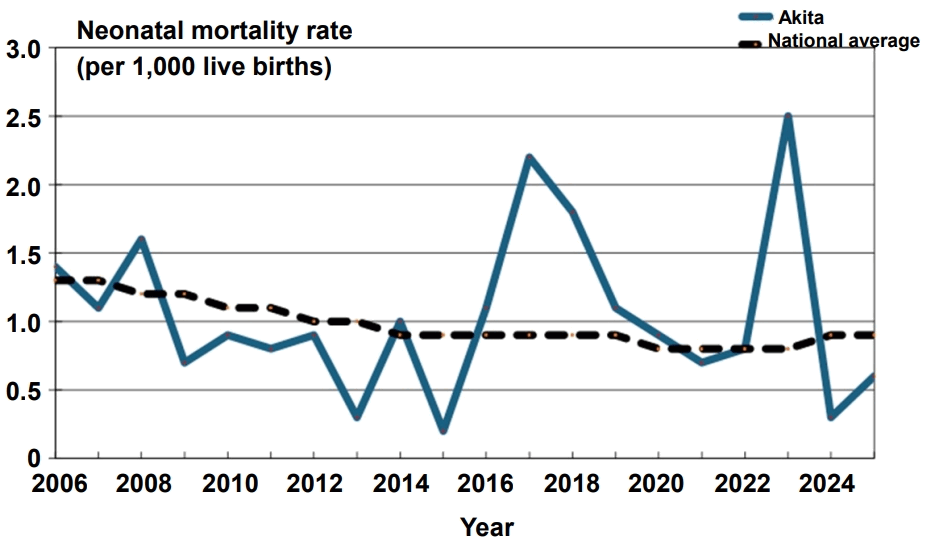
Trends in neonatal mortality in a low-birthrate region. Annual neonatal mortality rates in Akita Prefecture compared with the national average in Japan (2006–2025). Neonatal mortality increased after 2016 and remained characterized by substantial year-to-year fluctuations during follow-up.
Two major trends were observed. First, the number of deaths among extremely low-birth-weight infants increased. In low-birthrate settings, reduced case volumes may limit clinical exposure and make it difficult to maintain high-level neonatal resuscitation and intensive care skills. Second, the number of deaths associated with chromosomal abnormalities, particularly trisomy 18, has increased. Trisomy 18-related deaths increased from 3 cases in 2006–2015 to 6 cases in 2016–2020. Many of these patients were prenatally diagnosed, and nonintensive (palliative) care was selected following multidisciplinary discussions with their families.
Updated regional data from 2021 to 2025 demonstrated substantial annual fluctuations in neonatal mortality. Although the mortality rates were lower in most years after 2020, a marked increase was observed in 2023 (2.5 per 1,000 live births). A review of these cases revealed that deaths associated with trisomy 18 and extremely low-birth-weight infants continued to contribute substantially to neonatal mortality, suggesting that the challenges identified from this perspective remain relevant. During this period, regional perinatal teams continued with multidisciplinary mortality review meetings, neonatal resuscitation training, and collaborative quality improvement activities aimed at maintaining clinical expertise and improving outcomes.
Key challenges in neonatal care
These observations highlighted two emerging challenges. The first was the maintenance of clinical expertise in low-volume settings. As the number of high-risk deliveries decreases, sustaining proficiency in neonatal intensive care becomes increasingly difficult. Another challenge is supporting complex perinatal decision-making. Advances in prenatal diagnosis have increased the opportunities for informed discussions. Care choices are increasingly individualized, including the option of palliative care.
Implications for healthcare systems
These findings have broader implications for individual regions. Many countries have experienced declining birth rates, and similar challenges are likely to emerge globally. Previous studies have demonstrated a volume-outcome relationship in neonatal intensive care, with lower-volume centers showing less favorable outcomes among very low-birth-weight infants [3]. Therefore, maintaining clinical expertise in high-risk neonatal care may become increasingly challenging in regions with declining birth rates. Strengthening regional and nationwide collaborative systems may help maintain clinical expertise through centralized care, shared training programs, and quality improvement initiatives [4]. A system-level approach should include the regionalization of high-risk deliveries, maintenance of neonatal transport systems, interinstitutional case review conferences, and continuous quality improvement initiatives. These strategies help maintain clinical expertise despite the declining case volumes. Similar challenges may be encountered in other regions experiencing declining birth rates and demographic change. Therefore, observations from Akita Prefecture are considered relevant beyond a single region. In addition, structured support for perinatal palliative care and family-centered decision-making is essential [5].
Furthermore, educational strategies are needed to sustain clinical competency in low-volume settings, including simulation-based training and interinstitutional collaboration. Policy-level support for optimizing resource allocation and ensuring equitable access to specialized neonatal care is critical.
Conclusion
In low-birthrate societies, neonatal mortality trends reflect both reduced clinical exposure and evolving perinatal decision making. Addressing these challenges requires system-level approaches. The lessons learned from population-based observations in Japan may inform future neonatal care strategies worldwide.
Notes
Conflicts of interest
No potential conflict of interest relevant to this article was reported.
Funding
This study received no specific grant from any funding agency in the public, commercial, or not-for-profit sectors.
Author contribution
Conceptualization: HA; Data curation: HA, HM, YO, HA, AS, TI, MM; Formal analysis: HA, HM, YO; Methodology: HA, HM, AS; Project administration: HA, HM, YO, HA, AS, TI, MM; Visualization: HA; Writing - original draft: HA; Writing - review & editing: HA