Association between maternal traumatic stress related to Great East Japan Earthquake and behavioral problems in offspring
Article information

Abstract
Background
Women who experienced the Great East Japan Earthquake (GEJE) and subsequently became pregnant may have children who are more likely to exhibit emotional and behavioral problems. However, few longitudinal studies have investigated the developmental outcomes among children born to mothers who experienced natural disasters before pregnancy and continued to experience stress symptoms thereafter.
Purpose
This study aimed to examine the association between maternal traumatic stress related to the GEJE and behavioral problems in their children.
Methods
A total of 21,656 mother-child pairs were included in the analysis; 52.0% of the offspring were male. Maternal traumatic stress symptoms related to the GEJE were assessed using items evaluating recollection, emotional distress, somatic reactions, and avoidance behaviors (Cronbach α=0.681). Child behavioral outcomes at 2 and 3 years of age were assessed using the Child Behavior Checklist for Ages 1½–5 (CBCL/1½–5). Missing data were addressed by multiple imputation, and a multivariable logistic regression was performed with adjustment for maternal psychological distress, social isolation, sleep problems, parity, breastfeeding, disaster-related exposure, parental history of mental illness, and socioeconomic characteristics. Covariate selection was guided by a directed acyclic graph.
Results
Compared with mothers who reported no traumatic stress symptoms, those reporting one or 2 symptoms had a higher odds of their children exhibiting internalizing (odds ratio [OR], 1.34; 95% confidence interval [CI], 1.06–1.69), externalizing (OR, 1.29; 95% CI, 1.07–1.55) and total problems (OR, 1.38; 95% CI, 1.11–1.72) at age 2 and internalizing (OR, 1.38; 95% CI, 1.13–1.69), externalizing (OR, 1.21; 95% CI, 1.01–1.45) and total problems (OR, 1.37; 95% CI, 1.10–1.71) at age 3. Mothers reporting 3 or 4 symptoms showed stronger associations, a pattern consistent with a dose-response relationship supported by a formal test for trends for most outcomes. These findings were consistent with those of sensitivity analyses using continuous CBCL scores.
Conclusion
These findings suggest that maternal mental health support beyond pregnancy may be important for women of reproductive age in disaster-affected areas and could help inform preventive strategies addressing the intergenerational effects of trauma following largescale disasters such as the GEJE.
Key message
Question: Does prepregnancy maternal traumatic stress influence behavioral outcomes in early childhood?
Finding: Children born to mothers who reported greater disaster-related traumatic stress showed higher risks of internalizing, externalizing, and total behavioral problems at ages 2 and 3 years consistent with a dose-response relationship.
Meaning: Long-term maternal mental health support covering the broader reproductive period may play a role in addressing intergenerational behavioral problems after large-scale disasters.
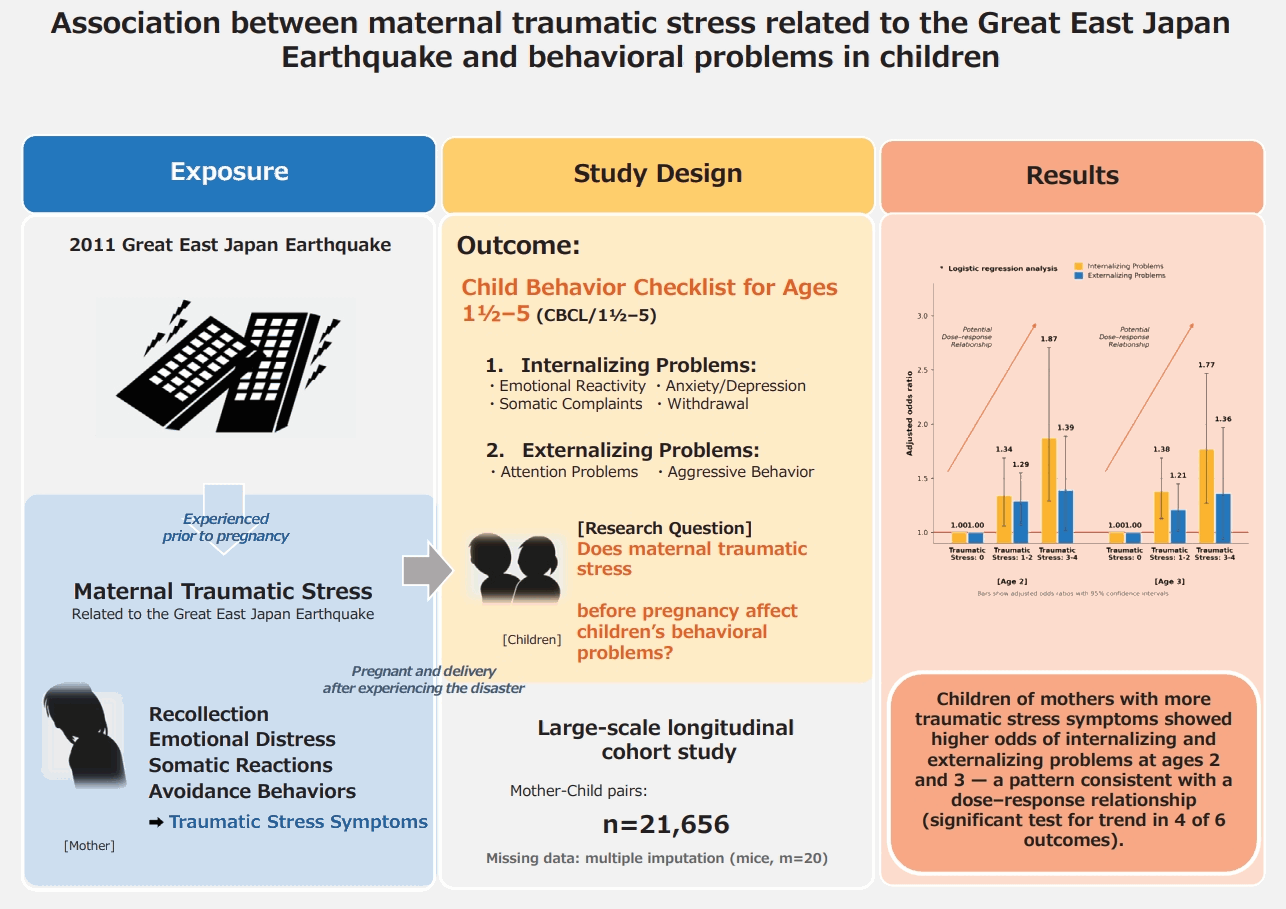
Graphic abstract.
Introduction
The Great East Japan Earthquake (GEJE) in March 2011, which reached a maximum seismic intensity of 7 and a magnitude of 9.0, was the strongest earthquake ever recorded in Japan. The massive tsunami that followed caused devastating destruction, particularly in coastal regions. Stressful events such as natural disasters have been shown to adversely affect those who experience them, often resulting in mental health issues, including posttraumatic stress disorder (PTSD) [1]. Previous studies have demonstrated that women who have experienced traumatic events face an increased risk of sleep disorders and perinatal depression [2,3]. Moreover, maternal PTSD symptoms have been associated with difficulties in mother-infant bonding [4]. Stress related to the GEJE has also been identified as a risk factor for depression and PTSD among survivors [2,5].
Maternal sleep disturbances and perinatal depression have been linked to emotional and behavioral problems in children [3,6]. In addition, impaired maternal attachment behaviors in the postpartum period may be associated with an increased risk of behavioral problems in children, as assessed in previous studies using the The Ages & Stages Questionnaires, Third Edition [7]. Children of mothers with PTSD are at greater risk of behavioral problems, partly due to difficulties with self-regulation [8]. Based on this evidence, we hypothesized that women who experienced the GEJE and subsequently became pregnant may have children who are more likely to exhibit behavioral problems.
Most previous studies of disaster-related maternal stress and child behavior have restricted their analyses to women exposed during pregnancy [9], and only a few have focused on women who became pregnant after the disaster; those that did were limited by relatively small sample sizes and single-time-point assessment [10,11]. A recent study from the same disaster context, Fukuchi et al. [12], examined the intergenerational transmission of disaster experiences; however, it differed substantially from the present study. That study included 218 parents and 219 children in disaster-affected areas of Iwate and Fukushima, used parents' subjective perceptions of disaster-related harm as the exposure, and examined parental mental health as a mediator in a small, proxy-reported sample. In contrast, the present study draws on a large, population-based birth cohort, defines the exposure as a symptom-based measure of persistent maternal posttraumatic stress in women who were not pregnant at the GEJE, and assesses child behavior longitudinally at both ages 2 and 3. Longitudinal evidence from Asia, including Japan, remains limited, and examining the association between preconception disaster-related stress and offspring behavioral problems may provide important insights for postdisaster maternal and child health.
In this study, we addressed these limitations by utilizing mother-child data from a large-scale birth cohort. Specifically, we conducted a longitudinal analysis using data from the Tohoku Medical Megabank Project’s Three-Generation Cohort Study, focusing on women who experienced traumatic stress from the GEJE prior to pregnancy and subsequently gave birth. We examined the association between maternal traumatic stress and behavioral problems in their children at ages 2 and 3.
Given that children with behavioral problems are at increased risk of future economic and social disadvantages [13], our findings may provide a basis for developing strategies to develop countermeasures that target maternal mental health and child behavioral issues following large-scale disasters such as the GEJE, as well as for preparing for future catastrophic events. This report presents our findings as a contribution to the growing body of evidence on postdisaster maternal and child health.
Methods
1. Design and participants
Data for this study were obtained from the Tohoku Medical Megabank Project Birth and Three-Generation Cohort Study (TMM BirThree Cohort Study), as described elsewhere [14,15]. Pregnant women receiving care at 50 obstetric clinics and hospitals across Miyagi and Iwate Prefectures were recruited between July 2013 and March 2017. The conceptual model of this study was shown in Fig. 1. At the time of the GEJE, the women included in this study were not pregnant and subsequently participated in the TMM BirThree Cohort Study. After giving birth, we examined the association between the number of traumatic stress symptoms related to the GEJE and neurodevelopmental behavioral problems in their children.
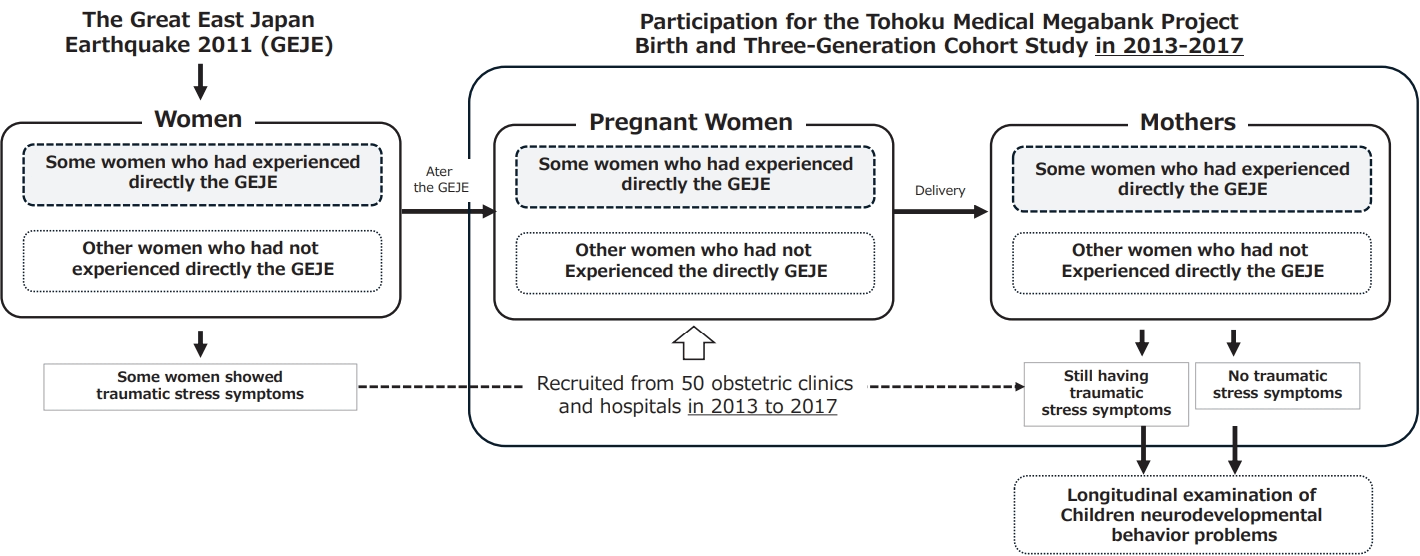
Conceptual model of present study. GEJE, Great East Japan Earthquake.
Of the 23,730 mother-child pairs enrolled in the TMM BirThree Cohort, we excluded 615 instances of consent withdrawal, 954 multiple births, 28 infants with chromosomal abnormalities, asphyxia, or cerebral palsy identified during the 1-month postnatal survey, and 477 cases in which either parent had a history of depression or PTSD before the GEJE, leaving 21,656 eligible mother-child pairs (Fig. 2). Rather than restricting the analysis to complete cases—which would have excluded a large number of participants with incomplete questionnaires and could introduce selection bias—we retained all eligible pairs and addressed missing data by multiple imputation (see Statistical Analysis).

Flow diagram illustrating participant recruitment and exclusion processes. TMM BirThree Cohort, Tohoku Medical Megabank Project Birth and Three-Generation Cohort; PTSD, posttraumatic stress disorder; GEJE, Great East Japan Earthquake.
2. Maternal traumatic stress related to the GEJE
Maternal traumatic stress related to the GEJE was assessed using investigator-developed questionnaire items administered 1 year after childbirth. Respondents were asked whether, within the past week, they had experienced any of the following 4 symptoms on 2 or more occasions when recalling the GEJE. The 4 symptom items were as follows:
(1) “Do you recall or dream about the disaster, even if you would prefer not to?” (recollection).
(2) “Do you become upset when something reminds you of the disaster?” (emotional distress).
(3) “Do you have physical reactions when you think about the disaster?” (somatic reactions).
(4) “Have you deliberately tried not to think about the disaster or avoided activities, people, or places that might remind you of it?” (avoidance behaviors)
Participants were then categorized into 3 groups based on the number of “yes” responses: group 1 (0 response), group 2 (1–2 responses), and group 3 (3–4 responses).
Because this 4-item scale was developed for the TMM BirThree Cohort Study and has not undergone external validation, we examined its internal reliability. Cronbach α was 0.681 and interitem correlations ranged from 0.281 to 0.437, indicating acceptable internal consistency for a brief 4-item screen.
3. Child behavioral problems
Child behavioral problems were assessed using the validated Japanese version of the Child Behavior Checklist for Ages 1½–5 (CBCL/1½–5) [16,17]. The CBCL/1½–5 consists of 100 items, including 99 that describe specific emotional or behavioral problems and one open-ended problem item. Mothers rated each item on a 3-point Likert scale: “not true (0),” “somewhat or sometimes true (1),” and “very true or often true (2).”
The CBCL/1½–5 yields 7 syndrome scales—Emotional Reactivity, Anxiety/Depression, Somatic Complaints, Withdrawal, Sleep Problems, Attention Problems, and Aggressive Behavior—as well as an “Other Problems” category. Three composite scores were derived: (1) total problems: sum of all 100 items (range, 0–200; cutoff 37), (2) internalizing problems: sum of emotional reactivity, anxiety/depression, somatic complaints, and withdrawal (range, 0–72; cutoff 10), and (3) externalizing problems (sum of attention problems and aggressive behavior; range, 0–48; cutoff 15)
T-scores for total, internalizing, and externalizing problems were calculated using normative Japanese data, with values ≥64 indicating scores in the clinical range. Because persistent behavioral problems often lead to long-term mental health and social difficulties [13,18], we analyzed outcomes longitudinally at 2 time points: ages 2 and 3.
4. Covariates
Covariate selection was guided by a prespecified directed acyclic graph (Fig. 3) [19]. Following the modified disjunctive cause criterion [20], the adjustment set comprised all measured pre-exposure covariates that were causes of the exposure, the outcome, or both: confounders (common causes of the exposure and the outcome) and pre-exposure risk factors for the outcome (causes of the outcome but not the exposure—namely child's sex, maternal age, parity, and paternal history of mental illness). The latter are not confounders; however, their inclusion is not expected to introduce bias and may improve the precision of the estimates. Variables lying on the causal pathway from the exposure to the outcome (mediators) were retained in the primary model by design. Accordingly, the resulting estimate should be interpreted as reflecting a controlled direct rather than a total effect (see below). We did not condition on variables identified as colliders (common effects of 2 variables on a path connecting the exposure and the outcome), which would open a biasing path (collider bias). Child sex was extracted from birth records, and maternal age at delivery and gestational age were extracted from medical records; hypertensive disorders of pregnancy (HDP) and gestational diabetes mellitus (GDM) were also extracted, as both have been associated with child developmental outcomes [21,22]. In addition to housing damage, GEJE-induced income loss and loss or missing of loved ones were included as indicators of disaster severity, and parity, breastfeeding, household income, and parental history of mental illness were included as covariates.
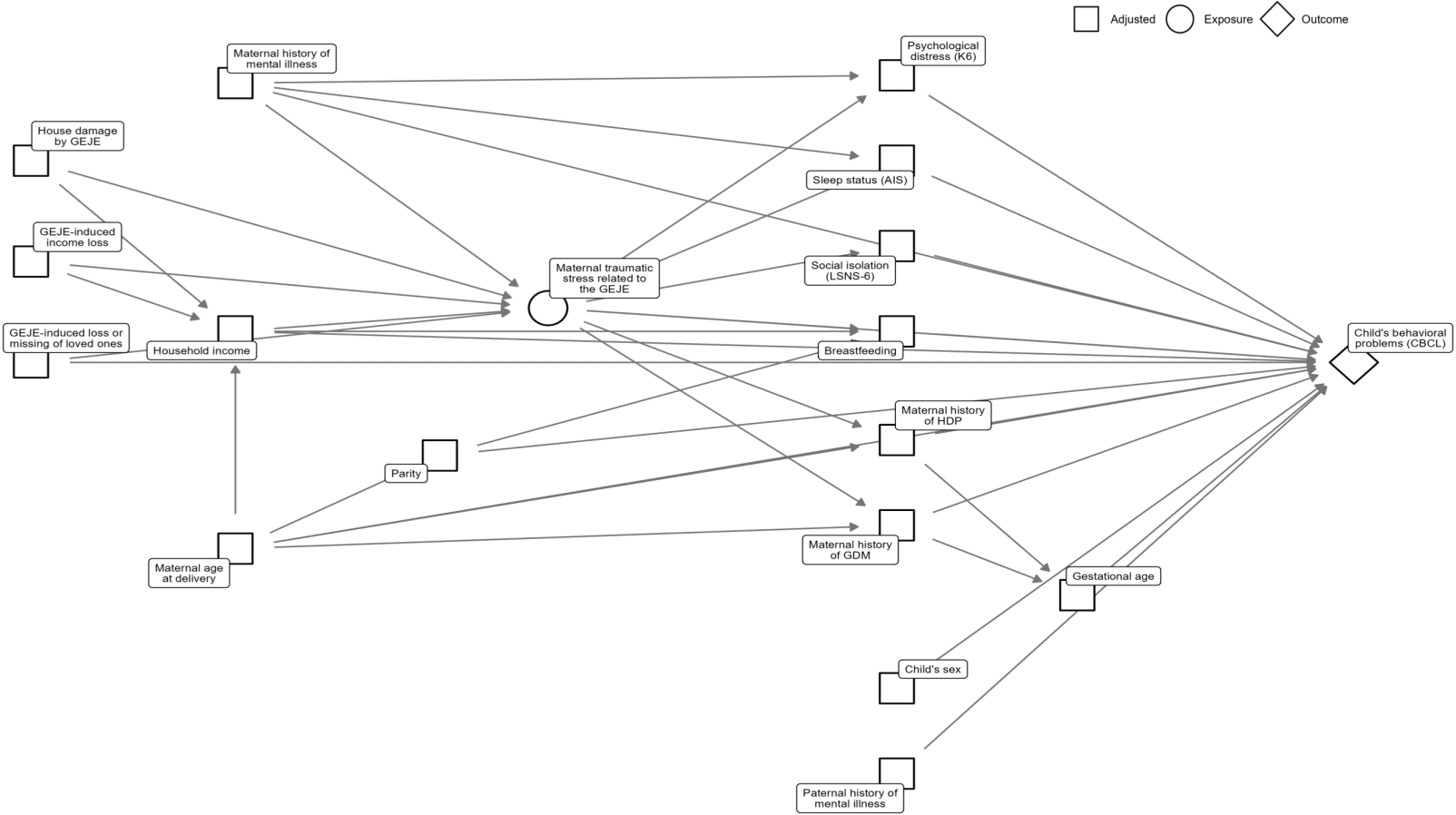
Directed acyclic graph illustrating assumed causal structure and covariate selection basis. GEJE, Great East Japan Earthquake; K6, Kessler 6; HDP, hypertensive disorders of pregnancy; GDM, gestational diabetes mellitus.
Under this causal structure, maternal psychological distress (Kessler 6, K6), social isolation (Lubben Social Network Scale-6, LSNS-6), sleep problems (Athens Insomnia Scale, AIS), breastfeeding, and pregnancy complications lie on the pathway downstream of the prepregnancy exposure and may act as mediators rather than confounders. Because the primary model conditions on these variables, its estimate is interpreted as a controlled direct effect that is conservative with respect to the total effect; the total effect is likely at least as large as the estimates reported.
Maternal psychological distress was measured in early pregnancy using the Japanese version of the K6 scale [23,24]. Total scores range from 0 to 24, with values ≥13 indicating severe psychological distress. Participants were classified into 2 groups (≥13 vs. ≤12). Children of mothers with higher psychological distress have been reported to exhibit more behavioral problems in early childhood [25].
Housing damage due to the GEJE, assessed 1-year postpartum, was categorized into 4 groups: completely destroyed/severely damaged, partially destroyed/partially damaged, no damage, and not residing in the affected area. Social isolation was assessed one year postpartum using the brief Japanese version of the LSNS-6 [26]. Scores range from 0 to 30, with values <12 indicating social isolation [27].
Parental history of mental illness (depression, bipolar disorder, PTSD, or schizophrenia) was obtained from a questionnaire administered 1 year postpartum. Parents with a history of depression or PTSD prior to the GEJE were excluded to minimize potential confounding. In contrast, depression and PTSD that developed after the disaster were included as covariates, as they may lie on the pathway between disaster-related traumatic stress and child behavioral outcomes. Maternal sleep status was assessed in early pregnancy using the Japanese version of the AIS [28,29]. Scores range from 0 to 24, with a cutoff of ≥6 indicating pathological insomnia. Maternal insomnia tendencies have been associated with poorer socio-emotional development in children [3].
Household income was assessed during midpregnancy and categorized into 3 groups: <4 million Japanese Yen (JPY), 4–6 million JPY, and ≥6 million JPY.
5. Statistical analysis
Maternal characteristics were compared across the 3 stress groups using chi-square tests. Missing data on all variables included in the regression models were addressed by multiple imputation by chained equations (R package mice; m=20 imputations), and estimates were pooled using Rubin rules [30]. First, we summarized participants’ baseline characteristics and examined their associations with child behavioral problems. These characteristics included child sex, maternal age at delivery, years from the GEJE to delivery, maternal education, housing damage status, number of residential moves, maternal alcohol and smoking history, psychological distress (K6), social isolation (LSNS-6), sleep status (AIS), household income, gestational age, parental history of mental illness, and maternal history of HDP and GDM.
Next, associations between maternal traumatic stress related to the GEJE and child behavioral problems at ages 2 and 3 were examined using univariate logistic regression models. To formally evaluate the dose-response pattern, a test for trend was conducted by entering the 3-level exposure as a single ordinal term and estimating the per-category odds ratio (OR). Because dichotomization at the clinical cutoff involves information loss, sensitivity analyses using the continuous CBCL scores were performed by linear regression (Supplementary Tables 1 and 2). Multivariate logistic regression analyses were also conducted, adjusting for child sex, maternal age, housing damage status, household income, psychological distress (K6), social isolation (LSNS-6), sleep status (AIS), parental history of mental illness, gestational age, and maternal history of HDP and GDM.
Finally, stratified analyses were performed for maternal psychological distress (K6), given its potentially strong influence on the association between maternal traumatic stress and child behavioral problems. All statistical analyses were conducted using R ver. 4.0.2 (R Foundation for Statistical Computing, Austria), with statistical significance defined as P<0.05.
6. Ethical approval and consent to participate
The TMM BirThree Cohort Study protocol was reviewed and approved by the Ethics Committee of Tohoku University Tohoku Medical Megabank Organization (2013-1-103-1; latest revision 2024-4-021). This study followed the STROBE (Strengthening the Reporting of Observational Studies in Epidemiology) guidelines. All methods were carried out in accordance with the Declaration of Helsinki. All participants provided their informed consent at enrollment. For participants with insufficient ability to understand the study protocol at any age, with the Ethics Committee’s approval, informed consent was obtained from their guardians.
Results
The basic characteristics of the participants are summarized in Table 1. Among mothers with available exposure data, 11,297 reported no traumatic stress symptoms, 1,489 reported 1 or 2 symptoms, and 332 reported 3 or 4 symptoms; missing values were addressed by multiple imputation. The proportions of participants with a K6 score ≥13, an LSNS-6 score <12, and an AIS score ≥6 increased progressively with the number of maternal traumatic stress symptoms.
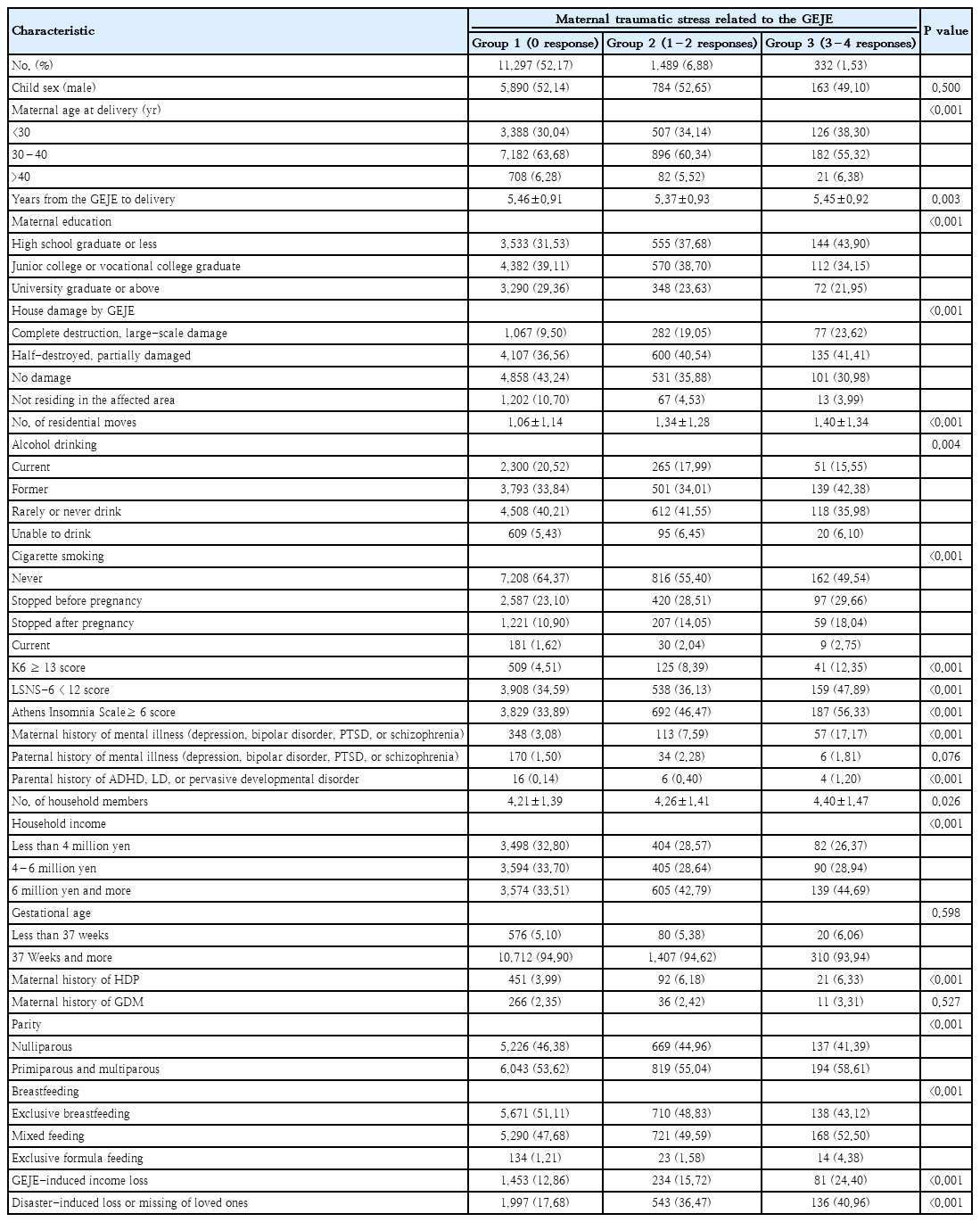
Basic characteristics of study participants
The proportions of children exceeding the CBCL cutoffs for internalizing, externalizing, and total problems increased with higher levels of maternal traumatic stress symptoms at both ages 2 and 3 (Table 2).
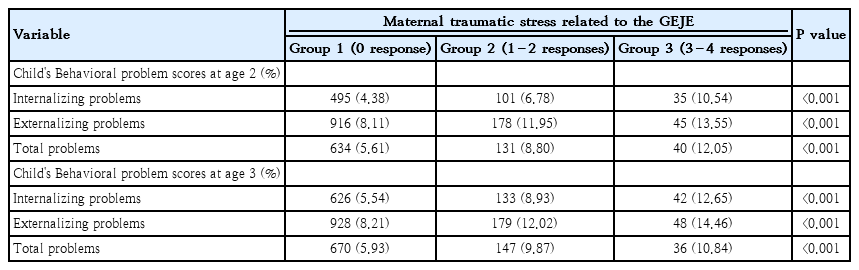
Proportion of children exceeding CBCL cutoff
The multivariable logistic regression results for 2-year-old children are presented in Table 3. After adjustment, among mothers reporting 1 or 2 traumatic stress symptoms, the ORs were 1.34 (95% confidence interval [CI], 1.06–1.69) for internalizing, 1.29 (95% CI, 1.07–1.55) for externalizing, and 1.38 (95% CI, 1.11–1.72) for total problems. Among mothers reporting 3 or 4 symptoms, the corresponding ORs were 1.87 (95% CI, 1.29–2.71), 1.39 (95% CI, 1.02–1.89), and 1.73 (95% CI, 1.24–2.43), respectively.
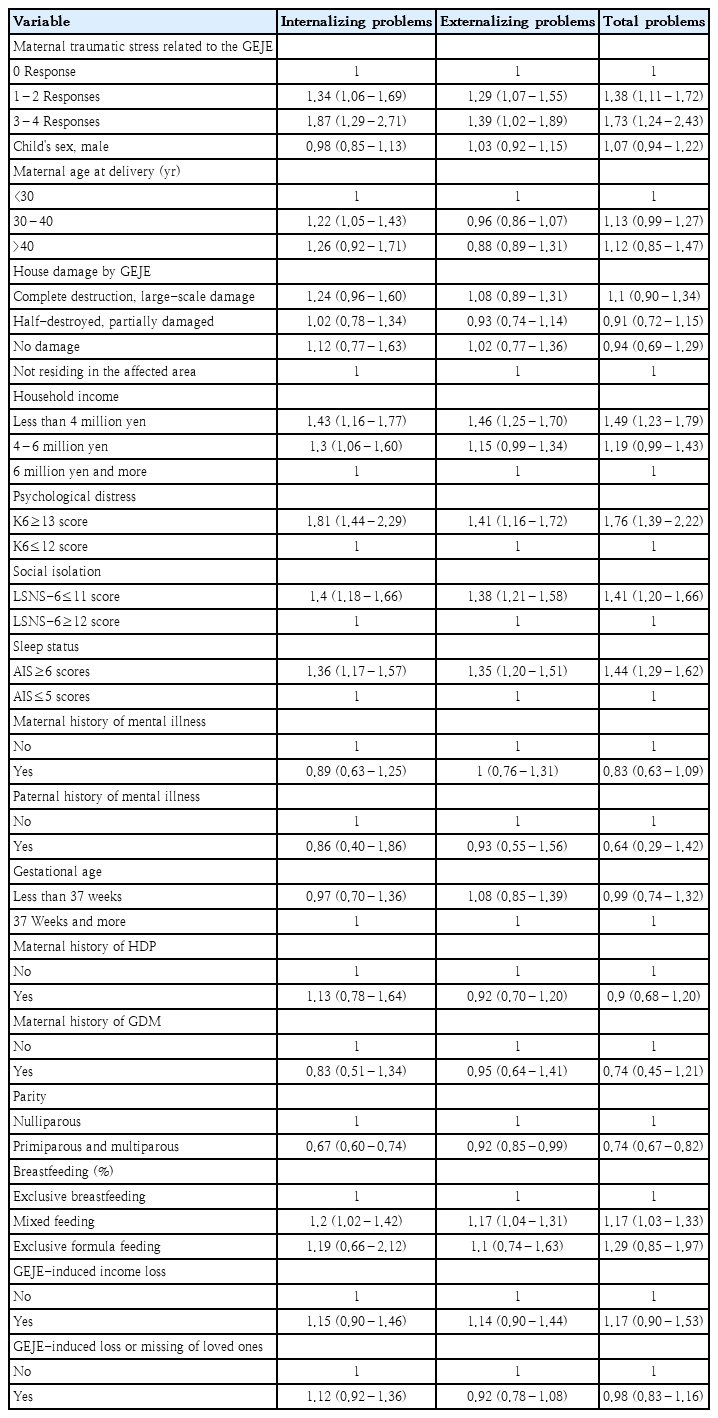
Multivariate logistic regression analysis of maternal traumatic stress and behavioral problems in their 2-year-old children
The results for 3-year-old children are presented in Table 4. Among mothers reporting 1 or 2 symptoms, the ORs were 1.38 (95% CI, 1.13–1.69) for internalizing, 1.21 (95% CI, 1.01–1.45) for externalizing, and 1.37 (95% CI, 1.10–1.71) for total problems. Among mothers reporting 3 or 4 symptoms, the ORs were 1.77 (95% CI, 1.27–2.47) for internalizing and 1.45 (95% CI, 1.03–2.04) for total problems, whereas the association with externalizing problems did not reach significance (OR, 1.36; 95% CI, 0.94–1.97).
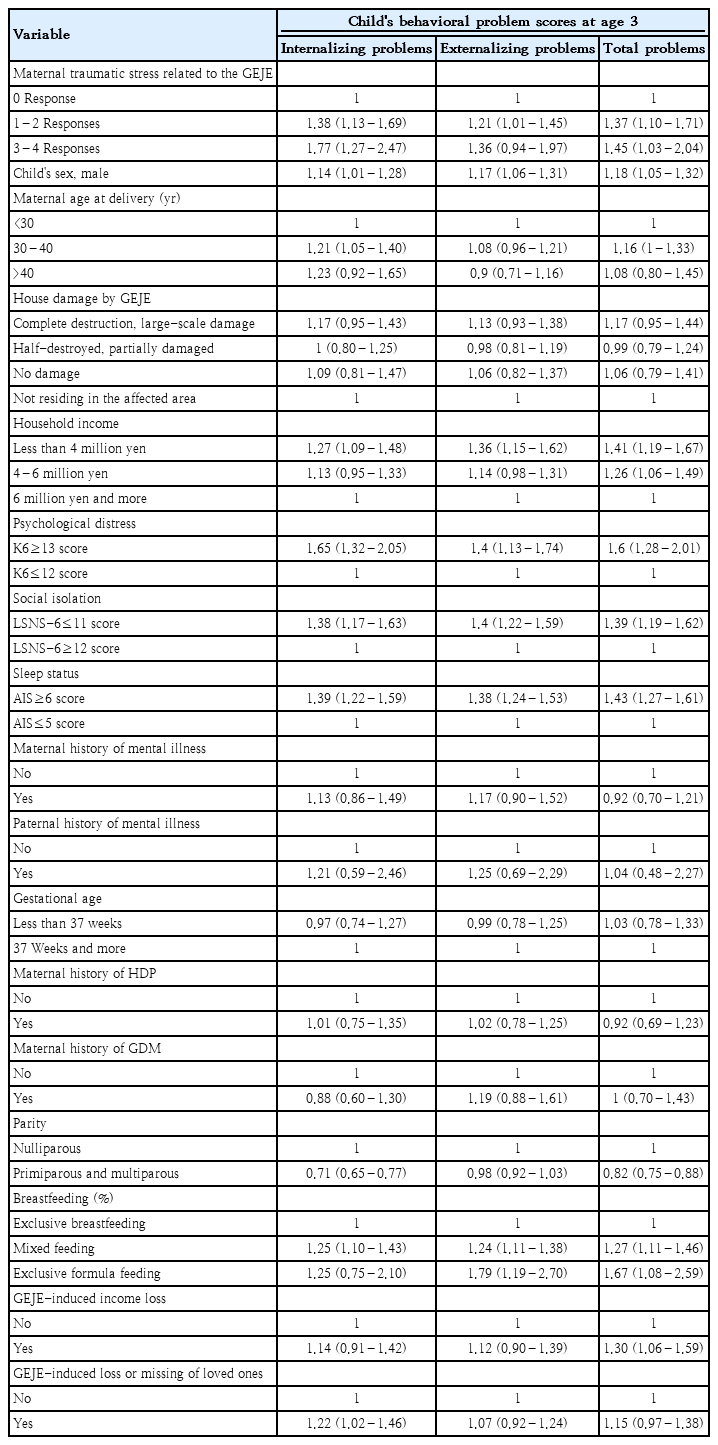
Multivariate logistic regression analysis of maternal traumatic stress and behavioral problems in their 3-year-old children
In summary, maternal traumatic stress symptoms related to the GEJE were associated with an elevated risk of behavioral problems in children at both ages, in a pattern consistent with a dose-response relationship. A formal test for trend supported this pattern for most outcomes: the per-step ORs were 1.37 (95% CI, 1.06–1.78; P=0.017) for internalizing, 1.24 (95% CI, 1.01–1.53; P=0.038) for externalizing, and 1.25 (95% CI, 0.99–1.59; P=0.063) for total problems at age 2, and 1.11 (95% CI, 0.87–1.42; P=0.384) for internalizing, 1.28 (95% CI, 1.04–1.57; P=0.017) for externalizing, and 1.26 (95% CI, 1.00–1.60; P=0.050) for total problems at age 3; a significant positive trend was observed for 4 of the 6 outcomes.
Sensitivity analyses using the continuous CBCL scores (linear regression; Supplementary Tables 1 and 2) yielded positive associations for all outcomes at both ages, consistent with the primary binary analyses.
There was also a consistent trend for children of mothers with higher levels of traumatic stress to exceed the CBCL total problems cutoff at both ages 2 and 3. Furthermore, higher maternal psychological distress, social isolation, and sleep problems were each associated with an increased likelihood of children exceeding the cutoff on all CBCL scales at both time points.
In analyses stratified by maternal K6 score (≥13 vs. ≤12; Supplementary Tables 3 and 4), the associations between maternal traumatic stress and child behavioral problems were evident among mothers with lower concurrent distress (K6≤12) but were not statistically significant among mothers with high concurrent distress (K6≥13; n= 1,156).
Discussion
To support women who experience trauma-related stress responses following large-scale disasters such as the GEJE, our findings demonstrate a significant association between maternal traumatic stress and behavioral problems in children. These results are consistent with prior similar research indicating that mothers who experienced PTSD or traumatic stress before childbirth are more likely to have children with behavioral problems [10,31]. Moreover, as the number of traumatic stress symptoms by reported mothers increased, the strength of the association with behavioral problems in their children also increased, a pattern consistent with a dose-response relationship that was formally supported by a test for trend for most outcomes.
Previous longitudinal studies conducted following the GEJE have reported associations between maternal stress symptoms and neurodevelopmental problems in children born to mothers who directly experienced the disaster [32]. In contrast, the women in our study were not pregnant at the time of the disaster. Nevertheless, our findings suggest that children born to women who experienced a disaster may still be affected, even in the absence of direct biological transmission through the placenta. These findings indicate that the effects of disaster-related traumatic stress may persist for several years and that maternal trauma experienced during the preconception period, as well as ongoing stress symptoms thereafter, may influence child behavioral problems. Therefore, maternal and child health interventions in disaster-affected areas may need to address not only trauma during pregnancy but also trauma experienced across the broader reproductive period.
Our findings complement, but are distinct from, Fukuchi et al. [12], which used parents' subjective disaster experiences as the exposure and parental mental health as a mediator in a small, proxy-reported sample from Iwate and Fukushima. The present study instead used a large, population-based birth cohort, a symptombased measure of persistent maternal posttraumatic stress in women who were not pregnant at the GEJE, and longitudinal outcomes at ages 2 and 3. The 2 studies address different populations, exposures, outcomes, and analytic approaches and are not overlapping.
Previous studies have shown that individuals exposed to major earthquakes—such as the magnitude 6.9 event in Armenia and the magnitude 8.0 event in China—are at increased risk for developing PTSD [1,5]. The GEJE, with a magnitude of 9.0 and followed by a massive tsunami, caused extensive destruction and posed a similarly high risk of PTSD among survivors. Furthermore, the affected regions had limited medical resources even before the disaster, and residents’ mental health relied heavily on informal community networks. The collapse of these community networks after the disaster likely had a substantial negative impact on maternal mental health [2]. The present findings extend this literature by demonstrating that even when the disaster occurred before pregnancy, persistent maternal traumatic stress symptoms were associated with behavioral problems in early childhood. This may suggest that the long-term psychological impact of disasters can influence maternal functioning and the postnatal environment, thereby affecting child behavioral development.
A previous study examining the relationship between traumatic experiences from the GEJE and postpartum depression found that a greater number of traumatic experiences was associated with a higher risk of postpartum depression, again suggesting a dose-response relationship [2]. Furthermore, greater disaster impacts were significantly associated with poorer parental mental health, which was associated with more emotional and behavioral problems in children even without direct trauma exposure [12]. That study, which also used data from the same cohort as the present research, began in December 2013, more than 2 years after the earthquake in March 2011 [2]. These findings indicate that major earthquakes may have long-lasting effects on women’s mental health.
Mothers experiencing traumatic stress leading to PTSD or postpartum depression may face significant difficulties in establishing maternal-child bonding [4]. Previous studies have also shown that when parent-child bonding is impaired, children aged 2 years and older are at increased risk for developing behavioral problems [7]. These findings suggest a reciprocal relationship between maternal mental health and children’s behavioral outcomes. One possible explanation for our findings is that mothers who experienced traumatic stress due to the GEJE may have had difficulty forming emotional bonds with their children, which may in turn be reflected in behavioral problems in their offspring.
In addition, several possible mechanisms may also explain this association. Previous studies have reported that PTSD symptoms among individuals affected by earthquakes are associated with the loss of homes and property, deterioration in economic conditions, and reduced quality of life. Similarly, in the present study population, traumatic stress may also influence parenting behaviors, emotional responsiveness, and the overall home environment, which may in turn affect early childhood behavioral development.
Beyond these psychosocial pathways, biological mechanisms may also contribute. Maternal traumatic stress has been linked to dysregulation of the hypothalamic-pituitary-adrenal axis and to glucocorticoid receptor (NR3C1) methylation, to prenatal programming through elevated maternal cortisol during a subsequent pregnancy, and to intergenerational epigenetic transmission of stress [33,34]. Although our observational data cannot test these mechanisms directly, they offer plausible complementary explanations for the associations observed.
The association was evident among mothers with lower concurrent distress but was not statistically significant among mothers with high concurrent distress (K6 ≥13); this subgroup was relatively small (n=1,156; 5.3% of the sample), yielding limited power, and a ceiling effect is also plausible, as mothers with severe concurrent distress already have a high baseline probability of reporting child behavioral problems.
This study has several important limitations. First, the generalizability of the findings may be limited because the TMM BirThree Cohort Study was conducted exclusively in Miyagi Prefecture. Second, measurement bias is possible because the CBCL is a parent-reported instrument. Mothers experiencing psychological distress may be more likely to perceive or report behavioral problems in their children. Third, the specificity of the assessment tools is a potential limitation: the items used to evaluate maternal traumatic stress related to the GEJE were developed specifically for the TMM BirThree Cohort Study and have not undergone external validation. Fourth, several unmeasured variables—such as paternal traumatic stress, household environment, and parenting practices—were not included in the analyses, even though they may influence child neurodevelopment. In addition, temporal ambiguity and reverse causality cannot be fully excluded, because parenting stress from a child with behavioral difficulties could sustain maternal posttraumatic symptoms; because the primary model adjusts for potential mediators, the estimate represents a controlled direct effect that may underestimate the total effect. Missing data were addressed by multiple imputation, which retained the full eligible sample and reduced selection bias relative to complete-case analysis [35].
Despite these limitations, this study has several notable strengths. It was conducted using a postdisaster cohort and included a large sample size with a longitudinal design, enabling the examination of child behavioral problems over time. In addition, the study uniquely focused on maternal traumatic stress experienced prior to pregnancy, which has been less frequently examined in previous research. Finally, children’s behavioral problems were assessed at both 2 and 3 years of age, allowing evaluation at multiple time points.
In conclusion, this study examined the association between maternal traumatic stress related to the GEJE before pregnancy and behavioral problems in children at ages 2 and 3, using data from a large-scale birth cohort. Our findings suggest that maternal mental health support beyond pregnancy may be important for women of reproductive age in disaster-affected areas and could help inform strategies to address the intergenerational effects of trauma following large-scale disasters such as the GEJE.
Supplementary materials
Linear regression analysis of association between maternal traumatic stress and behavioral problems in their children at 2 years of age
Linear regression analysis of association between maternal traumatic stress and behavioral problems in their children at 3 years of age
Multivariate logistic regression analysis of maternal traumatic stress and behavioral problems in their children at 2 years of age stratified by K6 score
Multivariate logistic regression analysis of maternal traumatic stress and behavioral problems in their children at 3 years of age stratified by K6 score
Notes
Conflicts of interest
No potential conflict of interest relevant to this article was reported.
Funding
The TMM BirThree Cohort Study was supported by grants from the Ministry of Education, Culture, Sports, Science and Technology (MEXT) and the Japan Agency for Medical Research and Development (AMED) (JP21tm0124005 and JP21tm0424601).
Acknowledgments
The authors would like to express their appreciation to the mothers and children who participated in the TMM BirThree Cohort Study and staff members of the Tohoku Medical Megabank Organization. The list of members is available at https://www.megabank.tohoku.ac.jp/english/a240901/.
Author contribution
Conceptualization: ST; Data curation: TO, SK; Formal analysis: ST; Funding acquisition: TO, SK; Methodology: ST, CK, MO; Project administration: TO, SK; Visualization: MO; Writing - original draft: ST; Writing - review & editing: MO, CK, MI, AN, GS, TO, SK