
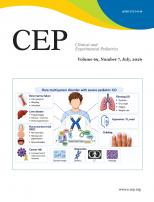



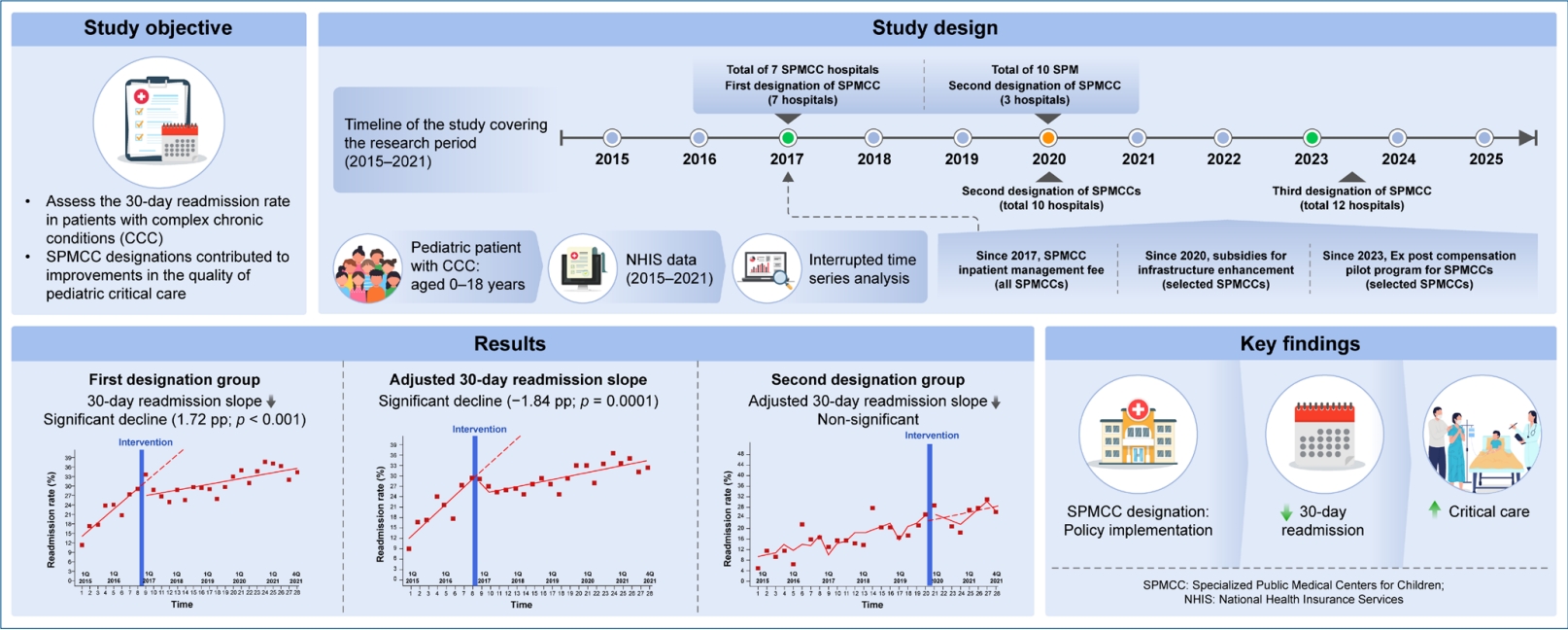
Graphical abstract. SPMCC, Specialized Public Medical Center for Children; NHIS, National Health Insurance Service; pp, percentage points.
Introduction
Advancements in medical technology have substantially decreased pediatric mortality, thereby increasing the number of children with medical complexity (CMC) [1-3]. CMC has demonstrated markedly higher mortality rates and substantially greater use of complex, resource-intensive healthcare services than children without such diagnoses [4,5]. The same phenomenon has been observed in South Korea. The number of children and adolescents with complex chronic conditions (CCCs) in Korea has increased, and medical expenditures have escalated [6]. Consequently, the demand for highly specialized CCC clinical services has intensified, requiring coordinated multidisciplinary care with child-specific facilities and medical equipment [7].
However, operating child-specific multidisciplinary teams and maintaining facilities and equipment for children necessitate substantial capital and operating outlays [8]. Prevailing reimbursement mechanisms rarely offset these costs, placing specialized pediatric services in a classic market-failure domain with limited prospects for financial return [9-11]. A similar phenomenon was observed in Korea in the early 2000s: the pediatric healthcare delivery system was underdeveloped, with only 8 pediatric hospitals comprising one tertiary-level and 7 secondary-level institutions, and these were concentrated in or near Seoul [12]. Consequently, the Korean government initiated a project to establish children’s hospitals within national university hospitals to strengthen the pediatric care system [13]. Through the government's "Establishment and Operation of Children's Hospitals" project, children's hospitals were set up at 5 national university hospitals (Busan, Gyeongsangbuk-do, Gangwon-do, Jeonbuk-do, and Jeollanam-do). However, high costs and low revenue lead to persistent deficits and understaffing [14]. In 2016, the government identified pediatric care as a priority for public support and introduced Specialized Public Medical Centers for Children (SPMCCs) [15].
The SPMCC designation is reserved for institutions that fulfill the rigorous thresholds set forth in the Public Health and Medical Services Act and its accompanying notification on the Standards for SPMCC designation. To qualify, a candidate center must operate 14 distinct clinical departments, including the full range of pediatric subspecialties, pediatric surgical disciplines, child and adolescent psychiatry, radiology, and rehabilitation medicine; maintain a minimum of 100 inpatient beds (including a minimum of 5 pediatric intensive care beds and 15 neonatal intensive care beds); provide dedicated pediatric operating rooms and laboratories; employ no fewer than 17 board-certified physicians (including pediatricians and pediatric surgeons); and meet the mandated nurse-to-patient ratios for general pediatric wards, neonatal intensive care units, and pediatric intensive care units. Seven university hospitals were initially designated SPMCCs. The number of designated centers was expanded to 10 in 2019 and 13 in 2023 with the inclusion of 3 additional centers specializing in critical pediatric care.
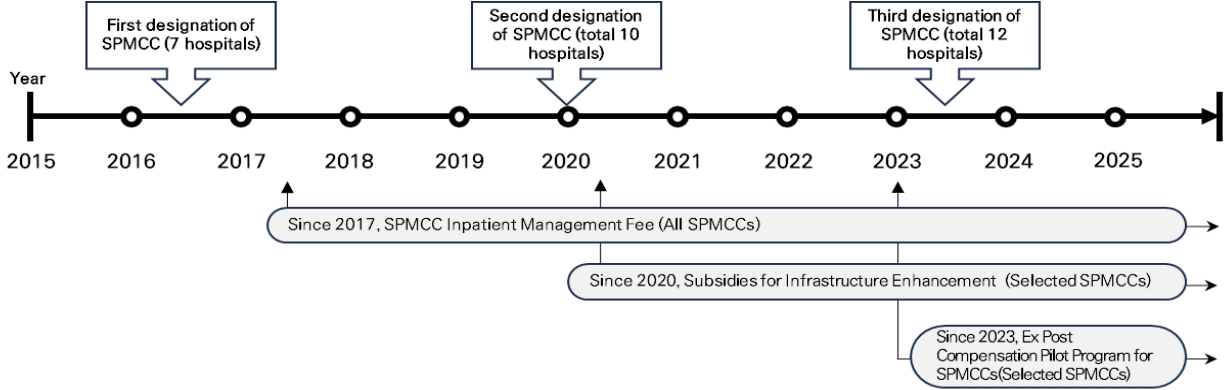
Since April 2017, institutions designated as SPMCCs may bill inpatient management fees for pediatric patients admitted to general wards [16]. Furthermore, starting in 2020, selected institutions began receiving subsidies for facility- and equipment-related costs. In addition, to offset operating deficits, the government launched a pilot program as an alternative reimbursement mechanism in January 2023 (Fig. 1). Each center’s accounts and cost data were analyzed to estimate the net profits or losses arising from pediatric services. A benchmark support amount is then calculated, and ex post compensation is provided in the form of a subsidy [17]. Although SPMCCs face no mandated service quotas or other compulsory performance benchmarks, investments in dedicated facilities, equipment, and specialized staff have markedly increased care for critically ill pediatric patients [6,18]. While SPMCCs have been shown to deliver a substantial volume of care for children with CCCs, it remains unknown whether they have tangibly improved the quality of clinical services. Accordingly, this study aimed to assess whether SPMCC designations lead to improvements in pediatric critical care outcomes.
Methods
1. Study design
This study utilized a quasi-experimental, pre-post design without a control group to evaluate changes in the rate of all-cause unplanned readmissions within 30 days of discharge (30-day readmission rate) following the SPMCC designation. This intervention was designed to designate hospitals as SPMCCs and to indirectly improve the quality of medical care. There were no control groups for 2 reasons. First, the designation as an SPMCC presupposes that an institution already possesses substantial pediatric capacity, including dedicated facilities, specialized equipment, and appropriately trained personnel to manage high-acuity cases. Consequently, it is difficult to identify nondesignated hospitals that meet comparable standards and serve as credible controls. Second, the difficulty in adjusting for severity without information on the results of physical examinations and laboratory tests, such as heart rate, blood pressure, body temperature, pupillary reactivity, and mental status [19], results from the limitations of the data source [20].
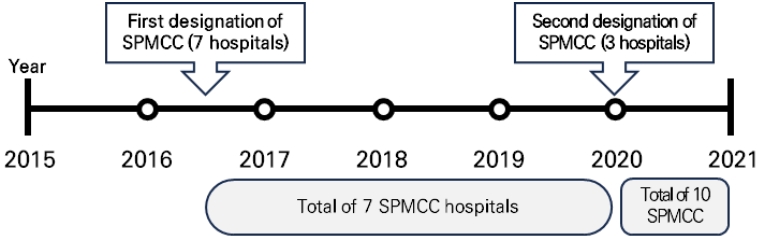
In mid-2016, 7 hospitals received their initial designation as SPMCCs; several early designees did not fully satisfy all designation requirements at first but achieved full compliance in 2017. Subsequently, 3 additional hospitals were designated SPMCCs in 2020. Analysis of the period from 2015 to 2021 allowed for a clear assessment of the outcomes before and after SPMCC designation (Fig. 2).
2. Data source and study population
Data were obtained from the National Health Insurance Service (NHIS) [21], which covers approximately 97% of the Korean population. The database contains information on qualifications and insurance premiums, medical treatment history, and death records of patients, as well as facility characteristics such as nursing grades and nurse staffing levels [22]. The study sample included health insurance claims data for pediatric patients aged 0–18 years whose CCC was managed at medical institutions designated as SPMCCs [23,24] between January 1, 2015, and December 31, 2021.
The concept of CCCs was introduced to identify the evolving patterns of childhood morbidity and mortality in which diverse individual conditions account for many childhood deaths. It also described a population in which advances in medical technology have shifted the epidemiology of childhood illness from acute to chronic, with problems that were once acutely fatal becoming processes that result in prolonged disability and death [25]. By design, the CCC classification does not encompass all chronic conditions of childhood but is strongly associated with mortality, morbidity, functional limitations, high healthcare resource utilization, and complex clinical care programs [26]. The CCC classification and its subclassification were developed by examining all childhood and adolescent deaths (aged 0–18 years in Washington State, USA, from 1980 to 1997) [25]. Version 2 of the CCC classification was subsequently published to reflect the 2014 International Classification of Diseases, Tenth Revision (ICD-10) revision [23]. CCCs are divided into 11 groups and have been adapted for use in Korea according to ICD-10 (KCD-5/KCD-6) [24].
3. Outcome measures and covariates
The primary outcome was the 30-day unplanned readmission rate, which was defined as hospitalization within 30 days of discharge after the initial admission. Readmission rates are widely employed as indicators of healthcare resource utilization and quality of care in children’s hospitals [27-30]. In the United States, the Center for Medicare and Medicaid Services developed a hospital-wide, all-cause 30-day readmission indicator that adjusts for patient characteristics, including of patient factors such as sex, age, and severity of illness, as well as composite measures of provider-level conditions and services, to adjust for patient and hospital risk factors [31]. The Canadian Institute for Health Information adjusts for sociodemographic variables such as income quartiles and urban or rural residences. Incomplete discharge planning, suboptimal quality of care at admission, and insufficient community healthcare resources after discharge are considered potential contributors to 30-day readmission [32].
Consistent with these frameworks, 30-day readmission rates among children aged 0–18 years with CCCs were adjusted for covariates such as sex, age (0, 1–4, 5–9, 10–14, and 15–18 years), household income quartiles (Q1: medical aid beneficiaries, Q2: 1–6 vigintiles of health insurance premiums, Q3: 7–13 vigintiles, and Q4: 14–20 vigintiles), patient residence (Seoul capital area, Busan area, Daegu area, Chungcheongbuk-do, Chungcheongnam-do area, Gwangju area, Gangwon-do area, Jeonbuk-do area, and Jeju-do area), and CCC diagnostic category (neurologic or neuromuscular, cardiovascular, respiratory, renal and urologic, gastrointestinal, hematologic or immunologic, metabolic, other congenital or genetic defect, malignancy, premature and neonatal, and miscellaneous, not elsewhere classified). Residential areas were categorized based on the location of the designated SPMCC.
We used health insurance claims data from the NHIS to calculate readmission rates at the hospitalization-episode level, while excluding episodes that ended in death. An episode of hospitalization was defined as the admission of a pediatric patient aged 0–18 years with CCCs to an SPMCC, where the end-of-care date on the baseline statement and the start-of-care date on the next claim were within one day of each other for the same patient at the same institution. The discharge date was defined as the initial hospitalization date on the claims and number of days of care. As medical care was available without distinction between medical institutions, we defined the reference institution as the institution where the first hospitalization occurred at study entry. Readmissions occurring within 30 days under the same conditions were considered as readmissions to the reference hospital if they occurred at the same medical institution. For hospital classification, 7 and 3 institutions were identified as SPMCCs based on their initial designation status as determined by the medical institution codes.
4. Statistical analysis
Descriptive statistics were used to characterize the study population. Pearson chi-square test was used to compare the categorical variables between the first and second SPMCC groups. Subsequently, the crude and adjusted 30-day readmission rates were estimated using logistic regression models that included time (quarterly from 2015 to 2021), sex, age, income level, residence, and CCC diagnosis as covariates. For this purpose, patients with CCC were assigned to a single CCC subtype based on their primary diagnosis to ensure mutual exclusivity across CCC subtypes and to avoid double-counting in the descriptive analysis.
Interrupted time series (ITS) analysis was used to evaluate the changes in the 30-day readmission rate following the designation of the SPMCC. Segmented regression was employed to estimate the immediate level and slope changes between the pre- and postintervention segments, allowing for distinct intercepts and slopes in each segment [33,34]. Using SAS PROC AUTOREG, the ITS regression model was estimated using an autoregressive model because measurements are correlated over time, and observations that are closer in time often have stronger correlations [33]. The Durbin-Watson (DW) statistic was used to assess autocorrelation [35]. The outcome variable was the 30-day readmission rate (%). Accordingly, the regression coefficients were interpreted as percentage points for level changes and percentage points per quarter for slope changes [33,36].
All analyses were performed using SAS Enterprise Guide ver. 7.1 (SAS Institute, USA) at the Big Data Center of the NHIS, and statistical significance was tested at a 5% significance level.
5. Ethics statement
This study was approved by the institutional review board (IRB) of the National Medical Center, Korea (IRB No. NMC-2023-01-006). The IRB committee waived the requirement for written informed consent because only secondary data containing no personally identifiable information were used.
Results
1. Baseline characteristics
A total of 16,252 pediatric hospitalization episodes among children with CCCs in SPMCC hospitals were identified between 2015 and 2021. Of these, 13,000 episodes occurred in hospitals designated as SPMCCs in 2017 (first designation group), and 3,252 episodes occurred in hospitals designated as SPMCCs in 2020 (second designation group). Among episodes in the first SPMCC group, the 30-day readmission rate was 29.34%, whereas that in the second SPMCC group was 31.12% (n=1,012).
Statistically significant differences in 30-day readmission episodes were observed between the first and second SPMCC groups across sex, age group, area of residence, income level, and CCC diagnostic categories (Table 1). In both groups, male patients accounted for higher proportion (53.24% in the first group and 61.50% in the second), with the most common age group being 1–4 years (37.37% and 33.27%, respectively).
In the first SPMCC group, the majority of patients resided in the Seoul capital area (Seoul, Incheon, and Gyeonggi-do), comprising 5,022 cases (38.63%). In contrast, in the second group, the Daejeon area (Daejeon, Sejong, Chungcheongbuk-do, and Chungcheongnam-do) had the highest proportion, with 1,125 cases (34.62%). Regarding income level, both groups had a higher proportion of patients in the highest tertile of NHIS premium (53.06% in the first group and 48.47% in the second). Among CCC diagnostic categories, hematological or immunological conditions were the most prevalent (25.29% and 25.95%, respectively), followed by other congenital or genetic disorders (22.80% and 21.68%).
2. Thirty-day readmission rates of SPMCCs
Adjusted 30-day readmission rates for SPMCCs were calculated using a multivariate model adjusted for quarterly time points, sex, age, area of residence, income level, and CCC diagnostic categories. Quarterly trends in both observed and adjusted 30-day readmission rates were examined by SPMCC designation group (Tables 2 and 3). In the first SPMCC group, quarterly observed readmission rates ranged from 37.78% to 11.38%, while adjusted rates ranged from 36.50% to 8.84%. In the second group, observed rates ranged from 41.74% to 12.82%, and adjusted rates ranged from 30.65% to 5.02%.
3. Change in 30-day readmission rates following the SPMCC designation
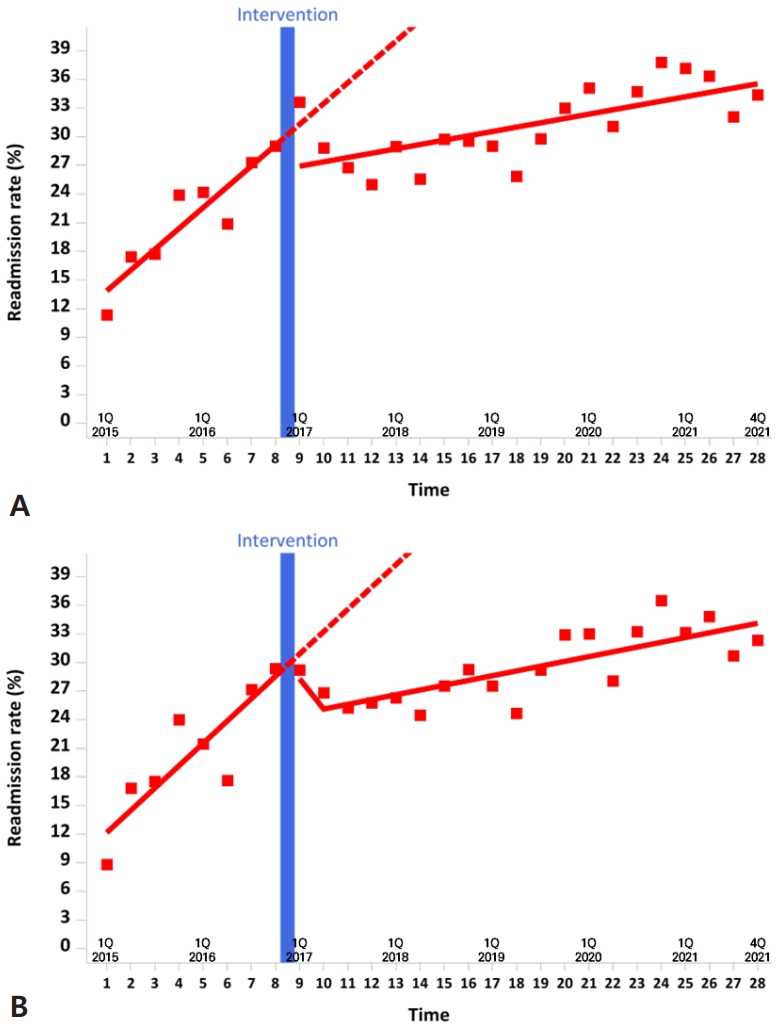
Changes in the observed 30-day readmission rates before and after the first SPMCC designation were evaluated using segmented regression analysis (Table 4; Fig. 3A). Before the intervention, this rate increased over time. At designation, the readmission rate decreased by 2.65 percentage points, the difference was not significant. In the postintervention period, the slope decreased by 1.72 percentage points per quarter. The DW statistic was 1.6154. A similar pattern was observed in the adjusted 30-day readmission rates (Table 4; Fig. 3B). The immediate change in the level at designation was a 0.75 percentage point decrease (P=0.69), which was not statistically significant, whereas the postintervention slope decreased by 1.84 percentage points per quarter (P<0.001). The DW value was 1.7812.
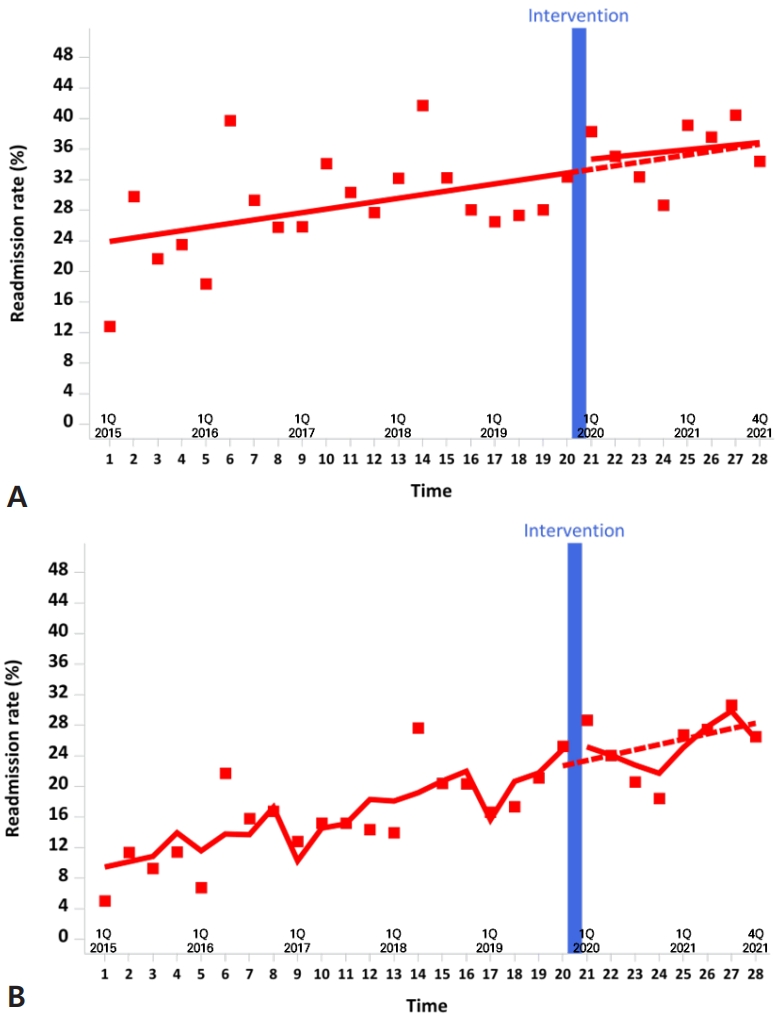
In the second SPMCC group, changes in the observed 30-day readmission rates were analyzed using segmented regression analysis. The preintervention values showed an increasing trend. At the time of designation, the level appeared to decrease and the postintervention slope trended downward; however, neither the immediate level change nor the postintervention slope change reached statistical significance (Table 5; Fig. 4A). The DW statistic was 1.9105. The adjusted 30-day readmission rates showed a similar qualitative pattern. There was an apparent decrease in designation and a downward postintervention slope; however, neither change was statistically significant. The DW statistic was 2.1819 (Table 5; Fig. 4B).
Discussion
In this study, we evaluated the effect of the SPMCC designation on the quality of care by analyzing changes in 30-day readmission rates among children and adolescents with CCCs before and after each center’s designation. The findings indicated that in the first designation group, both the observed and adjusted readmission rates decreased significantly in the postdesignation period, with a downward trend in the adjusted rates that reached statistical significance. These findings suggest that the SPMCC designation may improve the quality of pediatric medical care and reduce readmissions over time. However, the second designation group showed no statistically significant change despite a downward trend.
Amid rising readmission rates among children with CCC [37], the SPMCC designation was associated with a significant decline in 30-day readmission rates. While the SPMCC designation framework requires institutions to maintain minimum standards for physicians and nursing staffing as a condition of continued designation, these structural requirements may strengthen multidisciplinary care capacity. However, as this study lacked data on staffing levels or facility resources before and after designation, the structural mechanisms by which designation influenced readmission rates could not be empirically confirmed. Although previous studies have demonstrated that multidisciplinary teams comprising pediatric subspecialists and nurses are associated with reduced readmission rates [38-40] the observed reduction in readmission rates in this study should be interpreted with caution due to the lack of empirical confirmation of these structural changes. These findings align with the existing literature from the United States, where specialized pediatric centers and freestanding children's hospitals have demonstrated better clinical outcomes [41]. Previous studies have emphasized the role of multidisciplinary teams, advanced pediatric equipment, and dedicated infrastructure in improving outcomes in medically complex children. Our findings contribute to the body of evidence regarding the Korean healthcare system. Nevertheless, the 3 SPMCCs designated in 2020 showed a downward trend in 30-day readmission rates, although this did not reach statistical significance. This finding is likely attributable to the short observation period, which resulted in insufficient statistical power [42-44].
The 30-day readmission rates observed in this present study were higher than those reported in the United States. Prior studies conducted in the United States reported modest interhospital variations in unplanned 30-day readmissions—7.2% versus 5.6% across 72 children’s hospitals [30], under 10% across 64 hospitals overall [28], and a mean of 11.3% in the same 64 hospitals [27]. In contrast, patients with CCC aged 0–18 years admitted to Korean SPMCCs showed quarterly readmission rates of 11.38%–37.78% in the first group and 12.82%–41.74% in the second group, with risk-adjusted peaks of 36.50% and 30.70%, respectively. Although patients who died were excluded, the present analysis did not exclude newborns or those admitted for hematological or immunological diseases and malignant neoplasms. Thus, oncology-related hospitalizations were not excluded. Many CCCs require scheduled recurrent admissions as part of routine management. Therefore, comparisons with diagnosis-specific readmission rates for severe conditions are more appropriate than comparisons with aggregate all-cause pediatric rates. For example, a previous study reported a 21.1% 30-day readmission rate for malignant neoplasms and a 17.3% rate for injury and poisoning using the Chronic Condition Indicator metrics, which, although not pediatric-specific, better approximated the complexity of the CCC population [26,30].
To comprehensively assess the quality of care, it is appropriate to calculate readmission rates that include both same-hospital and other-hospital readmissions [45]. However, this study evaluated the impact of designation SPMCCs as a policy intervention on healthcare quality within designated institutions. As readmissions to other hospitals may be influenced by factors beyond the control of SPMCCs, same-hospital readmission was selected as the indicator as it more directly reflects each institution's clinical practices. The primary objective was to compare changes before and after SPMCC designation to assess whether the quality of care at designated institutions improved in accordance with the designation’s intended purpose. Given the nature of CCCs, patients are likely to receive regular outpatient or inpatient care. Given the scale of SPMCC-designated institutions and their designation criteria, it was assumed that the likelihood of readmission to another institution would be relatively low. Although excluding readmissions to other institutions carries the risk of underestimating the overall readmission rate, the indicator’s temporal consistency was maintained as a measure of changes in readmission rates attributable to the SPMCC designation policy intervention.
In addition, this study used the all-cause 30-day readmission rate as an indicator to assess the extent to which designated institutions managed patient conditions following the SPMCC designation policy intervention. However, failure to distinguish between planned and unplanned readmissions may lead to an overestimation of the readmission rate. Given that patients with CCCs utilize continuous medical services, defining planned readmissions is of considerable importance; however, no domestically applicable algorithm currently exists for identifying planned readmissions among CCC patients in South Korea; therefore, none could be applied in this study. If the inclusion of planned readmissions resulted in an overestimation of the readmission rate, the magnitude of the reduction in readmission rate attributable to the effects of the SPMCC designation may have been underestimated.
In summary, the readmission rate reported in this study may have been under- or overestimated because of the exclusion of readmissions to other healthcare institutions and the inclusion of planned readmissions among patients with CCC. It was not possible to determine which of the 2 opposing influences, underestimation or overestimation, exerted a greater effect on the reported readmission rates. Future studies should incorporate analyses that include readmissions to other healthcare institutions from the perspective of healthcare delivery system mechanisms. Moreover, to enable a more rigorous assessment of the quality of care provided at SPMCCs, it is necessary to develop a Korea-specific algorithm to identify planned readmissions among pediatric patients with CCC and apply it to subsequent quality-of-care evaluations.
This study is the first to evaluate the effectiveness of the SPMCC designation policy using a nationwide dataset and a robust quasi-experimental approach. Despite these contributions, this study had several limitations that warrant consideration. First, the structural differences between SPMCCs and general tertiary hospitals precluded the use of the latter as a control group, thereby limiting causal inferences. In addition, the customized NHIS database lacks the variables necessary for clinical severity adjustment [20]. Although CCCs by definition represent severe illnesses requiring multifaceted medical care, the CCC classification itself does not capture individual patient acuity. Therefore, severity adjustment is required to compare SPMCCs with non-SPMCCs in tertiary hospitals. However, such an adjustment is infeasible when only claims data are used. To prevent distortions due to differences in patient case mix across years and institutions, this study adjusted readmission rates by including CCC diagnostic categories as covariates. However, beyond adjustment based on the primary diagnosis, the model did not fully capture the clinical severity or complexity of individual patient conditions. Although using the number of CCC categories as an additional covariate is one approach to adjusting for medical complexity, it was not included in the present study, given the risk of multicollinearity due to its high correlation with the primary diagnosis and subtype variables. Second, because the analysis was confined to SPMCC, the findings may not be generalizable to institutions without this designation. Finally, the shorter postdesignation observation period for the second group, designated in 2020, limits the ability to assess the long-term impacts.
Future studies should integrate other clinical data sources to address these limitations. Although this study focused on the 30-day readmission rate as a key quality indicator, future evaluations should incorporate a broader set of measures, including patient-reported outcomes, mortality, functional status, and disease-specific indicators. Given the rising number of patients with CCC, it is necessary to monitor and manage readmission rates stratified by CCC diagnostic category. Given that clinical severity and medical complexity exhibit substantial heterogeneity among patients with CCC, future studies should use high-fidelity clinical data and severity-adjustment algorithms. Such a comprehensive framework would enable a multidimensional appraisal of SPMCCs and support the ongoing enhancement of pediatric services. Furthermore, assessments of the SPMCC quality of care must cover sufficiently long observation periods to yield accurate estimates of policy effects. The delayed emergence of statistically significant effects following designation suggests that the benefits of such policy interventions may require time to fully materialize. Evaluations based solely on short-term metrics may underestimate the impact of institutional designation, and long-term follow-ups are warranted to assess sustained outcomes. Therefore, the use of diverse monitoring indicators measured at appropriate intervals is essential. Finally, comparative analyses with general tertiary hospitals and interregional evaluations may refine policy effectiveness estimates and provide more precise resource allocation.
Designation as an SPMCC and the provision of targeted public funding have enhanced the quality of pediatric medical care. The significant reduction in 30-day readmission rates following designation underscores the indispensable role of sustained government investment in pediatric specialty services. By establishing an infrastructure capable of managing high-acuity pediatric patients, SPMCCs address critical gaps in regional healthcare delivery systems and play a pivotal role in meeting the long-term needs of children with CCCs. Given the growing prevalence of CCCs among children [46,47], such systems are essential for meeting long-term care demands. The regional disparities in readmission rates, particularly the higher odds observed in some areas, highlight potential inequalities in access to specialized pediatric care. These geographical variations may reflect differences in referral systems, infrastructure, and availability of specialized personnel, indicating the need for a more balanced regional allocation and integration of services within the SPMCC network. Notably, a reduction in readmissions was achieved despite a significant decline in pediatric residency filling rates between 2019 and 2023, which exacerbated workforce shortages [48,49]. Previous studies have reported a link between healthcare staffing constraints and elevated readmission risks [50,51]. These findings suggest that system-level policy interventions can partially mitigate the adverse effects of resource constraints. Under the fee-for-service reimbursement system, disparities exist in the scale of financial support among SPMCCs, depending on the number of beds and patient volume. SPMCCs with fewer beds may receive limited subsidies for inpatient management fees, which may be insufficient to support meaningful investments in personnel and infrastructure. Accordingly, the government sought to address this issue by extending financial support to cover the operational costs necessary to sustain SPMCCs. Continued policy support, including financial incentives and workforce development strategies, is essential to maintain and expand the care model. Given the demonstrated success of the SPMCC initiative, proactive public investment should also be directed toward other healthcare domains characterized by market failure, thereby promoting improvements in quality, equity, and efficiency across the broader health system. The effects of these policy interventions should be evaluated to improve policy evidence and support.


 PDF Links
 PubReader
 ePub Link
 XML Download
 PubMed
 Download Citation