
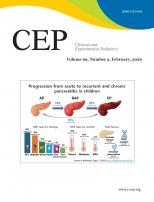



Graphical abstract. AP, acute pancreatitis; RAP, recurrent acute pancreatitis; CP, chronic pancreatitis; HTG, hypertrigliceridemia; OR, odds ratio; CI, confidence interval.
Introduction
Once considered rare, acute pancreatitis (AP) in children is now recognized with increasing frequency, with incidence rates approaching those seen in adults [1,2]. The incidence of childhood AP is in the range of 3–13 cases per 100,000 persons per year; on the other hand, the incidence of pediatric chronic pancreatitis (CP) is approximately 2 cases per 100,000 persons per year [3]. While most pediatric AP cases resolve without sequelae, a significant subset of patients experience progression to recurrent AP (RAP) and, subsequently, CP [2]. The natural history, risk factors, and outcomes of this progression remain incompletely understood, especially in the pediatric population, where etiologies and disease trajectories differ from those in adults [4,5].
Major risk factors for pancreatitis progression in adults such as alcohol use and smoking are rarely implicated in children [6]. Instead, pediatric AP and its recurrence are often associated with genetic predispositions (such as pathogenic variants in PRSS1, CFTR, or SPINK1) and structural or metabolic factors (e.g., pancreas divisum, biliary anomalies, hypertriglyceridemia) [6]. Given that the causes of pancreatitis in children diverge substantially from those in adults, applying adult data to pediatric cases may not be appropriate [6]. This underscores the need for pediatric-specific research on disease course and risk factors.
RAP and CP in children are associated with substantial morbidity, including chronic pain [7], exocrine and endocrine insufficiency, and impaired quality of life [8]. Identifying children at risk for progression, understanding the timing and mechanisms of disease evolution, and recognizing modifiable and nonmodifiable risk factors are critical for optimizing management and improving long-term outcomes [2,5,9]. This meta-analysis aimed to synthesize current evidence on the rate of progression from acute to recurrent and CP in children, and to identify key risk factors associated with this progression.
Methods
We conducted our systematic review and meta-analysis in accordance with the PRISMA (Preferred Reporting Items for Systematic Reviews and Meta-analyses) 2020 guidelines (Supplementary Table 1) [10]. The study protocol was prospectively registered in the International Prospective Register of Systematic Reviews (PROSPERO, CRD420 251086520), and all analyses were carried out in full compliance with the registered protocol.
1. Eligibility criteria
We included studies based on predefined criteria structured using the CoCoPop [11] (Condition, Context, Population) and PECO [12] (Population, Exposure, Comparator, Outcome) frameworks to address both progression rates and associated risk factors. Eligible studies included pediatric patients (under 18 years) diagnosed with AP, RAP, or CP. We included studies (prospective or retrospective observational studies, case series) that either reported the rate of progression from AP to RAP, AP to CP, or RAP to CP over time, or presented comparative data between disease groups relevant to potential risk factors for progression (e.g., age, sex, etiology, severity). Studies were excluded if they focused solely on adult populations, lacked extractable data for either outcome, or were published as case reports, reviews, editorials, in vitro and animal studies or abstracts .
To ensure methodological consistency, diagnostic definitions were recorded as reported in the original studies. Among the 68 included studies, 76% used the International Study Group of Pediatric Pancreatitis: In Search for a Cure (INSPPIRE) [13] criteria for pediatric pancreatitis, while 24% employed alternative frameworks, including other institutional criteria, ICD (International Classification of Diseases)-based definitions, or combinations thereof. According to INSPPIRE definitions, AP was diagnosed when ≥2 of the following were present: (1) abdominal pain compatible with AP; (2) serum amylase and/or lipase ≥3× the upper limit of normal; (3) imaging findings consistent with AP. RAP was defined as ≥2 distinct episodes with complete resolution of pain (≥1-month interval) or enzyme normalization between episodes [13]. CP was defined as ≥1 of: typical pain plus characteristic imaging, exocrine insufficiency plus imaging findings, or endocrine insufficiency plus imaging findings [13]. Disease severity was classified according to the 2012 Revised Atlanta Classification (mild: no organ failure or complications; moderate: transient organ failure <48 hours or local complications; severe: persistent organ failure >48 hours) [14].
Additionally no minimum follow-up duration was applied as an exclusion criterion; studies were included regardless of follow-up length to ensure comprehensive coverage of the available evidence.
2. Information sources and search strategy
We conducted a systematic search of 3 major medical databases, PubMed/MEDLINE, the Cochrane Library (CENTRAL), and Embase on December 21, 2024. The search was limited to studies published from 1992 onward and used the following search terms: acute AND (chronic OR recurrent) AND pancreatitis. To ensure methodological rigor, we followed the Cochrane Handbook guidelines for both study selection and data extraction [15]. Although the INSPPIRE [13] criteria are most commonly used in pediatric populations, they were established in 2012 and are diagnostically based on the original Atlanta Classification introduced in 1992 [16]. As the core diagnostic framework for AP (the 2-out-of-3 rule) was first formalized in the 1992 Atlanta criteria, we limited our search to studies published from January 1, 1992 onward to ensure consistency with standardized diagnostic definitions across studies.
3. Study selection and data extraction
All references were managed using EndNote 21 (Clarivate Analytics, USA), and duplicates were removed before screening. Two independent reviewers (EBG and ET) screened studies in 2 stages, first by title and abstract, then by full text. Disagreements at either stage were resolved through discussion with a third reviewer (MO). Cohen Kappa coefficient [17] was calculated after each screening phase to assess interrater agreement. Data were independently extracted by the same 2 reviewers (EBG and ET), with discrepancies resolved by the third reviewer (MO). Extracted information included first author, year of publication, geographic location, study period, study design, number of centers involved, sample size, age distribution, percentage of male participants, follow-up duration, and the proportion of patients progressing to RAP and CP, including breakdowns by etiology and disease severity. In addition, we extracted group-level comparative data (e.g., comorbidities, laboratory parameters, clinical features) for AP, RAP, and CP subgroups when such comparisons were available in at least 3 studies for a given parameter.
Where multiple studies reported data on potentially overlapping populations, we included only the study with the largest sample size. In cases of missing or unclear data, study authors were contacted for clarification.
4. Risk of bias
Two independent authors (EBG and ET) assessed the methodological quality of the included studies using the Joanna Briggs Institute Prevalence Critical Appraisal Tool (JBI) [18] and the Quality In Prognostic Studies (QUIPS) tool [19], depending on the study type. The JBI tool was applied to studies that reported the progression of the disease, such as recurrence rates or progression rates to CP. In contrast, the QUIPS tool was used for studies that compared diagnostic groups (e.g., AP vs. RAP vs. CP) based on various clinical, demographic, or laboratory parameters. A third author (MO) resolved any disagreements that arose.
5. Data synthesis
All statistical analyses were performed using R v4.2.1 (R Foundation, Austria) [20], utilizing the meta [21] and dmetar22) packages. To account for anticipated between-study variability, a random-effects model was employed for all meta-analyses. Heterogeneity was quantified using the I² statistic described by Higgins and Thompson [23], and prediction intervals (PI) were reported when appropriate, following the recommendations of Inthout et al. [24] For proportion outcomes, the number of patients experiencing the event and the total sample size were extracted from each study, and pooled proportions with 95% confidence intervals (CI) were computed. For dichotomous comparisons, odds ratios (ORs) with 95% CIs were calculated by extracting event counts and group sizes for each comparator group. For continuous outcomes, the mean difference was used as the effect size, with the corresponding sample size, mean, and standard deviation collected from each study.
Forest plots were used to visually summarize the pooled results for outcomes reported in at least 3 studies. Funnel plots and Peter tests were used to assess publication bias, but only for outcomes with a minimum of 10 studies [25]. Additionally, leave-one-out sensitivity analyses were conducted to examine the influence of individual studies on overall estimates and heterogeneity. A 2-sided P value less than 0.05 considered significant.
Results
1. Search and selection
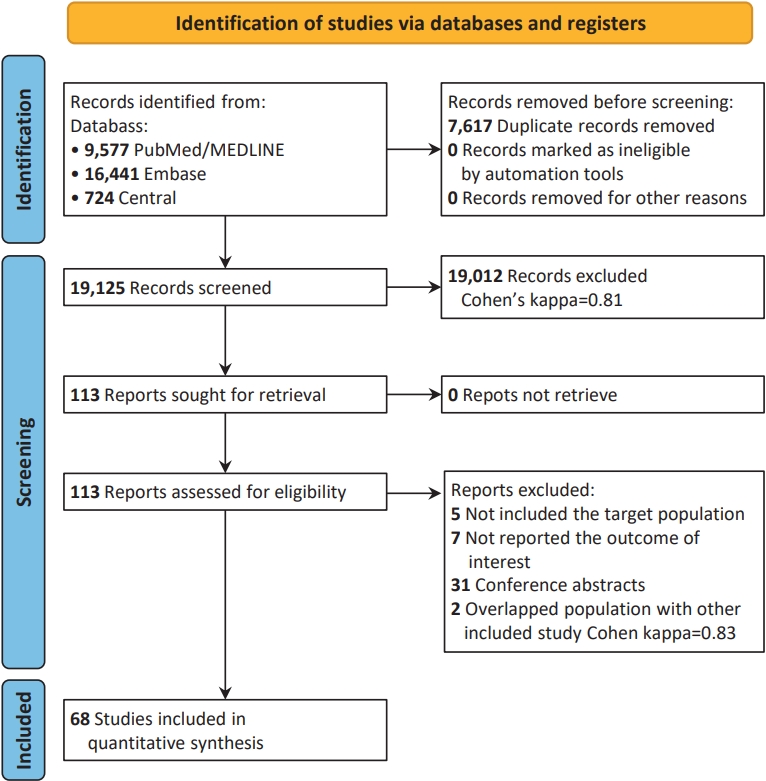
We identified 19,125 records through our systematic search. After screening titles, abstracts, and full texts, we included 68 studies in both the qualitative and quantitative syntheses. The selection process is shown in Fig. 1.
2. Basic characteristics of included studies
The full review identified 68 studies, 44 [2,5,9,26-65] (Table 1) focusing on the progression of AP to RAP or CP, and 24 (Supplementary Table 2) comparing AP, RAP, and CP patient goups.
Of the 44 studies focusing on the progression of AP, 38 were retrospective and 6 were prospective, while 40 were single-center and 4 were multicenter. These studies enrolled patients between 1979 and 2022, were published between 1996 and 2024, and provided data on a total of 4,104 pediatric cases to our quantitative synthesis. Twenty-four studies were conducted in Asia (55%), primarily in China and India, 10 in Europe (23%), 6 in North America (14%), and 4 in the Middle East (9%), with none originating from South America or Africa. Sample sizes ranged from 11 to 371 participants; 29 cohorts enrolled fewer than 100 children, while 15 included 100 or more. Sex distribution was available in 41 cohorts, and boys predominated in 30 of them. Disease severity was reported in 12 cohorts, of which severe AP ocurred in approximately 11% of index attacks.
3. AP progression rates based on etiology and severity
Using only articles with the INSPPIRE diagnostic criteria, RAP developed in 21% of children after initial AP (95% CI, 17%–24%; 95% prediction interval [PI], 9%–41%; I²=78%, τ²=0.22; k=27 studies, N=2,837 patients). When including all studies regardless of diagnostic criteria, the overall estimate was 18% (95% CI, 16%–22%; 95% PI, 7%–41%; I²=76%, τ²=0.30; k=39 studies, N=3,587 patients). Direct progression from AP to CP occurred in 10% (95% CI, 6%–16%; 95% PI, 3%–28%; I²=67%, τ²=0.12; k=5 studies, N=727 patients). Among RAP patients, 35% (95% CI, 24%–49%; 95% PI, 12%–69%; I²=78%, τ²=0.24; k=7 studies, N=548 patients) developed CP.
Etiology specific progression rates to RAP varied significantly (χ2=25.74, degrees of freedom=5, P<0.001 for subgroup differences), with hypertriglyceridemia-associated AP showing the highest rate of recurrence (33%; 95% CI, 6%–79%; 95% PI, 0%–99%; I²=0%, τ²=0; k=3 studies, N=21 patients), followed by idiopathic (28%; 95% CI, 18%–39%; 95% PI, 9%–61%; I²=68%, τ²=0.28; k=8 studies, N=344 patients) and biliary (19%; 95% CI, 11%–32%; 95% PI, 6%–50%; I²=54%, τ²=0.23; k=7 studies, N=283 patients) etiologies. Trauma-, drug- and virus-induced AP had lower progression rates (16%; 95% CI, 6%–36%; 95% PI, 5%–40%; I²=0%, τ²=0; k=5 studies, N=49 patients), (14%; 95% CI, 5%–34%; 95% PI, 3%–46%; I²=0%, τ²=0.16; k=6 studies, N=78 patients), and (3%; 95% CI, 1%–12%; 95% PI, 0%–20%; I²=18%, τ²=0; k=4 studies, N=149 patients), respectively) (Fig. 2; Supplementary Fig. 1). Disease severity showed a trend toward higher recurrence rates, although subgroup differences were not statistically significant (χ²=2.60, degrees of freedom [df]=2, P=0.272). Severe AP progressed to RAP in 39% (95% CI, 15%–71%; 95% PI, 2%–95%; I²=76%, τ²=1.35; k=7 studies, N=85 patients), compared with 24% for moderate cases (95% CI, 17%–32%; 95% PI, 17%–33%; I²=0%, τ²=0; k=6 studies, N=206 patients) and 21% for mild cases (95% CI, 13%–31%; 95% PI, 7%–47%; I²=67%, τ²=0.15; k=6 studies, N=387 patients) (Fig. 2; Supplementary Fig. 1).
4. Factors associated with disease progression
1) Patient characteristics and nonmodifiable factors
Anatomical abnormalities showed significant associations, with general structural anomalies associated with RAP (OR, 3.15; 95% CI, 1.51%–6.56; 95% PI, 1.26–7.87; I²=0%, τ²=0; k=5 studies, N=575 patients) (Fig. 3; Supplementary Fig. 2) and pancreas divisum to CP (OR, 2.64; 95% CI, 1.51–4.63; 95% PI, 1.16–6.02; I²=17%, τ²=0.05; k=7 studies, N=977 patients) (Fig. 4; Supplementary Fig. 2). Genetic mutations in PRSS1 were strongly associated with CP development (OR, 4.56; 95% CI, 3.06–6.80; 95% PI, 2.76–7.54; I²=0%, τ²=0; k=7 studies, N=1,068 patients) (Fig. 4; Supplementary Fig. 2). In contrast, male sex, race (white or Hispanic), and family history of AP demonstrated no significant associations with progression to RAP or CP (Figs. 3 and 4 Supplementary Figs. 3 and 4).
Age at study inclusion did not differ significantly between AP and RAP or between CP and RAP. Clinical parameters, including length of stay, amylase, lipase, white blood cell count, and C-reactive protein (CRP) levels, showed no significant differences between the AP and RAP groups (Fig. 5; Supplementary Figs. 3 and 5). Other genetic variants (SPINK1, CFTR, and CTRC), broader genetic AP categorization, and anatomical features (choledochal cysts, annular pancreas, and maljunction) lacked statistical significance (Figs. 3 and 4; Supplementary Fig. 4).
2) Clinical and procedural factors
Medication-related AP was associated with a reduced risk of CP (OR, 0.26; 95% CI, 0.07–0.91; 95% PI, 0–14.09; I²=0%, τ²=0; k=3 studies, N=827 patients). Exocrine pancreatic insufficiency (EPI) exhibited a robust association with CP (OR, 22.82; 95% CI, 9.26–56.25; 95% PI, 1.52–341.69; I²=0%, τ²=0; k=4 studies, N=152 patients). Interventional procedures significantly associated with CP included biliary sphincterotomy (OR, 4.16; 95% CI, 3.24–5.34; 95% PI, 0.32–54.36; I²=0%, τ²=0; k=3 studies, N=956 patients), biliary stenting (OR, 5.79; 95% CI, 4.42–7.60; 95% PI, 0.04–769.49; I²=0%, τ²=0; k=3 studies, N=958 patients), and pancreatic duct stenting (OR, 12.19; 95% CI, 3.16–46.97; 95% PI, 0.02–6822.01; I²=56%, τ²=0.15; k=3 studies, N=957 patients) (Fig. 4; Supplementary Fig. 2). Conversely, autoimmune AP and metabolic AP showed no significant associations with RAP or CP (Figs, 3 and 4; and Supplementary Fig. 5). Diabetes mellitus was not associated with RAP, but showed a nonsignificant trend toward an increased risk of CP (OR, 3.77; 95% CI, 0.98–14.45; 95% PI, 0.12–120.85; I²=0%, τ²=0; k=4 studies, N=169 patients) (Figs. 3 and 4; Supplementary Figs. 2, 4, and 6). The presence of systemic lupus erythematosus in AP patients was not associated with an increased risk of RAP. Clinical complications, including pseudocysts, necrotizing AP, abdominal pain, intensive care unit admission, gastrointestinal symptoms (vomiting, diarrhea), obstructive factors, fever, fluid collections, acute peripancreatic fluid collections, and acute necrotic collections, were not predictive of disease progression (Figs, 3 and 4; Supplementary Figs. 6 and 7).
5. Risk of bias assessment
We assessed study quality using the JBI tool for studies reporting the progression of AP and the QUIPS tool for comparison studies. Most studies had a moderate risk of bias, primarily due to small sample size in studies reporting the progression of AP and uncontrolled confounding in comparative studies. These limitations should be taken into account when interpreting our results. Detailed risk of bias assessments can be found in Supplementary Tables 3 and 4.
6. Publication bias and heterogeneity
We examined heterogeneity only for the overall recurrence rate from AP to RAP, as this was the only outcome with sufficient studies (≥10) for meaningful analysis. Several approaches were employed. First leave-one-out analysis was conducted but only marginally reduced the substantial heterogeneity observed (Supplementary Fig. 8). Next, to address diagnostic heterogeneity, we performed sensitivity analyses stratifying studies by diagnostic framework (INSPPIRE vs. non-INSPPIRE) (Supplementary Fig. 9). We also compared studies with reported versus unreported follow-up duration (Supplementary Fig. 9), conducted a subgroup analysis stratified by follow-up length (<12 months, 12–36 months, and >36 months; Supplementary Fig. 10), and performed a meta-regression restricted to studies with documented follow-up to examine whether follow-up length was associated with RAP progression (Supplementary Fig. 11). Progression rates differed significantly by diagnostic framework (P=0.019), whereas follow-up reporting status had no significant impact (P=0.161), and subgroup analysis (χ²=2.29, df=2, P=0.319) with meta-regression confirmed no association between follow-up duration and progression rates (P=0.976) (Supplementary Figs. 9-11). When examining technical factors potentially contributing to heterogeneity, we found that smaller studies (sample size <100) reported significantly higher RAP rates compared to larger studies (21% vs 18%, χ²=3.91, df=1, P=0.048). Similarly, shorter study periods (<7 years) were associated with higher RAP proportions than longer studies (22% vs 16%, χ²=3.98, df=21, P=0.046) (Supplementary Fig. 12). Other factors, including study design, geographical region, single- vs multicenter setting, and gender distribution, did not significantly influence heterogeneity (Supplementary Fig. 13).
For publication bias assessment, both visual inspection of the funnel plot and Peter test (P>0.305) indicated no significant publication bias for the AP→RAP progression outcome specifically (Supplementary Fig. 14). Publication bias assessment was limited to this outcome due to insufficient studies (≥10) for other progression pathways.
Discussion
Our meta-analysis provides a comprehensive overview of the rate and risk factors for progression from AP to RAP and CP in the pediatric population. It is the first meta-analysis to specifically address this topic in children.
Our findings reveal a substantial risk of recurrence and chronicity in pediatric pancreatitis, with approximately one-fifth of children experiencing recurrence, one-tenth progressing to CP after an initial acute episode, and a 35% (CI, 24–49) transition rate from RAP to CP. This recurrence rate is comparable to that seen in adult populations, where recurrence rates of 20%–21% [66,67] have been reported; however, the rate of progression to CP is slightly higher compared to the 8% (AP→CP) and 24% (RAP→CP) observed in the adult population [68]. Our analysis found no significant association between follow-up duration and AP→RAP progression across multiple approaches (P=0.161 for reporting status, P=0.319 for subgroup analysis, P=0.976 for meta-regression). This suggests that most progression occurs within the first 1–2 years after initial presentation, consistent with clinical observations that children at risk typically experience recurrence early in their disease course [4,5,64].
Hypertriglyceridemia-associated pancreatitis showed the highest recurrence rate (33%; CI, 6–79), but this should be interpreted cautiously due to small number of studies, small sample size (k=3 studies, N=21 patients) and wide uncertainty (95% PI, 0%–99%). This finding is consistent with its known tendency to cause more severe inflammation through free fatty acid-mediated acinar cell injury and sustained metabolic derangement [69]. Idiopathic pancreatitis demonstrated the second-highest recurrence rate (28%; CI, 18–39). This underscores the importance of comprehensive evaluation, including genetic testing and advanced imaging such as endoscopic ultrasound and magnetic resonance cholangiopancreatography, in seemingly idiopathic cases [70]. A recent study reported that positive findings on endoscopic ultrasound were associated with a reduced incidence of recurrent idiopathic AP over a 1-year follow-up period [71]. Biliary pancreatitis, the third most common cause, was associated with a 19% (CI, 11–32) risk of recurrence. This moderate rate likely reflects the effectiveness of definitive treatment, such as cholecystectomy for gallstones [72]. However, recurrence remains a possibility, potentially due to retained common bile duct stones, microlithiasis, or underlying sphincter of Oddi dysfunction, highlighting the need for continued vigilance even after the primary biliary cause has been addressed [72]. In contrast, etiologies representing a singular, often self-limited insult to the pancreas, such as trauma (16%; CI, 6–36), drug-induced (14%; CI, 5–34), and virus-induced AP (3%; CI, 1–12), were associated with the lowest risks of recurrence, aligning with clinical expectations. Similarly, medication-related (not drug-induced) AP was associated with a lower risk of CP (OR, 0.26; CI, 0.07–0.91), further strengthening that singular, self-limiting insults have smaller effects on the progression of AP compared to permanent risk factors.
Severe AP was associated with a nearly doubled risk of progression to RAP (39%; CI, 15%–71%) compared to mild cases (21%; CI, 13%–31%), however the severe AP estimate should be interpreted with caution due to the small sample size (N=85) and the wide prediction interval (95% PI, 2%–95%). This likely reflects the extent of necrosis-driven fibrosis, as severe episodes trigger robust inflammatory cascades and the activation of pancreatic stellate cells [73]. Histopathological studies confirm that severe AP induces collagen deposition and ductal distortion, creating a profibrotic microenvironment [73]. These findings underscore the importance of aggressive initial management to mitigate long-term sequelae.
PRSS1 mutations were strongly associated with CP (OR, 4.56; CI, 3.06–6.80), highlighting the role of genetic predisposition in CP inflammation. PRSS1 mutations cause aberrant trypsinogen activation, leading to sustained pancreatic inflammation and fibrosis [74]. This finding aligns with research from the INSPPIRE consortium and the Chinese cohort reported by Zeng et al., which demonstrated a 3.48-fold increased risk of developing CP in children with gene mutations [9,75]. This underscores the importance of genetic screening, particularly in recurrent cases, to identify children who may benefit from genetic counseling and potentially preventive strategies such as lifestyle modifications and closer clinical surveillance. Interestingly, mutations in SPINK1, CFTR, and CTRC, which have been previously implicated in pancreatitis susceptibility, did not reach statistical significance in our analysis. This nonsignificance may reflect limited sample sizes or heterogeneous genetic backgrounds across studies and warrants further large-scale genetic epidemiological studies in pediatric populations.
Our analysis also showed that anatomical anomalies substantially influence the risk of progression. Structural anomalies in general (OR, 3.15; CI, 1.51–6.56) and pancreas divisum specifically (OR, 2.64; CI, 1.51–4.63) were associated with a significantly increased risk of RAP and CP, respectively. Pancreas divisum, previously debated as a pathogenic factor, is now increasingly recognized in pediatric pancreatitis, supporting recommendations for routine evaluation of anatomical abnormalities in children presenting with pancreatitis [76].
The nonsignificant findings for demographic factors (male sex, race) and common clinical parameters (e.g., amylase, lipase, white blood cell count, and CRP) suggest that these variables might have limited utility as isolated predictive markers for progression. Similarly, clinical complications such as pseudocysts or necrotizing pancreatitis were not predictive, challenging the clinical assumption that early complication severity consistently predicts long-term outcomes. This may reflect effective acute-phase management, preventing long-term sequelae, or indicate the need for larger studies to clarify these associations.
Our analysis revealed strong associations between CP and both EPI (OR, 22.82; CI, 9.26–56.25) and interventional procedures such as biliary sphincterotomy (OR, 4.16; CI, 3.24–5.34), biliary stenting (OR, 5.79; CI, 4.42–7.60), and pancreatic duct stenting (OR, 12.19; CI, 3.16–46.97). These associations reflect advanced disease rather than causal relationships. EPI occurs only after extensive (>90%) loss of pancreatic acinar tissue, making it a late consequence of CP rather than a predictive risk factor [77]. Similarly, endoscopic interventions are typically performed in patients with more severe or complicated pancreatitis, representing therapeutic responses to advanced disease rather than risk factors for progression [78], Temporal analysis was limited as the studies did not specify whether procedures preceded or followed CP diagnosis. Emerging evidence suggests that timely endoscopic intervention in select cases, such as symptomatic pancreas divisum, might modify disease progression, although randomized controlled trials are lacking [76].
1. Strengths and limitations
A major strength of this meta-analysis is its comprehensive scope. To our knowledge, this is the first study to systematically synthesize the rates and risk factors for progression from acute to recurrent and CP in the pediatric population. The inclusion of 68 studies, spanning diverse geographic regions and healthcare settings, enhances the generalizability of our findings. We employed a rigorous methodology, including a prospectively registered protocol, and robust risk of bias assessment using validated tools (JBI and QUIPS). The use of subgroup and sensitivity analyses enabled us to account for between-study heterogeneity and explore the impact of etiology, severity, and study design on progression rates. Despite these strengths, several limitations should be considered. First, since adjusted estimates were not available, all risk factor analyses were based on raw data extracted from the included studies and therefore represent unadjusted ORs. Most included studies were retrospective and single-center, with a moderate risk of bias, often due to small sample sizes or incomplete control for confounding variables. Heterogeneity among the included studies was considerable, driven in part by differences in sample size, study period, and diagnostic definitions of AP. However, regarding disease progression, variability in diagnostic criteria affected only the overall recurrence rate estimates, as all studies examining other progression pathways (AP→CP, RAP→CP) and subgroup analyses (etiology, severity) were based exclusively on INSPPIRE definitions. Although we performed subgroup analyses and leave-one-out sensitivity analyses, residual heterogeneity remains a limitation. Finally, the observational nature of the included studies precludes definitive conclusions on causality for most risk factors.
2. Clinical and research implications
The substantial risk of recurrence and progression to CP after an initial AP episode in children underscores the need for close follow-up and early risk stratification. Moreover, the identified rates and risk factors enable patient risk stratification, offering an implication that can be applied immediately at the bedside [79,80]. Clinicians should maintain a high index of suspicion for RAP and CP, particularly in children with hypertriglyceridemia, idiopathic etiology, or severe initial episodes. The strong associations identified between PRSS1 mutations and CP, as well as between anatomical abnormalities and both RAP and CP, support the routine use of genetic testing and cross-sectional imaging in children with unexplained or recurrent pancreatitis. Early identification of patients at risk may enable targeted interventions, genetic counseling, and more personalized surveillance strategies. Our study highlights the need for long-term, multicenter cohort studies to chart the natural history of pediatric pancreatitis. It emphasizes the urgency of randomized trials testing early, targeted interventions in high-risk children to modify disease progression.
In conclusion, this meta-analysis demonstrates that approximately 1 in 5 children with AP will experience recurrence, and more than one-third of those with RAP will progress to CP. Recurrence is most common after hypertriglyceridemic, idiopathic or severe index attacks, while progression is further promoted by structural anomalies and genetic mutations.


 PDF Links
 PubReader
 ePub Link
 XML Download
 PubMed
 Download Citation