
Search

  • HOME
  • Search
Original Article
Cardiology
Influence of atrial septal defect on mitral valve growth after repair of coarctation of the aorta or an interrupted aortic arch in infants
Yi-Chia Wang, Heng-Wen Chou, Chi-Hsiang Huang, Hsing-Hao Huang, Yih-Sharng Chen, En-Ting Wu, Shyh-Jye Chen, Ming-Tai Lin, Shuenn-Nan Chiu, Shu-Chien Huang
Clin Exp Pediatr. 2026;69(4):322-329.   Published online January 13, 2026
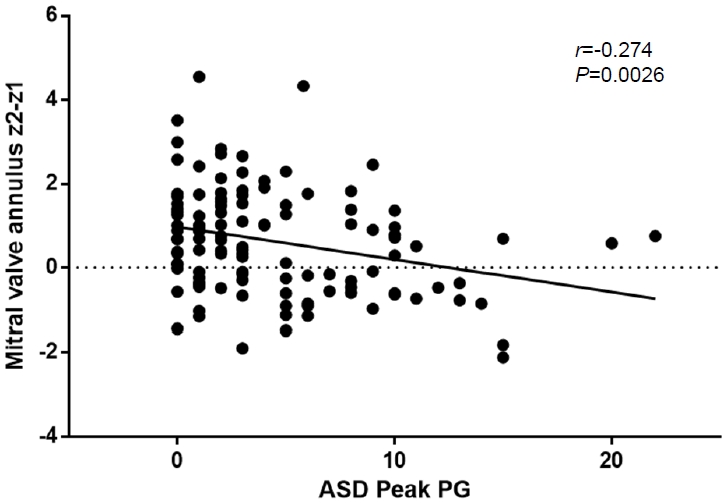
Question: Does atrial septal defect (ASD) physiology affect postrepair mitral valve growth in patients with coarctation of the aorta or an interrupted aortic arch?
Finding: Mitral valve growth occurred after biventricular repair but not single-ventricle palliation, particularly in patients with small valves and low ASD pressure gradients.
Meaning: The ASD pressure gradient determines mitral valve growth and should guide surgical strategies in patients with borderline hypoplastic left heart syndrome.
Case Report
A False Diagnosis of Hypoplastic Left Heart Syndrome in a Fetus
Youn Jeong Shin, Sung Hee Jang, Jung Yun Choi, Eun Sook Han
Clin Exp Pediatr. 2002;45(2):267-272.   Published online February 15, 2002
Typical hypoplastic left heart syndrome(HLHS) is a distinct pathologic entity with aortic atresia, mitral atresia, very hypoplastic or absent left ventricle and thread like ascending aorta. Occasionally, the lesser degree of hypoplasia is found and is called hypoplastic left heart complex(HLHC) by some authors. This HLHC is often associated with critical aortic stenosis. Fetal echocardiography has enabled us to observe...
Original Article
Hypoplastic Left Heart Syndrome : Report of a Unique Survivor.
Hang Bo Cho, Seong Ho Kim, Ha Baik Lee, Kyu Hwang Rhee, Chong Moo Park
Clin Exp Pediatr. 1988;31(6):790-795.   Published online June 30, 1988
Hypoplastic left heart syndrome is a rare, and fatal congenital heart disease. Most of the patients with this syndrome die within the 1st month of life. Recently we experienced a hypoplastic left heart syndrome in a child who was unusually living without surgical intervention for 3 and half years. The unique clinical course might result from a number of favorable hemodynamic factors and intact...


TOPICS

Browse all articles >

ARTICLE CATEGORY

Browse all articles >

BROWSE ARTICLES
FOR CONTRIBUTORS
ABOUT
Editorial Office
Korean Pediatric Society
#1606 Seocho World Officetel, 19 Seoun-ro, Seocho-ku, Seoul 06732, Korea
Tel: +82-2-3473-7306    Fax: +82-2-3473-7307    E-mail: office@e-cep.org                

Clinical and Experimental Pediatrics is an open access journal. All articles are distributed under the terms of the Creative Commons Attribution NonCommercial License (http://creativecommons.org/licenses/by-nc/4.0/)

Copyright © 2026 by Korean Pediatric Society.      Developed in M2PI