
Search

  • HOME
  • Search
Original Article
Cardiology
Influence of atrial septal defect on mitral valve growth after repair of coarctation of the aorta or an interrupted aortic arch in infants
Yi-Chia Wang, Heng-Wen Chou, Chi-Hsiang Huang, Hsing-Hao Huang, Yih-Sharng Chen, En-Ting Wu, Shyh-Jye Chen, Ming-Tai Lin, Shuenn-Nan Chiu, Shu-Chien Huang
Clin Exp Pediatr. 2026;69(4):322-329.   Published online January 13, 2026
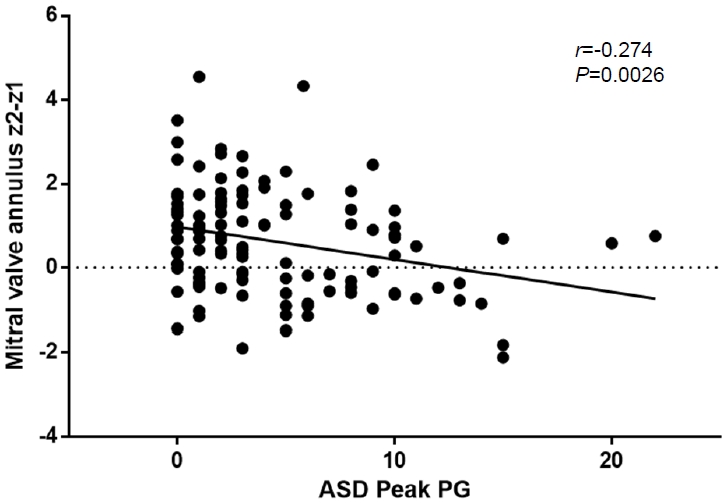
Question: Does atrial septal defect (ASD) physiology affect postrepair mitral valve growth in patients with coarctation of the aorta or an interrupted aortic arch?
Finding: Mitral valve growth occurred after biventricular repair but not single-ventricle palliation, particularly in patients with small valves and low ASD pressure gradients.
Meaning: The ASD pressure gradient determines mitral valve growth and should guide surgical strategies in patients with borderline hypoplastic left heart syndrome.
Infantile Marfan syndrome in a Korean tertiary referral center
Yeon Jeong Seo, Ko-Eun Lee, Gi Beom Kim, Bo Sang Kwon, Eun Jung Bae, Chung Il Noh
Clin Exp Pediatr. 2016;59(2):59-64.   Published online February 29, 2016
Purpose

Infantile Marfan syndrome (MFS) is a rare congenital inheritable connective tissue disorder with poor prognosis. This study aimed to evaluate the cardiovascular manifestations and overall prognosis of infantile MFS diagnosed in a tertiary referral center in Korea.

Methods

Eight patients diagnosed with infantile MFS between 2004 and 2014 were retrospectively evaluated.

Results

Their median age at the time of diagnosis was 2.5 months (range,...

Case Report
Pyridoxine responsive sideroblastic anemia in a boy with mitral valve prolapse
June Seung Sung, Ki Hwan Kim, Dong Gyun Han, Mi Jeong Kim, Young Kook Cho, Hae Yul Chung, Hee Jo Baek, Jae Sook Ma, Hoon Kook, Tai Ju Hwang
Clin Exp Pediatr. 2006;49(11):1223-1226.   Published online November 15, 2006
Sideroblastic anemia is a rare, heterogeneous group of disorders characterized by hyperferremia, microcytic hypochromic anemia, and bone marrow erythroid hyperplasia with the presence of numerous ringed sideroblasts. We describe herewith the case of a rare coincidence of sideroblastic anemia and mitral valve prolapse with resultant regurgitation in a 2-year-old boy. In addition to the inherent propensity for the development of...
Two Cases of Double-Orifice Mitral Valve Detected by Echocardiography
Kwan Cheol Oh, Yong Wook Kim, Ki Bok Kim
Clin Exp Pediatr. 1998;41(6):825-830.   Published online June 15, 1998
Double-orifice mitral valve is a rare congenital anomaly. Most cases of double-orifice mitral valve are hemodynamically normal and remain symptomless, so that it is usually discovered incidentally in autopsy or during surgical correction of a cardiovascular abnormality. Recently, however, it is increasingly recognized as such, since the echocardiography has gained wide acceptance as a non-invasive diagnostic tool by the M-mode, two-dimensional and color Doppler echocardiogram....
Original Article
Evaluation of Pulmonary Venous, Mitral and Aortic Flow Pattern by Doppler Echocardiography in Neonates
Hye Soon Kim, Young Mi Hong, Gyoung Hee Kim
Clin Exp Pediatr. 1994;37(5):596-605.   Published online May 15, 1994
Pulmonary vein velocities have recently been estimated in conjunction with mitral flow velocities to increase our understanding of ventricular filling. The advent of transesophageal echocardiography with pulsed doppler imaging capability has provided a method by which both the mitral valve and pulmonary vein velocities can be easily recorded because of the posterior approach providing unimpeded interrogation of cardiac structures. The purpose...
Tricuspid atresia associated with double orifice mitral valve and coronary sinus septal defect.
In Sook Park, Ki Soo Kim, Young Seo Park, Chang Yee Hong, Shi Joon Yoo, Meong Gun Song
Clin Exp Pediatr. 1991;34(8):1139-1145.   Published online August 31, 1991
Clinical, echocardiographic and angiographic findings of a very rare case of cardiac malformation is presented. The main features were tricuspid atresia, coronary sinus septal defect, and double orifice mitral valve. These defects were correctly diagnosed by echocardiography and were confirmed by angiocardiography. This patient was palliated successfully with blade balloon atrial septostomy and bidirectional cavopulmonary shunt. To the best of our knowledge, this is the...


TOPICS

Browse all articles >

ARTICLE CATEGORY

Browse all articles >

BROWSE ARTICLES
FOR CONTRIBUTORS
ABOUT
Editorial Office
Korean Pediatric Society
#1606 Seocho World Officetel, 19 Seoun-ro, Seocho-ku, Seoul 06732, Korea
Tel: +82-2-3473-7306    Fax: +82-2-3473-7307    E-mail: office@e-cep.org                

Clinical and Experimental Pediatrics is an open access journal. All articles are distributed under the terms of the Creative Commons Attribution NonCommercial License (http://creativecommons.org/licenses/by-nc/4.0/)

Copyright © 2026 by Korean Pediatric Society.      Developed in M2PI