
Search

  • HOME
  • Search
Original Article
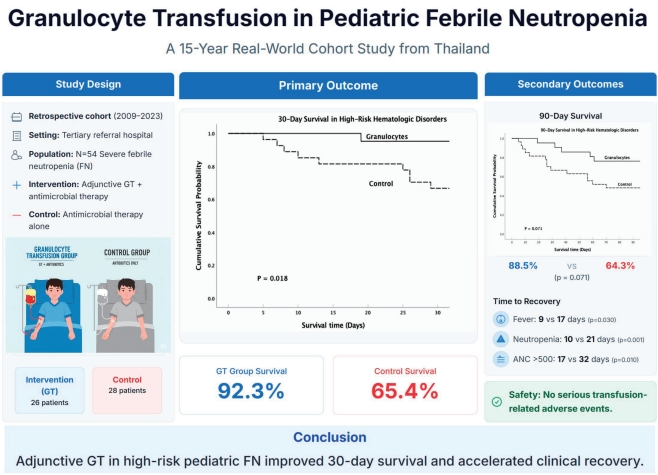
Granulocyte transfusion improves survival in pediatric febrile neutropenia: a 15-year cohort study
Witsanu Phetsai, Kleebsabai Sanpakit, Jassada Buaboonnam, Kamon Phuakpet, Nassawee Vathana, Nattee Narkbunnam, Fon Kladed, Chayamon Takpradit
Question: Does granulocyte transfusion improve survival and clinical recovery in pediatric febrile neutropenia?
Finding: In this 15-year real-world cohort, granulocyte transfusion significantly increased 30-day survival (92.3 % vs. 65.4%; adjusted odds ratio, 0.105; P=0.020) and accelerated fever and neutrophil recovery without serious adverse events.
Meaning: Granulocyte transfusion may be an effective adjunctive therapy for severe neutropenic infections in children, particularly in low- and middle-income settings.
DOI: https://doi.org/10.3345/cep.2025.01186    [Epub ahead of print]
Oncology
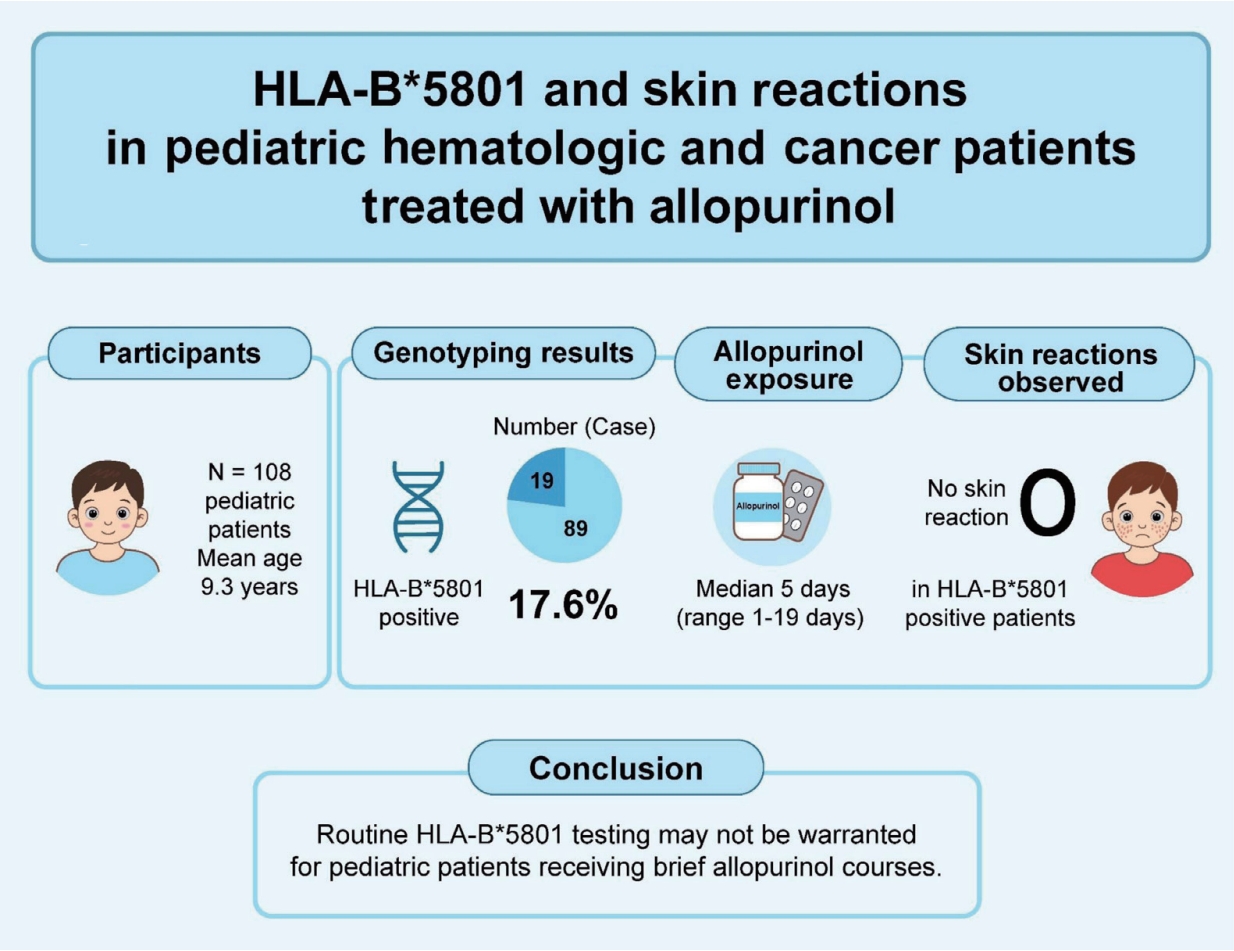
HLA‒B*58:01 and skin reactions in pediatric hematology and oncology patients treated with allopurinol
Parisa Maneechai, Cholada Ratanatharathron, Jassada Buaboonam, Kleebsabai Sanpakit
Clin Exp Pediatr. 2025;68(12):974-980.   Published online October 2, 2025
Question: Does human leukocyte antigen (HLA)–B*58:01 increase the risk of cutaneous reactions in pediatric patients with hematological and oncological diseases receiving allopurinol?
Finding: : Of 108 patients, 17.6% carried HLA–B*58:01 but none developed skin reactions. The only rash occurred in an HLA-B*58:01–negative patient.
Meaning: Short-duration allopurinol may mitigate severe cutaneous adverse reaction risk regardless of genotype. Routine HLA-B*58:01 screening may be unnecessary in pediatric patients with hematological and oncological diseases briefly receiving allopurinol.
Treatment outcomes of high-dose chemotherapy plus stem cell rescue in high-risk neuroblastoma patients in Thailand
Kunanya Suwannaying, Piti Techavichit, Patcharee Komvilaisak, Napat Laoaroon, Nattee Narkbunnam, Kleebsabai Sanpakit, Kanhatai Chiengthong, Thirachit Chotsampancharoen, Lalita Sathitsamitphong, Chalongpon Santong, Panya Seksarn, Suradej Hongeng, Surapon Wiangnon
Clin Exp Pediatr. 2022;65(9):453-458.   Published online May 24, 2022
Question: This study aimed to elucidate the outcomes of high-risk neuroblastoma (HR-NB) patients treated with high-dose chemotherapy and stem cell rescue without immunotherapy.
Finding: The 5-year overall survival and event-free survival rates were 45.1% and 40.4%, respectively.
Meaning: High-dose chemotherapy plus stem cell rescue followed by cis-retinoic acid for 12 months is well tolerated and could improve survival in patients with HR-NB in limited resource settings.


TOPICS

Browse all articles >

ARTICLE CATEGORY

Browse all articles >

BROWSE ARTICLES
FOR CONTRIBUTORS
ABOUT
Editorial Office
Korean Pediatric Society
#1606 Seocho World Officetel, 19 Seoun-ro, Seocho-ku, Seoul 06732, Korea
Tel: +82-2-3473-7306    Fax: +82-2-3473-7307    E-mail: office@e-cep.org                

Clinical and Experimental Pediatrics is an open access journal. All articles are distributed under the terms of the Creative Commons Attribution NonCommercial License (http://creativecommons.org/licenses/by-nc/4.0/)

Copyright © 2026 by Korean Pediatric Society.      Developed in M2PI