
Search

  • HOME
  • Search
Guideline
Oncology
Evidence-based clinical practice guidelines for pediatric hepatoblastoma: a systematic review and expert recommendations from Korea
Jin Kyung Suh, Jisun Hwang, Hee Mang Yoon, Kyong Ihn, Jung-Man Namgoong, Jeong A. Park, Jung-Sun Kim, Hyoung Soo Choi, Sung Hye Park, Dong Ah Park, Kyung-Nam Koh
Clin Exp Pediatr. 2026;69(11):912-924.   Published online October 23, 2026
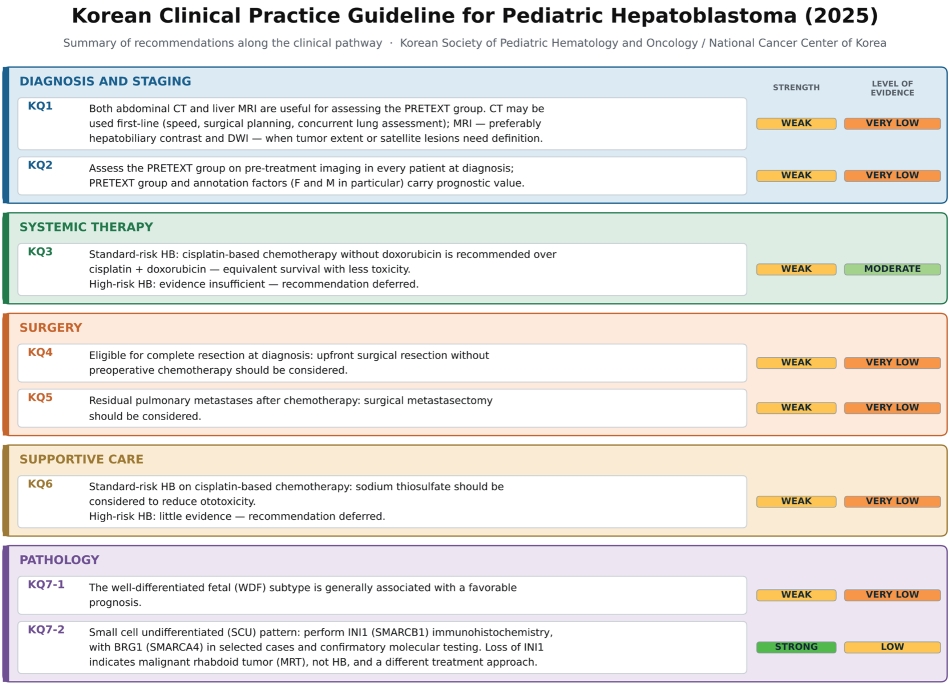
This is the first Korean evidence-based clinical practice guideline for pediatric hepatoblastoma. Key recommendations include computed tomography and magnetic resonance imaging for PRETEXT (PRE-Treatment EXTent of disease) staging, cisplatin monotherapy for standard-risk disease, upfront surgery for resectable tumors, metastasectomy for residual lung lesions, and sodium thiosulfate for otoprotection. Well-differentiated fetal histology carries a favorable prognosis, whereas the small cell undifferentiated pattern requires immunohistochemical and molecular testing to exclude malignant rhabdoid tumor.
Case Report
A case of recurrent hepatoblastoma : lung, heart and brain metastasis
Sun Mi Park, Byung Kyu Choe, Yeo Hyang Kim, Heung Sik Kim, Tae Chan Kwon, Hee Jung Lee
Clin Exp Pediatr. 2006;49(6):691-695.   Published online June 15, 2006
Hepatoblastoma is a hepatic tumor predominantly occurring in children. The usual site of metastasis is the lung. There are only several reports worldwide on the distant metastasis of hepatoblastoma to the central nervous system in children. Only one reported case showed survival of a patient after multiple resections of a recurrent brain lesion. Involvement of the cardiovascular system has been...
Original Article
Effectiveness of Preoperative Transcatheter Arterial Chemoembolization in Hepatoblastoma
Pyoung Han Hwang, Dae Sun Jo, Dae Yeol Lee, Jung Soo Kim
Clin Exp Pediatr. 2000;43(8):1098-1105.   Published online August 15, 2000
Purpose : To evaluate the effectiveness of transcatheter arterial chemoembolization(TACE) as a preoperative treatment for initially unresectable hepatoblastomas. Methods : From January 1995 to July 1999, we identified two boys and three girls(age range : 5- 27 months; mean age : 12 months) with pathologically-confirmed hepatoblastoma. To assess response to treatment, we utilized an identical TACE procedure for all the patients....
Case Report
A Case of Hepatoblastoma with Precocious Puberty
Chang Won Choi, Hyun Jin Park, Ki Woong Sung, Eun Sun Yoo, Hee Young Shin, Sei Won Yang, Hyo Seop Ahn
Clin Exp Pediatr. 2000;43(2):288-293.   Published online February 15, 2000
Hepatoblastoma is the most common primary malignant liver tumor in childhood. Most cases are boys generally below three years of age. Hepatoblastoma are associated with various non-metastatic syndromes. Rarely, human chorionic gonadotropin may be produced by the tumor. Ectopic gonadotropin production from this source is a rare cause of precocious puberty in boys. Since a report by Behrendt in 1931,...
Original Article
Results of Chemotherapy of Hepatoblastoma and Hepatocellular Carcinoma in Children
Kyung Duk Park, Gi Woong Seong, Jae Kyung Lee, Hong Hoe Koo, Hee Young Shin, Hyo Seop Ahn
Clin Exp Pediatr. 1995;38(2):195-206.   Published online February 15, 1995
Purpose : Surgical excision has been the primary treatment for hepatoblastoma and hepatocellular carcinoma. However, at presentation, only one third of such tumors are surgically resectable. Without operation, the disease is fatal. Therefore, neoadjuvant chemotherapy has been introduced for conversion of the unresectable tumors into the resectable ones. We studied th e effects of chemotherapy for hepatic malignancy in children. Methods...
A Case of the Hepatoblastoma with Precocious Puberty.
In Young Park, Byung Jun Lee, Byung Churl Lee
Clin Exp Pediatr. 1989;32(5):735-740.   Published online May 31, 1989
Hepatoblastoma is a rare neoplasm in childhood. Hepatoblastoma associated with precocious puberty caused by human chorionic agonadotropin (HCG) secreted by the tumor itself, is very rare. We experiened a case of hepatoblastoma with precocious puberty in a 28-month-old boy, who was admitted because of abdominal pain, enlarged testis & penis, pubic hair and a deep voice. Diagnosis was made by typical Clinical manifestation, elevated...


TOPICS

Browse all articles >

ARTICLE CATEGORY

Browse all articles >

BROWSE ARTICLES
FOR CONTRIBUTORS
ABOUT
Editorial Office
Korean Pediatric Society
#1606 Seocho World Officetel, 19 Seoun-ro, Seocho-ku, Seoul 06732, Korea
Tel: +82-2-3473-7306    Fax: +82-2-3473-7307    E-mail: office@e-cep.org                

Clinical and Experimental Pediatrics is an open access journal. All articles are distributed under the terms of the Creative Commons Attribution NonCommercial License (http://creativecommons.org/licenses/by-nc/4.0/)

Copyright © 2026 by Korean Pediatric Society.      Developed in M2PI