
- Review Article
- Allergy
- IgE-mediated food allergies in children: prevalence, triggers, and management
- Sooyoung Lee
- Clin Exp Pediatr. 2017;60(4):99-105. Published online April 25, 2017
-
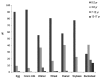
Food allergy (FA) is a serious health problem, and severe FA such as food-induced anaphylaxis can often be life threatening. The incidence of FA has been increasing especially in children. They usually develop early in life and affect up to 10% of children. The 2 most common food allergens worldwide are milk and eggs, while the third one varies depending...
- Rhinovirus and childhood asthma: an update
- Dae Jin Song
- Clin Exp Pediatr. 2016;59(11):432-439. Published online November 18, 2016
-
Asthma is recognized as a complex disease resulting from interactions between multiple genetic and environmental factors. Accumulating evidence suggests that respiratory viral infections in early life constitute a major environmental risk factor for the development of childhood asthma. Respiratory viral infections have also been recognized as the most common cause of asthma exacerbation. The advent of molecular diagnostics to detect...
- Original Article
- Allergy
- Clinical and laboratory findings of childhood buckwheat allergy in a single tertiary hospital
- Kyujung Park, Kyunguk Jeong, Sooyoung Lee
- Clin Exp Pediatr. 2016;59(10):402-407. Published online October 17, 2016
-
Purpose Buckwheat allergy is one of the most severe types of food allergy in some countries, especially among children. However, few studies have investigated this condition. The aim of this study was to report the clinical and laboratory findings in Korean children with buckwheat allergy.
Methods Thirty-seven subjects, aged 1 to 14 years, were enrolled by retrospective medical record review from January 2000...
- Review Article
- Allergy
- Impact of perinatal environmental tobacco smoke on the development of childhood allergic diseases
- Hyeon-Jong Yang
- Clin Exp Pediatr. 2016;59(8):319-327. Published online August 24, 2016
-
Allergic diseases such as asthma, allergic rhinitis, atopic dermatitis, and food allergy, are most common chronic, noncommunicable diseases in childhood. In the past few decades, the prevalence has increased abruptly worldwide. There are 2 possible explanations for the rising prevalence of allergic diseases worldwide, that an increased disease-awareness of physician, patient, or caregivers, and an abrupt exposure to unknown hazards....
- Original Article
- Allergy
- The relationships among birth season, sunlight exposure during infancy, and allergic disease
- Jung Min Hwang, Se Hyun Oh, Mee Yong Shin
- Clin Exp Pediatr. 2016;59(5):218-225. Published online May 31, 2016
-
Purpose The recent increase in the prevalence of allergic diseases is hypothetically attributed to immune dysregulation in turn caused by a reduction in exposure to sunlight. We explored relationships between birth season, sunlight exposure, exercise duration, and an allergic disease.
Methods We performed a questionnaire-based survey on allergic diseases among elementary school students. Birth time was categorized according to the season (summer and...
- Review Article
- Allergy
- A practical view of immunotherapy for food allergy
- Tae Won Song
- Clin Exp Pediatr. 2016;59(2):47-53. Published online February 29, 2016
-
Food allergy is common and sometimes life threatening for Korean children. The current standard treatment of allergen avoidance and self-injectable epinephrine does not change the natural course of food allergy. Recently, oral, sublingual, and epicutaneous immunotherapies have been studied for their effectiveness against food allergy. While various rates of desensitization (36% to 100%) and tolerance (28% to 75%) have been...