
Search

  • HOME
  • Search
Original Article
Neurology
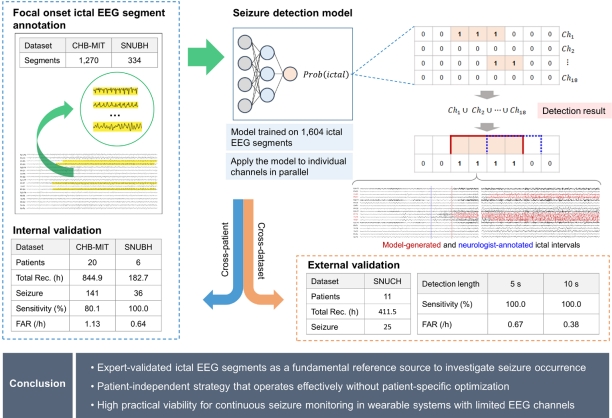
Patient-independent automated pediatric seizure monitoring based on expert-labeled electrographic ictal data as core reference knowledge
Yoon Gi Chung, Jaeso Cho, Anna Cho, Hunmin Kim, Byung Chan Lim
Clin Exp Pediatr. 2026;69(8):665-675.   Published online July 14, 2026
Question: Can deep learning models trained on expert-verified electroencephalography segments reliably detect seizures and be applied to single-channel wearable monitoring?
Finding: This technique demonstrated 80.1%–100% sensitivity and low false-alarm rates. On 1,604 expert-labeled segments, the model outperformed previous studies in terms of latency and accuracy across unseen datasets.
Meaning: Expert-labeled data are essential for achieving universal seizure detection. This channel-specific approach enabled efficient and continuous monitoring using wearable devices.
Review Article
Neurology
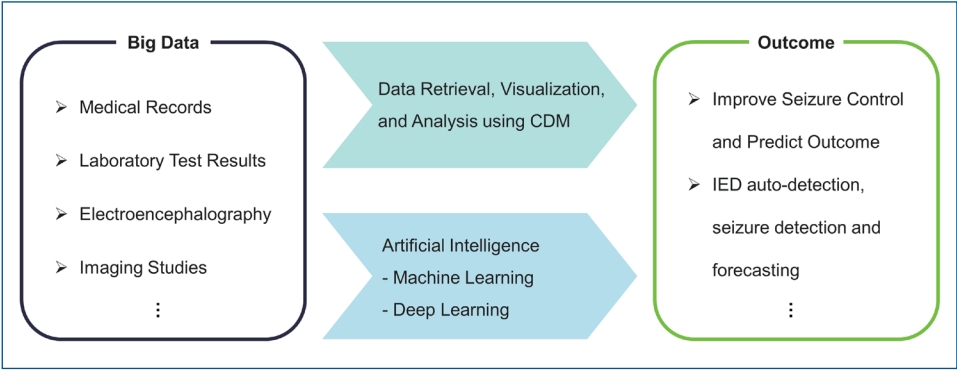
Big data analysis and artificial intelligence in epilepsy – common data model analysis and machine learning-based seizure detection and forecasting
Yoon Gi Chung, Yonghoon Jeon, Sooyoung Yoo, Hunmin Kim, Hee Hwang
Clin Exp Pediatr. 2022;65(6):272-282.   Published online November 26, 2021
· Big data analysis, such as common data model and artificial intelligence, can solve relevant questions and improve clinical care.
· Recent deep learning studies achieved 0.887–0.996 areas under the receiver operating characteristic curve for automated interictal epileptiform discharge detection.
· Recent deep learning studies achieved 62.3%–99.0% accuracy for interictal-ictal classification in seizure detection and 75.0%– 87.8% sensitivity with a 0.06–0.21/hr false positive rate in seizure forecasting.
Other
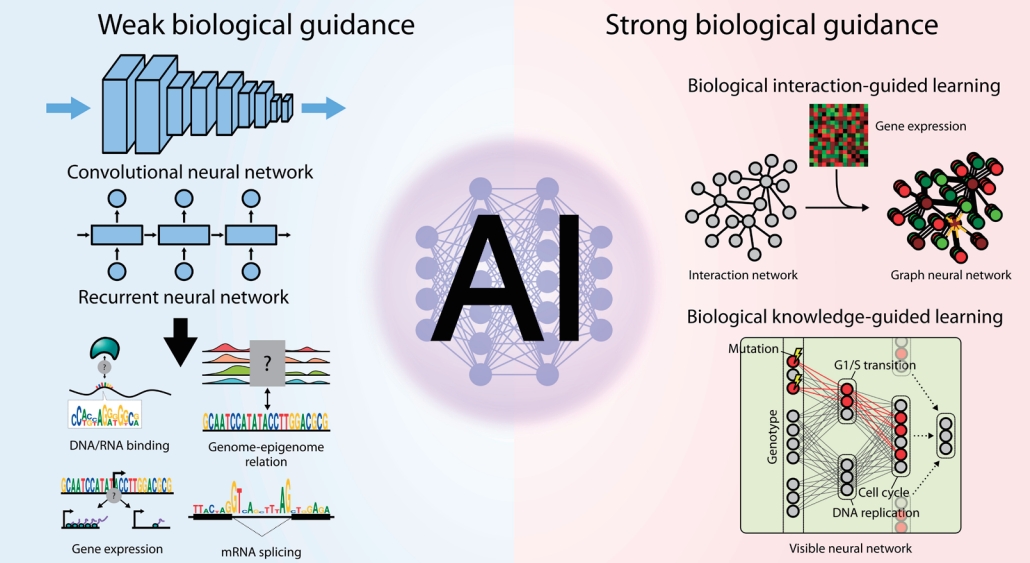
Knowledge-guided artificial intelligence technologies for decoding complex multiomics interactions in cells
Dohoon Lee, Sun Kim
Clin Exp Pediatr. 2022;65(5):239-249.   Published online November 26, 2021
· The need for data-driven modeling of multiomics interactions was recently highlighted.
· Many artificial intelligence-driven models have been developed, but only a few have incorporated biological domain knowledge within model architectures or training procedures.
· Here we provide a comprehensive review of deep learning models to decipher complex multiomics interactions regarding the biological guidance imposed upon them to facilitate further development of biological knowledge-guided deep learning models.


TOPICS

Browse all articles >

ARTICLE CATEGORY

Browse all articles >

BROWSE ARTICLES
FOR CONTRIBUTORS
ABOUT
Editorial Office
Korean Pediatric Society
#1606 Seocho World Officetel, 19 Seoun-ro, Seocho-ku, Seoul 06732, Korea
Tel: +82-2-3473-7306    Fax: +82-2-3473-7307    E-mail: office@e-cep.org                

Clinical and Experimental Pediatrics is an open access journal. All articles are distributed under the terms of the Creative Commons Attribution NonCommercial License (http://creativecommons.org/licenses/by-nc/4.0/)

Copyright © 2026 by Korean Pediatric Society.      Developed in M2PI