
Search

  • HOME
  • Search
Original Article
Peripheral blood cell counts of prematurely born, small for gestational age neonates
Mara Zuiderwijk, Sophie Groene, Enrico Lopriore, Vincent Bekker, Michiel Schoenaker
Background: Neonates born small for gestational age (SGA) are at an increased risk of multiple severe complications, including infections. This suggests that immune cells and other peripheral blood cells may be affected.
Purpose: Here we aimed to investigate whether SGA severity affects complete blood count and leukocyte differentiation of preterm neonates with a gestational age (GA) of <35 weeks and identify...
Neonatology (Perinatology)
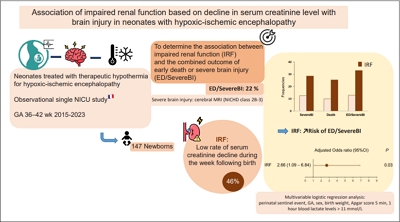
Association between impaired renal function based on decline in serum creatinine level and brain injury in neonates with hypoxic-ischemic encephalopathy
Mélaine Boget, William Rozalen, Jeanne Fayard, Mohamed Boucekine, Diane Gillot, Isabelle Grandvuillemin, Farid Boubred
Clin Exp Pediatr. 2026;69(5):437-442.   Published online April 27, 2026
Question: The clinical relevance of impaired renal function (IRF), based on the rate of serum creatinine level decline during the week after birth, in neonates treated with therapeutic hypothermia for hypoxic-ischemic encephalopathy need further investigation.
Finding: In this study, neonates with IRF had 2-fold higher risk of early death or severe brain injury.
Meaning: IRF can be used as a marker of adverse neonatal outcomes.
Nutrition
Human milk macronutrient composition and intake in relation to preterm infant growth: a cohort study
Eakkarin Mekangkul, Chonnikant Visuthranukul, Anongnart Sirisabya, Thaninee Chitsinchayakul, Santi Punnahitananda, Sirinuch Chomtho
Clin Exp Pediatr. 2026;69(5):428-436.   Published online April 22, 2026
Question: Is macronutrient intake, particularly that from human milk, distinctly associated with the growth of preterm infants?
Finding: Total protein and fat intake derived from human milk and fortifiers showed distinct positive associations with weight gain velocity.
Meaning: Particular attention to protein and fat composition during individualized human milk fortification can optimize weight gain in preterm infants.
Pulmonology
Effect of vitamin C supplement in treatment of childhood pneumonia requiring hospitalization: a randomized controlled trial
Chutima Phuaksaman, Katechan Jampachaisri, Klaita Srisingh
Clin Exp Pediatr. 2025;68(9):690-699.   Published online April 1, 2025
This study assessed the effects of vitamin C on children with community-acquired pneumonia (CAP). Vitamin C supplementation improved clinical symptoms within 48–72 hours compared to placebo but did not reduce the length of hospital stay (LOS). These findings suggest that vitamin C is beneficial for managing CAP severity, but does not affect LOS.
Review Article
Nutrition
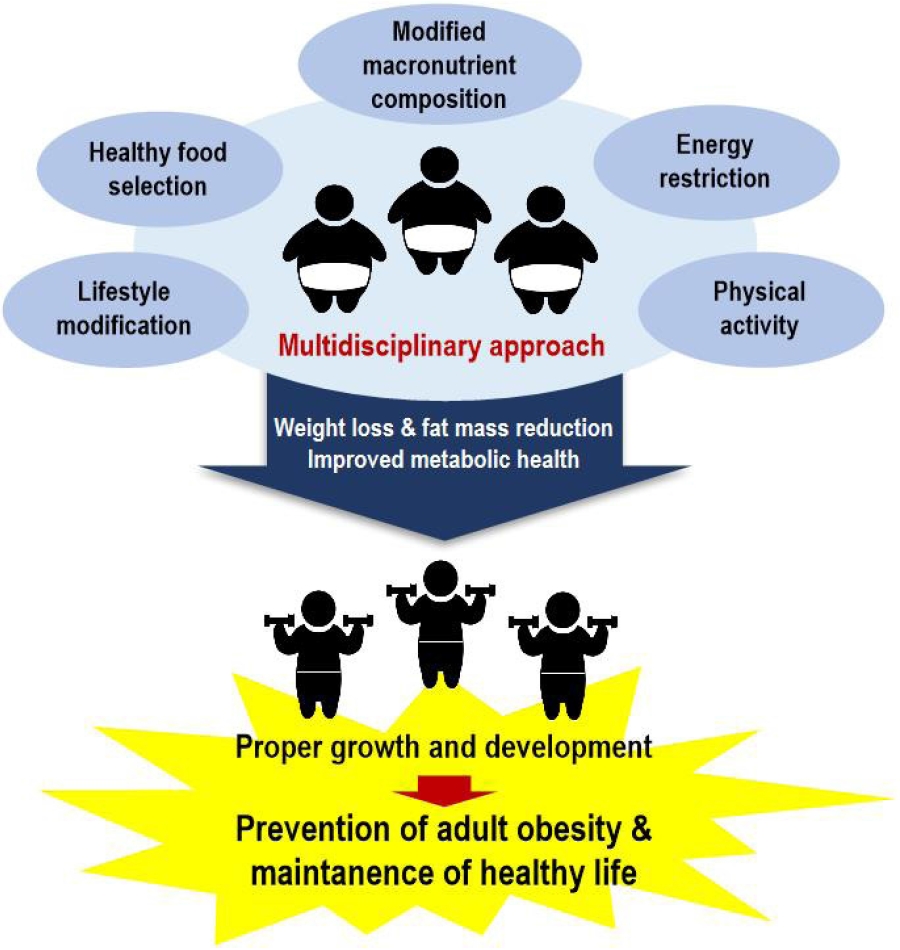
Macronutrients modified dietary intervention in the management of overweight/obese children and adolescents: a systematic review
Jihyun Park, Oh Yoen Kim
Clin Exp Pediatr. 2024;67(4):191-200.   Published online July 11, 2023
· Dietary macronutrient modifications affect the body composition of and metabolic markers in children and adolescents.
· Hypocaloric diets, regardless of macronutrient composition, are reportedly effective for weight loss in obese children.
· Future interventional studies with meta-analyses that include Korean children and adolescents are needed to provide basic information applicable to this population.
Gastroenterology
Clinical importance of immunonutrition in infants: a review of the recent literature
Ji Sook Park
Clin Exp Pediatr. 2022;65(7):337-343.   Published online February 17, 2022
Nutrients are important in the developing immune system. Human milk supplies diverse bioactives to prevent acute infection or chronic inflammation. Immunoglobulins, lactoferrin, and glutamine in human milk decrease gastrointestinal and respiratory infection. Human milk oligosaccharides promote the growth of intestinal microbiota, the gut barrier, and antimicrobial or antiviral activity. Micronutrients act as anti-inflammatory immunonutrients, too. However, the toxicity of some nutrients from an overdose should be considered.
Nutrition
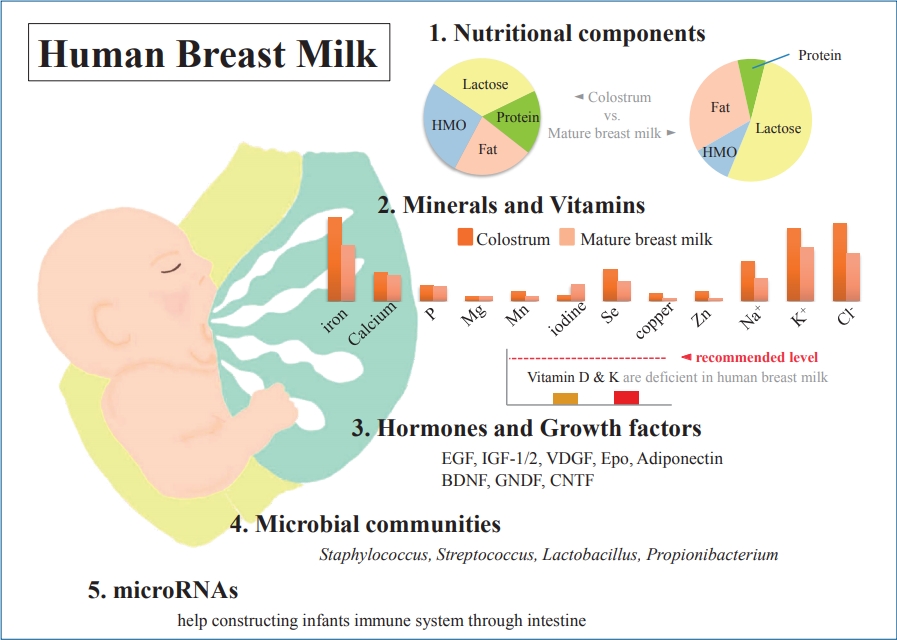
Components of human breast milk: from macronutrient to microbiome and microRNA
Su Yeong Kim, Dae Yong Yi
Clin Exp Pediatr. 2020;63(8):301-309.   Published online March 23, 2020
Human breast milk (HBM) is essential for the infant’s growth and development right after birth and is an irreplaceable source of nutrition for early human survival. Various infant formulas have many similarities to HBM in many components, but there is no perfect substitute for HBM. Recently, various breast milk components and their roles have been studied according to the development...
Original Article
Clinical Experiences with Total Nutrient Admixture in 26 Cases
Yong Soon Kwon, Eun Jin Choi, Soon Ok Byun, Ji Sub Oh, Hwan Seon Ryu, Charles D. Sands
Clin Exp Pediatr. 1992;35(7):921-932.   Published online July 15, 1992
Total Nutrient Admixture(TNA) is an intravenous nutrient system composed of dextrose, amino acid, fat, electrolytes, vitamins and trace elements in a single container which is administered over 24 hours. Twenty six seriously ill or premature neonatal patients reciving parenteral nutrition with TNA were studied by analyzing anthropometric parameters, laboratory values, and complications. The objective of the study was to test the...


TOPICS

Browse all articles >

ARTICLE CATEGORY

Browse all articles >

BROWSE ARTICLES
FOR CONTRIBUTORS
ABOUT
Editorial Office
Korean Pediatric Society
#1606 Seocho World Officetel, 19 Seoun-ro, Seocho-ku, Seoul 06732, Korea
Tel: +82-2-3473-7306    Fax: +82-2-3473-7307    E-mail: office@e-cep.org                

Clinical and Experimental Pediatrics is an open access journal. All articles are distributed under the terms of the Creative Commons Attribution NonCommercial License (http://creativecommons.org/licenses/by-nc/4.0/)

Copyright © 2026 by Korean Pediatric Society.      Developed in M2PI