
Search

  • HOME
  • Search
Original Article
Impact of bacterial infection on native liver survival in children with cirrhosis due to biliary atresia
Varissara Kaewchaivijit, Pornthep Tanpowpong, Songpon Getsuwan, Sophida Boonsathorn, Chatmanee Lertudomphonwanit, Suporn Treepongkaruna
Question: Are bacterial infections associated with lower native liver survival in children with biliary atresia (BA)?
Finding: Children with BA and proven/suspected bacterial infections, including cholangitis, had significantly lower native liver survival and higher rates of liver transplantation or death.
Meaning: Early recognition, appropriate management, and prevention of bacterial infections may improve native liver survival in children with BA-related cirrhosis.
DOI: https://doi.org/10.3345/cep.2026.00388    [Epub ahead of print]
Nephrology (Genitourinary)
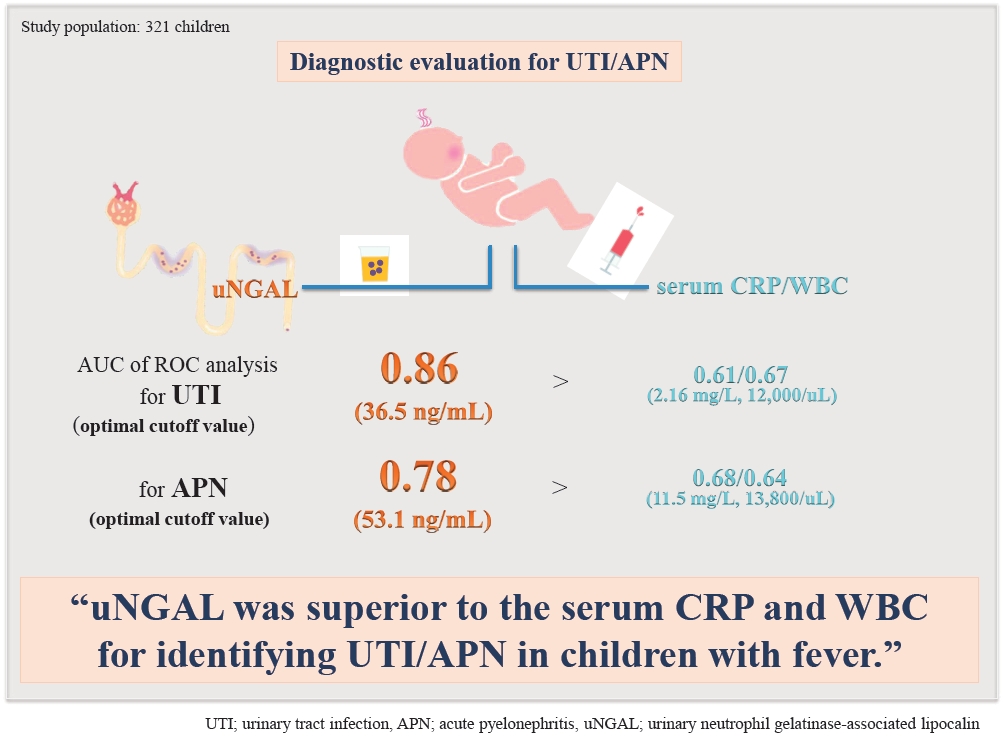
Urinary neutrophil gelatinase-associated lipocalin: a marker of urinary tract infection among febrile children
Ji Hyun Moon, Kee Hwan Yoo, Hyung Eun Yim
Clin Exp Pediatr. 2021;64(7):347-354.   Published online October 17, 2020
Question: Reliably diagnosing urinary tract infection (UTI) in febrile children is often difficult. Can urinary neutrophil gelatinase-associated lipocalin (uNGAL) better predict UTI and acute pyelonephritis (APN) than serum C-reactive protein (CRP) and white blood cell (WBC) count?
Finding: uNGAL better facilitated the prediction of UTI and APN, than serum CRP and WBC counts in febrile children.
Meaning: uNGAL is a suitable biomarker for UTI and APN in febrile children.
Cardiology
Clinical usefulness of serum procalcitonin level in distinguishing between Kawasaki disease and other infections in febrile children
Na Hyun Lee, Hee Joung Choi, Yeo Hyang Kim
Clin Exp Pediatr. 2017;60(4):112-117.   Published online April 25, 2017
Purpose

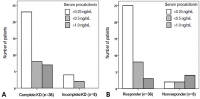
The aims of this study were to compare serum procalcitonin (PCT) levels between febrile children with Kawasaki disease (KD) and those with bacterial or viral infections, and assess the clinical usefulness of PCT level in predicting KD.

Methods

Serum PCT levels were examined in febrile pediatric patients admitted between August 2013 and August 2014. The patients were divided into 3 groups as...

Clinical Entities and Etiology of Invasive Bacterial Infections in Apparently Healthy Children
Joon Ho Lee, Eun Kyoung Song, Jin A Lee, Nam Hee Kim, Dong Ho Kim, Ki Won Park, Eun Hwa Choi, Hoan Jong Lee
Clin Exp Pediatr. 2005;48(11):1193-1200.   Published online November 15, 2005
ilus influenzae has been declined to 4% each from 23% and 14%, respectively, compared to previous study. S. agalactiae was the most common isolate in the infants ≤3 months. Among the infants and children aged 3 months to 2 years and children of 2-5 years, S. pneumoniae(57%, 52%, respectively, in each group) was the most common isolates followed by S....
Protein C as a Differential Marker for Bacterial Infection among Pediatric Patients with Fever
Eun Ha Mo, In Hae Nam, Kyung Duk Park
Clin Exp Pediatr. 2004;47(8):839-843.   Published online August 15, 2004
Purpose : This study was performed to find the clinical significance in protein C as a differential marker in the beginning stage of infection and prognosis factor in severe infection among pediatric patients who were admitted due to fever. Methods : A total of 40 pediatric patients who had temperatures higher than 37.5℃ on admission at the Department of Pediatrics,...
Predictors of Clinically Non Specific Bacterial Infection in Febrile Children Less than 3 Years of Age : WBC, ESR and CRP
Jeong A Nho, Young Il Rho, Eun Seuk Yang, Eun Young Kim, Yeong Bong Park, Kyung Rye Moon
Clin Exp Pediatr. 2003;46(8):758-762.   Published online August 15, 2003
Purpose : Our examination was designed to determine the diagnostic properties of the cutoff point for the prediction of bacteremia in febrile children less than 3 years of age. Cutoff point is the value that simultaneously maximizes both sensitivity and specificity. Methods : We conducted a retrospective study of febrile children, less than 3 years of age, who clinically have no...
Usefulness of Low Risk Criteria for Serious Bacterial Infection Among Febrile Infants Younger than Three Months of Age
So Hyun Kim, Ji Ah Jung, Hae-Soon Kim, Eun Sun Yoo, Sejung Sohn, Jeong Wan Seo, Seung Joo Lee
Clin Exp Pediatr. 2002;45(8):967-972.   Published online August 15, 2002
Purpose : A retrospective study was undertaken to evaluate the usefulness of low risk criteria for identifying febrile infants younger than three months unlikely to have serious bacterial infection. Methods : We conducted a retrospective study of 527 infants younger than three month with a axillary temperature ≥37.4℃. If they met the following all four criteria, appear well, WBC 5,000- 20,000/mm3,...
A Clinical Characteristics of Systemic Candidiasis in Neonatal Intensive Care Unit : Comparison with Systemic Bacterial Infection
Jung Hwa Lim, Kyung Pil Park, Jin Kyung Kim, Heng Mi Kim
Clin Exp Pediatr. 2002;45(7):847-854.   Published online July 15, 2002
Purpose : Long term hospitalized infants in neonatal intensive care units(NICUs) are prone to systemic infection. It is important to differentiate systemic candidiasis from systemic bacterial infection early in the course. Thus, in this study, we have compared clinical characteristics of systemic candidiasis and systemic bacterial infection, in premature low birth weight infants. Methods : Retrospective chart review of the medical...
Clinical Evaluation of Diagnostic Criteria for Early Prediction of Bacterial Infection in Febrile Neonates
Jai Il Cho, Sang Chun Lee, Hwan Il Kim, Cheol Am Kim, Kil Seo Kim
Clin Exp Pediatr. 1999;42(12):1661-1667.   Published online December 15, 1999
Purpose : A retrospective study was undertaken to test the hypothesis that febrile neonates, who have bacterial infections, can be accurately predicted early by diagnostic criteria. Methods : We conducted a retrospective study of 152 infants, 28 days or less of age, whose rectal temperature was at least 38℃. Past history, family history, finding on physical examinations and results of CBC,...
Significance of Acute Phase Reactants(APR) Score for the Early Detection of Neonatal Bacterial Infection
Seong Woo Kim, Myung Ho Oh, Kee Hyuk Kim, Jay G. Sim
Clin Exp Pediatr. 1998;41(11):1491-1497.   Published online November 15, 1998
Purpose : We performed acute phase reactants(APR) test to evaluate as an appropriate screening test for the early detection of neonatal bacterial infection. Methods : We selected 174 neonates and divided into two groups; sepsis group and well-baby group. We performed APR test. Results : There are no significant difference in total leukocyte count, immature to mature rentrophil ratio, toxic granules, and...
C-Reactive Protein and Duration of Antibiotic Therapy in Neonatal Bacterial Infection
Jae Il Yoo, Jin Hwa Jeong, Jeong Ho Lee, Jong Dae Cho
Clin Exp Pediatr. 1998;41(7):901-908.   Published online July 15, 1998
Purpose : To determine whether C-reactive protein(CRP) can be used as a parameter to assess the safety of discontinuing antibiotic therapy and allows a shorter course of therapy in neonates treated for suspected bacterial infection. Methods : We have experienced 193 cases of suspected neonatal bacterial infection at Pusan Maryknoll Hospital. CRP levels were measured daily by immunonephelometry. Infants with initial...
The diagnostic significance of APR score in early detection of neonatal bacterial infection.
Ki Won Park, Kyeong Choi, Young Youn Choi, Tai Ju Hwang
Clin Exp Pediatr. 1991;34(9):1223-1230.   Published online September 30, 1991
An accurate and rapid diagnostic test is essential in the management of bacterial infection in neonates because they lack specific symptoms and the bacterial infections in neonates tends to have rapid progression and poor prognosis. As for the method, APR (acute phase reactants), a score measuring C-reactive protein (CRP), 상racid glycoprotein (이-AG) and Haptoglobin (Hp) by latex agglutination seems to be one of promising methods. In...
Clinical Study of C-Reactive Protein in Neonatal Bacterial Infections.
Kyung Shin Kim, Myung Sung Moon, Jin Choi, Keun Soo Lee
Clin Exp Pediatr. 1983;26(9):866-871.   Published online September 30, 1983
Bacterial infections, such as sepsis, meningitis, pneumonia and urinary tract infection are frequent causes of death during neonatal period. Further more clinical symptoms of neonatal infections are often quite vague and the illnesses unexpectedly progress rapidly. The causative organisms are detected with difficulty in many instances. Therefore a quick, simple and.reliable laboratory test is obviously needed for easy recognization of neonatal bacterial...


TOPICS

Browse all articles >

ARTICLE CATEGORY

Browse all articles >

BROWSE ARTICLES
FOR CONTRIBUTORS
ABOUT
Editorial Office
Korean Pediatric Society
#1606 Seocho World Officetel, 19 Seoun-ro, Seocho-ku, Seoul 06732, Korea
Tel: +82-2-3473-7306    Fax: +82-2-3473-7307    E-mail: office@e-cep.org                

Clinical and Experimental Pediatrics is an open access journal. All articles are distributed under the terms of the Creative Commons Attribution NonCommercial License (http://creativecommons.org/licenses/by-nc/4.0/)

Copyright © 2026 by Korean Pediatric Society.      Developed in M2PI