
Search

  • HOME
  • Search
Original Article
Gastroenterology
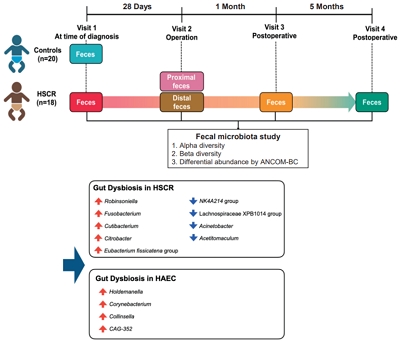
Longitudinal analysis of gut microbiota dysbiosis and bacterial signatures predictive of postoperative enterocolitis in children with Hirschsprung disease
Sireekarn Chantakhow, Chanon Kunasol, Jiraporn Khorana, Kanokkan Tepmalai, Nipon Chattipakorn, Siriporn C. Chattipakorn
Clin Exp Pediatr. 2026;69(3):214-227.   Published online December 10, 2025
Question: Do gut microbiota differ between patients with Hirschsprung disease (HSCR) and healthy children, and can specific bacterial taxa predict postoperative HSCRassociated enterocolitis (HAEC)?
Finding: Patients with HSCR showed gut dysbiosis with reduced diversity. Postoperative microbial changes included increased alpha diversity. Certain taxa, such as Eubacterium and Collinsella, were associated with recovery or HAEC.
Meaning: Distinct microbial signatures may help identify HAEC risk and guide microbiota-based strategies to improve outcomes.
General Pediatrics
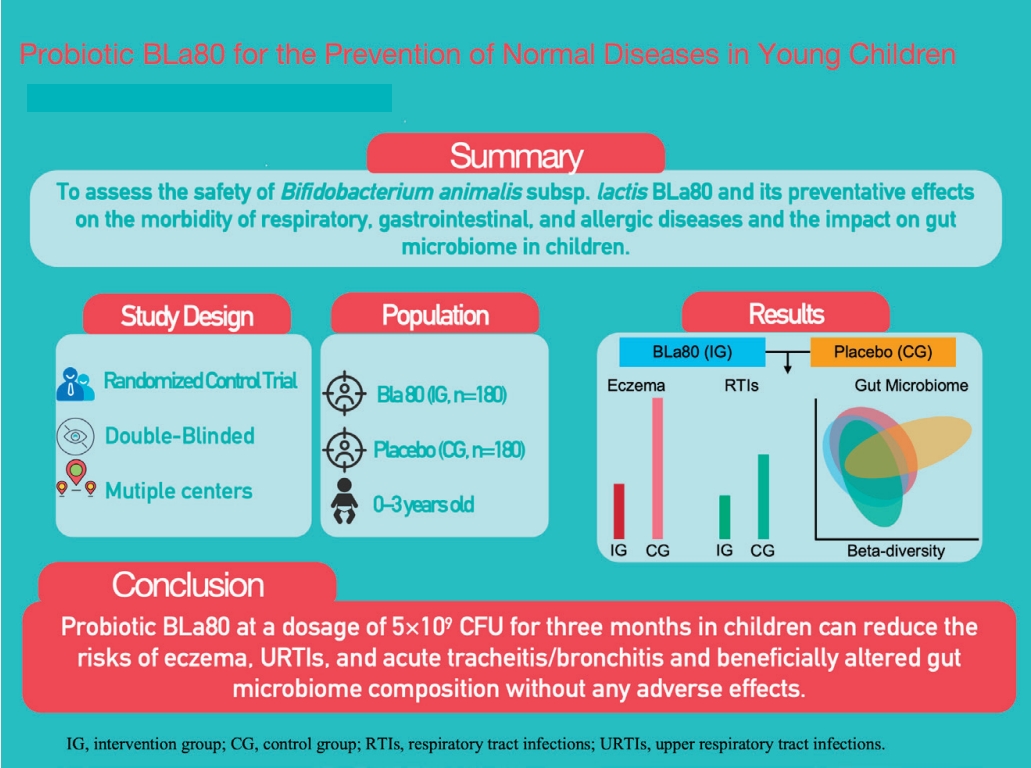
Bifidobacterium animalis subsp. lactis BLa80 for preventing allergic, respiratory, and gastrointestinal diseases in young children in China: a randomized double-blind placebo-controlled trial
Ke Chen, Xi Zhang, Kaihong Zeng, Jiayi Zhong, Shanshan Jin, Yang Nie, Ping Yang, Nianyang He, Haixia Chen, Yanmei Cao, Yunrong Fu, Ziji Fang, Wei Jiang, Changqi Lium
Clin Exp Pediatr. 2026;69(2):150-162.   Published online October 30, 2025
Question: Can probiotic BLa80 bring long-term benefits to the health of young children?
Finding: This trial demonstrated that the daily administration of s BLa80 at 5×10⁹ colony-forming units for 3 months in children can reduce the risk of eczema, upper respiratory tract infections, and acute tracheitis/bronchitis as well as beneficially improve the gut microbiome without any adverse effect.
Meaning: Bla80 can bring definite health benefits to young children.
Neonatology (Perinatology)
Characterization of gut microbiota in very low birth weight infants with versus without bronchopulmonary dysplasia
Anucha Thatrimontrichai, Manapat Praditaukrit, Gunlawadee Maneenil, Supaporn Dissaneevate, Kamonnut Singkhamanan, Komwit Surachat
Clin Exp Pediatr. 2025;68(7):503-511.   Published online February 26, 2025
Question: Does the gut microbiota differ between very low birth weight (VLBW) infants with versus without bronchopulmonary dysplasia (BPD)?
Finding: Common respiratory pathogens were notably elevated in the BPD group, whereas anaerobic and butyrate-producing taxa, key components of postbiotics, were dominant in the non-BPD group.
Meaning: In gut-lung communication, the interplay between the intestinal and respiratory systems may implicate pro- and postbiotics in VLBW infants with BPD.


TOPICS

Browse all articles >

ARTICLE CATEGORY

Browse all articles >

BROWSE ARTICLES
FOR CONTRIBUTORS
ABOUT
Editorial Office
Korean Pediatric Society
#1606 Seocho World Officetel, 19 Seoun-ro, Seocho-ku, Seoul 06732, Korea
Tel: +82-2-3473-7306    Fax: +82-2-3473-7307    E-mail: office@e-cep.org                

Clinical and Experimental Pediatrics is an open access journal. All articles are distributed under the terms of the Creative Commons Attribution NonCommercial License (http://creativecommons.org/licenses/by-nc/4.0/)

Copyright © 2026 by Korean Pediatric Society.      Developed in M2PI